Showing posts with label therapy dogs. Show all posts

Monday, June 16, 2014

Kids with autism connect, cuddle with future service dogs: 'I love them'

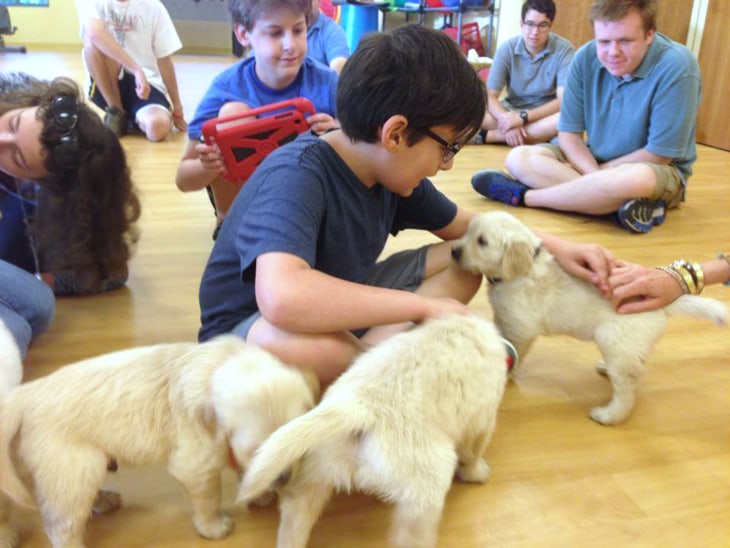
Students snuggle and play with puppies at the Lionheart School in Alpharetta, Georgia. The puppies will go on to become service dogs for war veterans and others with disabilities.

LionPaws via Facebook

Today – Pets By LauraT Coffey – Originally Posted on June 10, 2014 at 4:11 PM ET – Cross Posted at Just One More Pet

A student named Max, front, and other children snuggle and play with puppies at the Lionheart School in Alpharetta, Georgia. The puppies will go on to become service dogs for war veterans and others with disabilities.

For many children with autism, social interactions with strangers can be awkward and anxiety-inducing. But if the stranger is a gentle golden retriever puppy with huge paws and a quiet snore, something remarkable happens.

Throw a puppy into the mix, and the uneasiness tends to melt away.

“It’s just amazing,” said Elizabeth Dulin, co-founder and head of the Lionheart School, which serves students with autism in Alpharetta, Georgia. “When our kids interact with the dogs, we see reduced anxiety levels. ... They become calm and focused.”

One 11-year-old student named Max can quickly identify all seven of the puppies romping around the school. How can he name them so effortlessly when they look so similar? That’s easy.

“Because I love them,” Max told WXIA-TV in Atlanta.
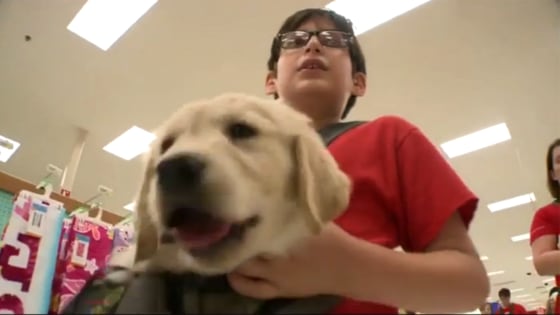
A student named Max holds a puppy in a Target store.

WXIA / 11Alive.com

Max, 11, converses with anyone who will listen about a puppy in his care during a field trip to a Target store.

Lionheart is home base for a new partnership with the paws4people foundation, which trains service dogs for war veterans, disabled kids and adults. Dubbed the “LionPaws Puppy Development Center,” the fledgling program sees to it that the future service dogs help as many people as possible throughout their training.

The puppies spend the first four months of their lives at Lionheart, where they befriend the school’s 39 students. The kids hold the puppies, talk to the puppies, bathe the puppies and go on field trips with the puppies — all the while socializing the animals and preparing them for more advanced obedience training ahead.

A puppy that will become a service dog.

LionPaws via Facebook

As this puppy trains to become a service dog, it will touch the lives of many humans in need.

The next stop is an inmate intervention program, where prisoners in good standing teach the puppies 125 commands and train them to open and close doors, turn lights on and off and perform other tasks. Inmates entrusted with the dogs’ training get more than a sense of purpose — they also receive recent job experience that can help them find employment when they get released.

The final phase of the dogs’ training happens at the University of North Carolina in Wilmington, where paws4people is based. Animal-loving students get college credit for making sure the dogs are fully prepared to go to their new homes — often with war veterans who are physically disabled or who have post-traumatic stress disorder.

Related story: 'She gives me independence': Service dog changes wounded veteran's life
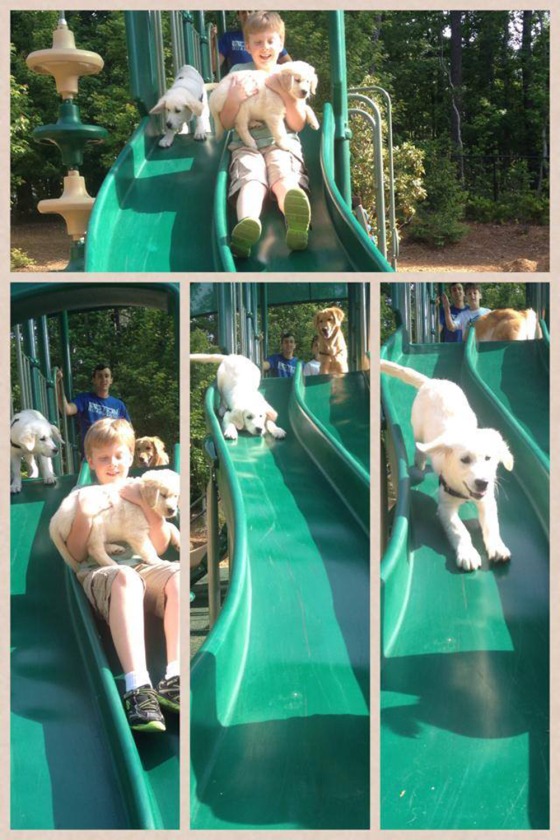
Puppies go down a slide with Lionheart students.

LionPaws via Facebook

Getting socialized: Puppies go down a slide with Lionheart students.

paws4people has been training service dogs for 14 years. The newest segment of socialization and training for some puppies — spending time with children with autism — began in January of this year. The results so far have been “nothing short of miraculous,” said Sarah Rosenbaum, director of the LionPaws Puppy Development Center.

Rosenbaum said she’s seen non-verbal children become chatty around the puppies, and she’s seen children with motor-skill deficits get up and run to see the puppies.

“They’re just so excited, which really is such a source of pride for me,” she told TODAY.com. “The children are providing for the puppies, and the puppies are providing for the children.”
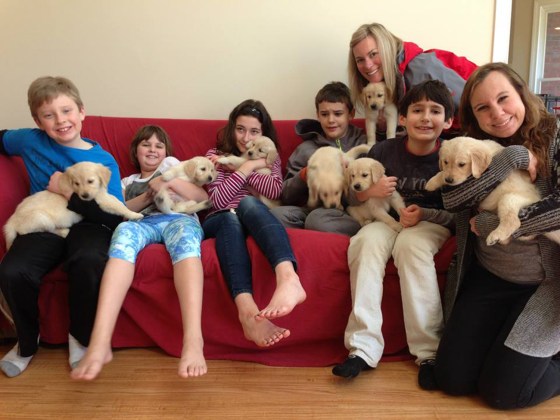
Adults and kids holding puppies on a couch.

LionPaws via Facebook

The puppies get plenty of affection during the first four months of their lives at the Lionheart School.

Lionheart’s first batch of seven puppies is about to move on to the inmate intervention phase of their training, and a new pile of puppies will arrive at the school soon. Five members of the school’s staff have become certified as dog handlers, and that makes it possible for one older service dog named LANGLEY to stay at the school year-round.

Dulin, the head of the Lionheart School, said LANGLEY and the puppies have been helping students to make social and emotional connections. On field trips to Target or to a nursing home, the children often will open up and make conversation with strangers about the puppies. Or when a student is having a bad day, a furry friend can help them regain a sense of normalcy.

“A lot of our kids have difficulty regulating their emotions,” Dulin told TODAY.com. “One little girl who deals with a lot of anxiety was riding in carpool one morning, and a boy who rides with her slammed his finger in the door. This little girl started crying and she could not stop.”

The girl locked herself, wailing, inside a bathroom stall and refused to come out. A teacher knew just what to do: Launch Operation LANGLEY. She brought LANGLEY into the bathroom and sat on the floor until the girl was ready to let the dog into her space.

“About three minutes later, the teacher saw a little ‘thumbs up’ sticking out from under the stall door,” Dulin said. “LANGLEY went into the stall, calmed her down, and then the two walked to class together. And she had been inconsolable — without LANGLEY, we probably would have needed to call her parents.”

Related story: Xena the Warrior Puppy, rescued from abuse, helps 8-year-old boy with autism
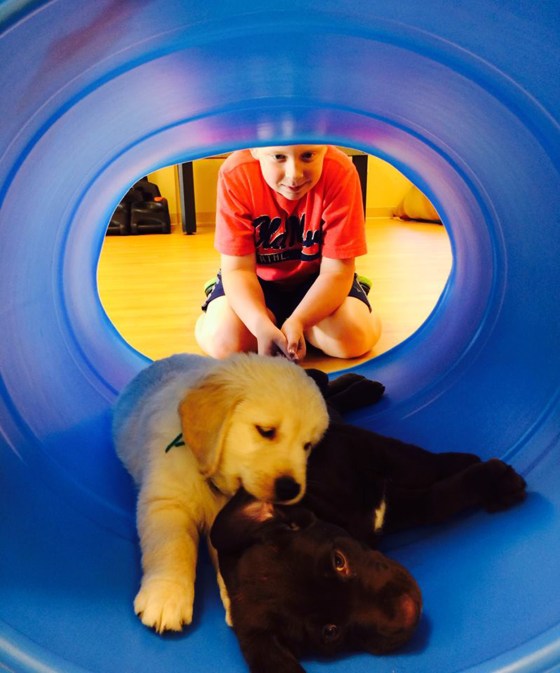
Puppies playing in playground equipment.

LionPaws via Facebook

Puppies take a break while playing with Lionheart students.

Research regarding the effects of companion animals on kids with autism is limited but encouraging. One study published last year revealed that children with autism spectrum disorder were more likely to talk, laugh, make eye contact and show other positive social behaviors in the presence of guinea pigs than they were in the presence of toys.

And in her 2010 paper “What a Dog Can Do: Children with Autism and Therapy Dogs in Social Interaction,” researcher Olga Solomon highlighted cases of dogs helping children to communicate and connect emotionally with others around them. As Solomon noted in her paper, “dogs lead humans elsewhere, and this elsewhere is often better than where we have been before.”

Related: 

Pet Therapy

Pets Reduce Stress at Work… More Companies, Citing Benefits, Allowing Pets at Work 

Pets are way better than Therapy!

Waltz Into a Healthy Old Age

Pet Alzheimer's Disease - Is Your Dog or Cat Showing Signs? 

Therapeutic benefits of music being used to treat Alzheimer’s, addiction, and depression 

Sarah Palin and Senator Mile Lee Take Time to Visit Service Dog Trainers While in Iowa 

Gov. Palin: Trig is getting a buddy!

Sunday, February 17, 2013

Activities for Alzheimer’s Patients

Alzheimer's disease  (AD) affects millions of people. The destruction of brain cells affects memory and behavior, and it is ultimately fatal. 

Although there is no cure, there are treatments that can help the brain function better, strengthen the patient's memory, and slow the progression of the disease.

Physical Activities

There are many activities people with Alzheimer's can do. Physical activity is a very important part of anyone's life; it is especially important if you suffer with degeneration problems of the mind. Physical activities help with blood pressure, proper blood flow, blood sugar, weight gain, and keeping the mind active and sharp. Physical activity for Alzheimer's patients doesn't have to be strenuous. You can help your loved one get involved with swimming, shuffle board or yoga. There are exercise classes at places like the YMCA or senior centers and senior facilities, or you can simply take daily walks around the neighborhood.

Hobbies

Hobbies have long been enjoyed by many people. They can be relaxing, as well as an active part of your life. If you suffer from Alzheimer's, you can try to stay active with your favorite hobby or get started with a new one. Gardening is a great hobby that helps you to use your mind as well as your physical body, which is good for exercise. Try to stay interested in reading if you like to read. You can do this by going to the library regularly to pick out new books, or go to a local bookstore. If you like to draw or paint, get the supplies you need and set up a space at home to do it.

In the early stages, if you like to fix things or work on cars, create an area where you can continue to work on your hobby. Whatever the hobby is, continue working with it so you can stay active.  However, there comes a time when using tools, especially electric tools, standing on ladders can create unsafe situations.

Mental Activities

Keeping active will not only help keep your mind strong, but it can help ward off problems such as depression. Mental activities can include getting involved in doing such things as number puzzles, or word puzzles in the newspaper. Stay involved in many different mental tasks and encourage yourself to accomplish these tasks on your own. Household tasks that you should encourage yourself to do include paying your own bills. Figure out the payments then mail them out. Keep trying to buy your own groceries so you can figure out money issues and how to make general payments. You can also take time to work on simple math problems, as well as buy games involving numbers. Crossword puzzles, Sudoku, actual puzzles and working on the computer (should be monitored in some cases), doing activities that stretch the mind, all help keep your mind sharper longer. Or you can help your grandchildren with their math homework. And to keep yourself feeling worthy and needed, let your family know that you are still there for them, even if you just offer a shoulder to lean on.

*Some people keep a puzzle in progress out that they and their spouse, caretaker or even just visitors can help the AD patient work on.

Reading

Reading to Alzheimer's patients is extremely important because it sparks conversation and keeps them engaged. The same is true of flipping through books, magazines and photo albums. Labeling photos that are hanging or standing on display around the house often helps patients with their, at least temporary, memory.

Laughter

Engaging in activities that spark laughter---watching a comedy shows and movies or listening to the radio---is key to the happiness an Alzheimer's patient. During the course of daily activities, try being silly or teasing the person a bit.

Hands On

Although Alzheimer's patients may not be able to engage in all of the things they once did, and the activities and scope will diminish as time goes on, there are a lot of ways they can (and should) keep active. Working in the garden and yard is very therapeutic. Consider weeding, planting and transplanting and raking as possible ways to keep Alzheimer's active. Simple household chores are an option, too, such as washing windows, folding laundry and sorting items like nails, cans or buttons.  Once they have moved into the moderate stage… no hammers, saws, scissors or power tools

Cooking

Cooking ‘with’ Alzheimer's patients poses an excellent and enjoyable challenge. Seek out recipes for soups, cookies and cakes as well as salads and instant puddings. Tailor the recipes to the patient's tolerance level to make it an enjoyable activity.  Again, cooking becomes more difficult as their condition worsens and they should not be using the stove, oven or sharp knives without supervision.

Social Activities

Being social actually helps prevent AD and also helps slow the progress of the disease.  Enrolling Alzheimer's patients in activities, clubs and events for and with other AD patients or with friends and family with similar interests and hobbies, especially if they shared those activities before the onset of the disease, is one of the best things for the AD sufferer as well as their caretakers and family.  It gives everyone a break and some fun time away from each other. Senior Daycare, as it has been dubbed, has become as prevalent, popular and often necessary as child and doggie daycare.

Driving

Patients with AD may pose increasing risks when driving, not only to themselves, but also to others, as their illness progresses. Yet the ability to drive may help preserve the quality of their lives in the early stages.

If AD patients can accept the loss of driving privileges voluntarily, as their condition worsens, it is better for everyone involved, patient, caregiver, family and doctors.

Pets and Therapy Pets

A family pet or therapy trained pet can be a great companion and of great comfort to those suffering from Alzheimer's and dementia as long as they are one the those that take their frustration out on the animals.  Most AD patients love the companionship and love give my a pet or therapy animal, but seem tend to yell at them, pat them much too hard, try to keep them from leaving their side even for a moment or feed them foods, especially snakes, that make the dogs sick.  If you have a family pet or access of a therapy pet or are thinking about getting one, make sure to monitor the behavior of the AD patient and be firm, like with those that exhibit inappropriate sexual behavior, when responding to their actions.

Games for Alzheimer's Buy games and activities created specifically for Alzheimer's store.best-alzheimers-products.com/

Related:

Final Stages of Alzheimer’s

Diagnosis & Treatment of Mild to Moderate Alzheimer's Disease

Advances for Alzheimer's, Outside the Lab

Warning Signs: A New Test to Predict Alzheimer's

Super Spice Secrets: Can This Miracle Spice Stop Cancer, Alzheimer's and Arthritis?

Drinking Coffee Slashes Risk of Alzheimer’s

Stop Using 'Natural' Deodorants Until You Read This

Alzheimer’s Disease and Inappropriate Sexual Behavior

Pet Therapy

Animals Helping the Ailing, the Elderly, and the Young

Pets are way better than Therapy! 

Wednesday, February 15, 2012

Londonderry School Uses Therapy Dog in Classroom

Southern New Hampshire Montessori Academy (SNHMA) has become one of the first schools in New England to bring in a therapy dog as a full time member of its community. Guardian, a Portuguese water dog, was chosen for his temperament, his silky soft hypoallergenic coat and teddy bear looks. While he’s in the process of completing his year-long training, Guardian is already having a positive impact in the classroom, where he is charged with being a calm, emphatic and steadfast best friend for little boys and girls.

Loundary School 1

“While school therapy dogs are still currently regarded as a cutting-edge educational tool, research is showing that dogs in the classroom can play a huge role in boosting students’ happiness, calmness, overall emotional well-being, and ability to learn,” explains Debra Hogan SNHMA’s Founder and Head of School.

Loundary School 2Guardian, who is always here to greet student with a wag and a lick in the mornings, has helped the younger pre-K students with separation anxiety as their parents drop them off in the morning. “He is happy to see the children come in in the mornings and offers a welcome huggable friend to little ones who are finding it hard to see Mom and Dad go,” says Hogan.

Guardian is also helping first graders hone in their reading skills, as Ms. Hogan explains: “Dogs are perfect listeners. They are not judgmental; they don’t care if you don’t get the words exactly right, and for most children, practicing reading aloud is all they need to become fluent readers.”

“Therapy dogs can have a positive impact on every aspect of the classroom from lessons planning, to teaching social skills and responsibility, to comforting students in a time of grief or personal crisis. They teach, they listen, they are unconditional friends. I have seen children who had attention deficit disorder become calmer. I have seen children with emotional difficulties lie down beside the dog and whisper things in his ear, things they’d never tell an adult, and then rise up ready to learn. Their self esteem really soared,” says Terri Hamilton, an Elementary Guidance Consultant and Parent-Child Connection Advocate.

Loundary School 3

Images courtesy of Tanya Swann Photography.

Southern New Hampshire Montessori Academy offers an academically focused education to children through an integrated curriculum. Concentration is given to educating the “whole child” (all facets of the child’s being, including: intellectual, physical, emotional, social and creative aspects) with a strong emphasis of hands-on and experiential learning where children develop their passion in technology, science, visual and performing arts, foreign language and physical education. Complementing a strong academic core, the school offers an enrichment program that includes elementary Latin, creative arts (visual and performing), daily physical education, technology and Spanish. For further information, please visit their website.

Source:  Londonderry News