Showing posts with label Autism. Show all posts

Monday, June 16, 2014

Kids with autism connect, cuddle with future service dogs: 'I love them'

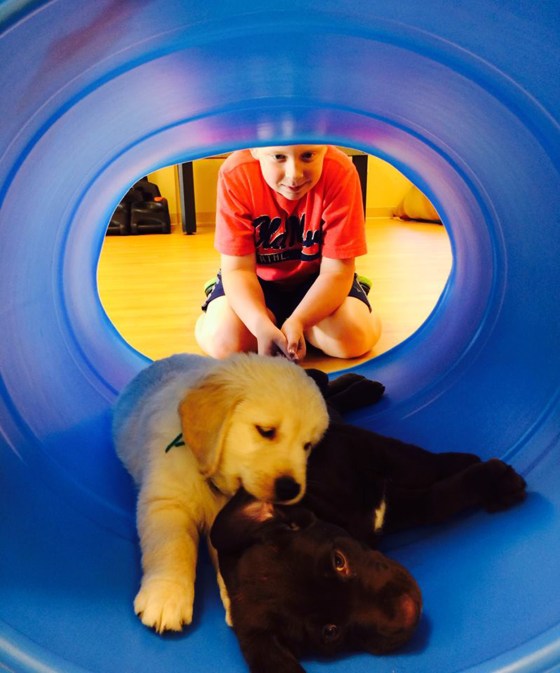
Students snuggle and play with puppies at the Lionheart School in Alpharetta, Georgia. The puppies will go on to become service dogs for war veterans and others with disabilities.

LionPaws via Facebook

Today – Pets By LauraT Coffey – Originally Posted on June 10, 2014 at 4:11 PM ET – Cross Posted at Just One More Pet

A student named Max, front, and other children snuggle and play with puppies at the Lionheart School in Alpharetta, Georgia. The puppies will go on to become service dogs for war veterans and others with disabilities.

For many children with autism, social interactions with strangers can be awkward and anxiety-inducing. But if the stranger is a gentle golden retriever puppy with huge paws and a quiet snore, something remarkable happens.

Throw a puppy into the mix, and the uneasiness tends to melt away.

“It’s just amazing,” said Elizabeth Dulin, co-founder and head of the Lionheart School, which serves students with autism in Alpharetta, Georgia. “When our kids interact with the dogs, we see reduced anxiety levels. ... They become calm and focused.”

One 11-year-old student named Max can quickly identify all seven of the puppies romping around the school. How can he name them so effortlessly when they look so similar? That’s easy.

“Because I love them,” Max told WXIA-TV in Atlanta.

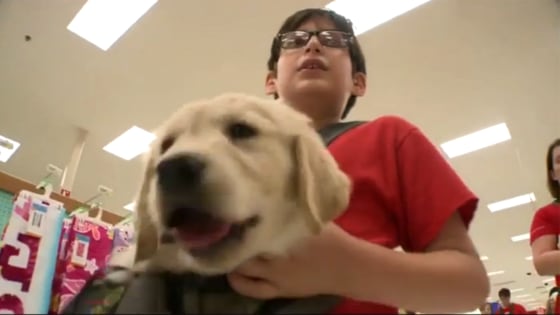
A student named Max holds a puppy in a Target store.

WXIA / 11Alive.com

Max, 11, converses with anyone who will listen about a puppy in his care during a field trip to a Target store.

Lionheart is home base for a new partnership with the paws4people foundation, which trains service dogs for war veterans, disabled kids and adults. Dubbed the “LionPaws Puppy Development Center,” the fledgling program sees to it that the future service dogs help as many people as possible throughout their training.

The puppies spend the first four months of their lives at Lionheart, where they befriend the school’s 39 students. The kids hold the puppies, talk to the puppies, bathe the puppies and go on field trips with the puppies — all the while socializing the animals and preparing them for more advanced obedience training ahead.

A puppy that will become a service dog.

LionPaws via Facebook

As this puppy trains to become a service dog, it will touch the lives of many humans in need.

The next stop is an inmate intervention program, where prisoners in good standing teach the puppies 125 commands and train them to open and close doors, turn lights on and off and perform other tasks. Inmates entrusted with the dogs’ training get more than a sense of purpose — they also receive recent job experience that can help them find employment when they get released.

The final phase of the dogs’ training happens at the University of North Carolina in Wilmington, where paws4people is based. Animal-loving students get college credit for making sure the dogs are fully prepared to go to their new homes — often with war veterans who are physically disabled or who have post-traumatic stress disorder.

Related story: 'She gives me independence': Service dog changes wounded veteran's life

Puppies go down a slide with Lionheart students.

LionPaws via Facebook

Getting socialized: Puppies go down a slide with Lionheart students.

paws4people has been training service dogs for 14 years. The newest segment of socialization and training for some puppies — spending time with children with autism — began in January of this year. The results so far have been “nothing short of miraculous,” said Sarah Rosenbaum, director of the LionPaws Puppy Development Center.

Rosenbaum said she’s seen non-verbal children become chatty around the puppies, and she’s seen children with motor-skill deficits get up and run to see the puppies.

“They’re just so excited, which really is such a source of pride for me,” she told TODAY.com. “The children are providing for the puppies, and the puppies are providing for the children.”

Adults and kids holding puppies on a couch.

LionPaws via Facebook

The puppies get plenty of affection during the first four months of their lives at the Lionheart School.

Lionheart’s first batch of seven puppies is about to move on to the inmate intervention phase of their training, and a new pile of puppies will arrive at the school soon. Five members of the school’s staff have become certified as dog handlers, and that makes it possible for one older service dog named LANGLEY to stay at the school year-round.

Dulin, the head of the Lionheart School, said LANGLEY and the puppies have been helping students to make social and emotional connections. On field trips to Target or to a nursing home, the children often will open up and make conversation with strangers about the puppies. Or when a student is having a bad day, a furry friend can help them regain a sense of normalcy.

“A lot of our kids have difficulty regulating their emotions,” Dulin told TODAY.com. “One little girl who deals with a lot of anxiety was riding in carpool one morning, and a boy who rides with her slammed his finger in the door. This little girl started crying and she could not stop.”

The girl locked herself, wailing, inside a bathroom stall and refused to come out. A teacher knew just what to do: Launch Operation LANGLEY. She brought LANGLEY into the bathroom and sat on the floor until the girl was ready to let the dog into her space.

“About three minutes later, the teacher saw a little ‘thumbs up’ sticking out from under the stall door,” Dulin said. “LANGLEY went into the stall, calmed her down, and then the two walked to class together. And she had been inconsolable — without LANGLEY, we probably would have needed to call her parents.”

Related story: Xena the Warrior Puppy, rescued from abuse, helps 8-year-old boy with autism

Puppies playing in playground equipment.

LionPaws via Facebook

Puppies take a break while playing with Lionheart students.

Research regarding the effects of companion animals on kids with autism is limited but encouraging. One study published last year revealed that children with autism spectrum disorder were more likely to talk, laugh, make eye contact and show other positive social behaviors in the presence of guinea pigs than they were in the presence of toys.

And in her 2010 paper “What a Dog Can Do: Children with Autism and Therapy Dogs in Social Interaction,” researcher Olga Solomon highlighted cases of dogs helping children to communicate and connect emotionally with others around them. As Solomon noted in her paper, “dogs lead humans elsewhere, and this elsewhere is often better than where we have been before.”

Related: 

Pet Therapy

Pets Reduce Stress at Work… More Companies, Citing Benefits, Allowing Pets at Work 

Pets are way better than Therapy!

Waltz Into a Healthy Old Age

Pet Alzheimer's Disease - Is Your Dog or Cat Showing Signs? 

Therapeutic benefits of music being used to treat Alzheimer’s, addiction, and depression 

Sarah Palin and Senator Mile Lee Take Time to Visit Service Dog Trainers While in Iowa 

Gov. Palin: Trig is getting a buddy!

Saturday, May 31, 2014

Rethinking the Definition of Autism and Aspergers

By Elise Ronan – The Times of Israel - Elise is the parent of two youngmen on the autism spectrum. She has been a volunteer special education advocate in …

Once again we have a mass murder and once again the media-whores are trying to blame it on aspergers, guns, misogyny and “white privilege.” When the reality is that the issue is mental illness and how it is treated, or not treated, in the United States. The family was fast to let the world know that their sociopath-narcissistic-highly disturbed-son had been diagnosed with aspergers. Not certain why that is even relevant. It is not that this family didn’t try to get the authorities involved. They actually alerted the police, who instead of searching his apartment or trying to get him involuntarily committed, found this murderer charming. Overly charming, by the way, is how most would describe every sociopath. Yet the question becomes, what is the point of letting everyone know about the autism diagnosis?

Yes, aspergers is the diagnosis of the moment. When doctors can’t figure out what category their patients fit into, they reach for something that is all encompassing. It just so happens that this decades all encompassing mental health diagnosis is aspergers. Before that it was ADD. Before that…who knows, but it was something. The problem too, is that psychiatry is a science that is not necessarily quantifiable in the same sense that something physical is quantifiable. Psychiatric definitions and understanding change as society changes. The “powers that be” in the psychiatric community consistently alter their view of what is a mental health disorder, and constantly change their opinion on what is, and is not, a cause for mental health concerns.

An additional problem that you have in the community is that so many of these book-learned people have never really dealt with autism or aspergers. They only read a book; took a class; heard a lecture. But they have no real experience in dealing with anyone with autism. A lot of times they simply look into the DSM and pick out something that sounds good and may be applicable to the situation at hand, something they simply cannot define for certain at the moment. That is exactly what happened with the boys when we visited one particular therapist.

Even though they had been given the dx of aspergers, when this particular therapist filled out his forms for insurance, he went into the DSM and looked for the dx that listed what he thought was more applicable to the boys. I argued with him that they had a relevant diagnosis that was appropriate. But he decided he knew better because as he pointed out to me, the DSM listed 4 applicable characteristics of “autism” instead of aspergers, which as far as he decided was more appropriate to the boys. He had never actually worked with, or had experience with, anyone with autism or aspergers. We went to him because he was used to working with adolescent males and highly recommended for that purpose. I had not realized until that moment that there really was a huge difference in approach when dealing with adolescent aspergeans and NTs.

Yes; we ended up leaving that therapist, but not because of this difference of opinion. When my younger son was having trouble with his 5th grade special ed teacher, instead of defending my son, he supported the teacher. Instead of coming up with some relevant classroom procedures that needed to be put into practice for my son, or relevant organizational skills that he had to learn, and that the teacher had to work on, this therapist decided that the teacher couldn’t be incompetent. The fact that he was having issues according to this therapist, had to mean that my son needed some heavy medication like risperdal or even an even stronger antipsychotic. (FYI- I am not against medication. I am against unnecessarily medicating.) According to this therapist there was no way that the teacher could be a gross incompetent,even though he had never met her, spoke with her or interacted with her on any level. Someone who is incapable of seeing the failings of another “professional,” is not someone you want working with your child.

As a note: I had not been told by the school district that this particular special ed teacher had been informed earlier in the year that she was not receiving tenure due to not meeting teaching standards. So she not only didn’t do her job vis-a-vis my son for the year,  but his entire class. (He was a fully included student with special support. And because the support was inadequate the entire class suffered.) In fact, she actually lost my son one day as well and tried to blame it on other people. The district did force her to go on medical leave half way through the year and put in a substitute, which helped the situation greatly. But unfortunately he had already been set back tremendously in his development. It took years and some very hands-on competent teachers to bring him back into the groove.

Meanwhile, I have been having a change of mind. The fact that the definition of autism/aspergers has been reworked by the DSM may not in the long run be entirely bad. I know that the aspergers community is very angry and there are psychiatrists who are unhappy about the methodology used to decide upon these new criteria. But perhaps when it is harder to diagnose someone with aspergers/autism, therapists and psychiatrists will actually have to figure out what is truly going on with a patient and not just decide that everyone with social issues must have aspergers/autism.

Autism is not simply about someone not understanding social issues. Autism is an entirely different brain wiring- a different operating system so to speak. It means that people see the world differently and interact with the world differently than an NT. It means they learn differently and work differently. It means they are able to think outside the limited box that the world has set up for itself. Autism does not mean that those with the dx are sociopathic, psychotic, violent or devoid of the ability to function within society on a healthy basis. These are all very different mental health issues. Quite frankly no, every sociopath is not an aspergean and every aspergean is not a sociopath. In fact one has nothing to do with the other.

The problem that you face is that the psychiatric community has made a habit of giving our children a list of dxes. These co-morbid issues are what cause the problems in society. While our children may have aspergers, they can also have OCD, anxiety, ADD, bi-polar, schizophrenia and (sadly) may even be a sociopath. But premeditated violent tendencies associated with the most extreme forms of these mental health issues have nothing to do with autism. They have to do with the comorbid issues. In fact, most of these co-morbid issues also do not result in violence or outward aggression either.

The interesting issue is whether under the new DSM definition would any of those with the most severest form of mental health issues even have a comorbid dx of any kind of autism? Would the psychiatric community be forced to actually reevaluate their patients to ensure that there is a real review of what is going on with their patients instead of dumping them into the mental health issue of the moment? Will there be more oversight and more accountability of the psychiatric profession instead of the media and society going  “autism” monster hunting?

Frighteningly, we have to be ever vigilant that the “witch-hunters” do not once again try to come after our children because of the reporting by an irresponsible media, police inaction and the psychiatrists who did nothing to stop a murderous rampage. My boys have no problem with telling everyone they have aspergers. They are proud of who they are. The problem is, that society’s ignorance about mental health and autism causes others to have problems with them, and it is this lack of societal education that is the real threat to their future.

A version of this blog post originally appeared in Raising Asperger’s Kids

More in this blog

Tuesday, May 27, 2014

The AD, ADD, ADHD, Autism, Aging… Inflammation and Nutrition Connection

“We live too short and we die too long!” …Dr. Myron Wentz

By Marion Algier – THITW and Ask Marion

The rate of occurrences of Alzheimer's-Dementia (AD), ADD, ADHD, Autism, and debilitating Aging symptoms are through the roof. Everyone I know either suffers from one of these conditions (themselves); has a child, grandchild, parent, or grandparent who is afflicted; or they know someone, if not several some-ones, within their close circle that suffers from one or more of these diseases and conditions.

We are drowning in epidemics…

Having become the caregiver for a father-in-law who suffers from Alzheimer’s as well as heart disease; a mother-in-law with RA and onset dementia, who is in complete denial about either of their conditions or her part in the development of those infirmities; and a husband who has developed several afflictions that are generally explained away as normal aging, this has all become very personal.  I have far too many friends and associates with children who suffer from ADD, ADHD, Autism… including Asperger's Syndrome (AS) and now I’m surrounded by the 80+ set, not to ponder the numbers and perhaps even the connection(s).

I have long believed that all these conditions and a lot more are related to a combination of diet, vaccines, too many meds, noise pollution and stress, etc…  a long list.  But we, who have become oblivious observers of our own lives have been sold ‘the official’ causes of these afflictions by Big Pharma, Big Agriculture, Big Business and a ruling class and their media minions who think they are smarter than we are or that we are ‘useless eaters’ just taking up space.

I recently went on the Adkins Diet to lose some weight I had slowly put on over several years and virtually over-night I noticed how much better I felt in general.  The Adkins diet had always worked for me when I needed to shed a few pounds, but this was the first time that I really took notice of how much better I felt while I was on it; perhaps it is my age or that I’m just more aware these days?  But I did a little more digging…

I am fairly stubborn!  My husband would say that is an understatement! So once I started my new eating regiment, I went 3+ months without ever cheating. But since, I have eaten carbs on a few special occasions and at a few events when I didn’t want to put anyone out.  Each time I noticed that I felt sluggish, tired or just a little out of sorts. Celiac Disease, requiring sufferers to eat gluten free, is also at epidemic proportions. And after Elizabeth Hasselbeck, formerly of The View and now co-host of Fox and Friends, appeared on The Factor as part of her book tour for The G-Free Diet: A Gluten-Free Survival Guide, Bill O’Reilly, not a Celiac sufferer, decided to give up wheat products to see if it would help him feel better in general.  He reported the same results that I had after going on Adkins.  He felt better and lost 20-pounds without changing anything else in his lifestyle… and he admits that since he doesn’t have a gluten allergy he does cheat once in awhile, but like me always feels a bit bloated or sluggish when he does.

Recently I watched a television program with Dr. Oz and then a day later I turned on PBS to find a special with Dr. David Perlmutter, a renowned neurologist, author and president of the Perlmutter Health Center. Perlmutter is known for advocating a functional and holistic approach toward treating brain disorders and is a frequent contributor to the Huffington Post, The Daily Beast and Mind Body Green.

At the Perlmutter Health Center, they deal with a variety of medical problems including arthritis, elevated cholesterol, bowel and digestive disorders, obesity, cardiovascular problems, respiratory disorders, including asthma, chronic fatigue syndrome, allergies, environmental sensitivity, cancer and a wide variety of other illnesses as well as a long list of neurological problems including epilepsy, stroke, Parkinsonism, dementia (including Alzheimer’s disease), myasthenia gravis, multiple sclerosis, amyotrophic lateral sclerosis, dystonia, joint pain and inflammation, other movement disorders, and neuropathy.

Changing our dietary habits and the eating habits of our children could also help reduce the symptoms of ADD, ADHD and even Autism.

In the PBS special Dr. Perlmutter pulled together what I had discovered independently through my research and was actually feeling myself.  Bottomline: Wheat (gluten), carbs, and sugar are silently killing our brains, causing inflammation throughout our bodies and creating food induced hyperactivity thereby contributing to the “A“ epidemics:  Alzheimer’s-Dementia (AD), ADD, ADHD, Autism (ASD) and aging.

Dr. Perlmutter points out that most of what Americans have been told about eating from the food pyramid they taught us in school, to shifting everyone to low fat diets, to giving up eating eggs, and to putting half of America on cholesterol medicine is wrong.

We need to cut our carbs, gluten, and sugar and pay attention to the sources of our food, plus add more good fats into our diet. 

Shop the outside aisles of the market and with the exceptions of a few spices, etc., check out and go home. Read the labels of everything pre-prepared, frozen, boxed or canned that you do consider buying. Put in a garden, using non-GMO seeds, and create a compost heap for fertilizer. (There are some amazing options even for apartment dwellers, window box herbs, and many cities and towns now have community garden plots.)  Eat less but better quality meat; try to buy wild or range grazed meat and poultry (and eggs) and wild and stream caught fish… or consider taking up hunting, fishing and gathering.  You can supplement your protein needs with legumes and nuts.

The book Wheat Belly: Lose the Wheat, Lose the Weight, and Find Your Path Back to Health (Cookbook) rightfully  blamed wheat for the American epidemic of obesity.  And Dr. Permutter’s book Grain Brain: The Surprising Truth about Wheat, Carbs, and Sugar -- Your Brain's Silent Killers deals specifically with the effects of too many carbs, wheat, and gluten on the brain.

grain brain book Looking at a Better Way

Dr. Perlmutter started looking at the role diet plays in brain health after he got tired of treating his patients’ symptoms with drugs, which at the time was the only tool in his arsenal. He describes it like trying to get rid of smoke while leaving the fire burning.

In the past decade he learned that the brain is extremely sensitive to the food we eat and that our diet plays a pivotal role in our brain health.

He also learned that brain cells do replace themselves, but once you have reached the Alzheimer’s stage it is too late.

Too Many Carbs, Too Little Fat

As we’ve moved towards a low-fat diet high in grains, the kind recommended in the USDA food pyramid below, we’ve traded in eating fat for eating more carbs. We have never before been exposed to this level of carbohydrate consumption in human history and this experiment is not going well.  Plus, much of the wheat, corn, and soy produced today has been genetically modified (GMO).

In a recent report on the 5-worst food companies there were 3 glaring occupants on the list: Monsanto, Nestle, and Coca Cola, that should jump out and cause everyone to both take note and do their homework.

food pyramid chart

High blood sugar levels correlate directly with brain shrinkage of the hippocampus, the seat of memory and the first target of Alzheimer’s. Perlmutter states quite emphatically that there is no treatment whatsoever for Alzheimer’s and that drugs flat-out don’t help.

If you begin to mentally lose it in your 60′s and 70′s, sometimes even earlier, it becomes very hard to reverse the trend, so it is much wiser to take steps to prevent mental decline sooner than later.

Excess carbs create inflammation and free radicals, two major causes of brain aging.

Perlmutter found in his practice that nothing is worse for your brain than a low-fat diet. It contains too many carbohydrates and too little brain-healthy fat. He promotes olive oil, coconut oil, butter, avocados, grass-fed meat, wild salmon, and eggs. (No margarine, trans fats or vegetable oil).  Have you ever thought about Canola Oil and asked yourself… what is a canola?

In his practice Dr. Permutter puts patients on a diet that is 50-60% good fats. The brain is 70% fat by dry weight and he finds this much fat is ideal. Glucose is considered the main fuel for the brain, but our brains are quite happy to burn fat which he refers to as a “super fuel” for the brain.

One of the biggest ongoing debates in nutrition is what are the best ratios of fat, carbs, and protein. Perlmutter cites a JAMA study that followed two groups for 12 months. One group was on the diet popularized by Dr. Atkins — a low carb/high fat/high protein diet. The second group followed Dr. Ornish’s low fat/low protein/high carbohydrate diet. This diet is identical to the ultra-low fat diet being promoted in the book Power Foods for the Brain.

For those of us who have been brainwashed into believing that low-fat is good, it may come as a shock that the people who followed the Atkins diet did better on all health markers including triglycerides, good cholesterol, and blood sugar levels.

Perlmutter reminds us to think of cholesterol as our brain’s friend. Low cholesterol levels increases the risk of suicide, depression, and dementia. The risk of dementia is reduced by 70% in those with high cholesterol. You read that right – high cholesterol reduces risk of dementia.

The Problem With Gluten

wheat in test tubes

Perlmutter appreciates that the book Wheat Belly made the public aware of the profound modification of wheat itself.

In the past 50 years, wheat has been changed to contain up to 50 times more gluten than it did when our ancestors baked their first loaf of bread.

We are biologically unprepared to handle this big of a change in such a short period of time. For arguments sake, Dr. Perlmutter states that humans have been around for 2.6 million years yet didn’t start eating wheat and gluten in any form until about 10,000 years ago; a mere blip in our entire existence! Or .004% to be more precise.

Gluten is a protein most commonly associated with wheat but can also be found in other grains like rye, oats, and barley; prepared foods of all kinds; and even in medications.

It’s been known for decades that gluten can cause a long list of neurological problems including dementia, headaches, seizures, tremors, depression, memory loss, and epilepsy in those who are gluten-sensitive. But what hasn’t been realized until recently is how ubiquitous gluten sensitivity is. If eating gluten tears up your gut, you know you have a problem. But it turns out that most people have no obvious digestive upset from gluten, so this is not a reliable indicator of gluten sensitivity.

Grain Brain makes a solid case for how eating more grains and carbohydrates of all kinds, and less goods fats, is taking a toll on our collective brain health. And it offers suggestions for what you can do about it.

Additionally, Dr. Permutter points out the need for vitamin D in our diets and that when watching our diets, it is the glycemic index that we should be concerned with.  In an example, he points out that between the four foods: wheat bread, white bread, white sugar and a candy bar, that reality is quite different from what most people think. When looking at the glycemic index the worst choice of the four foods listed is the wheat bread, not the candy bar.  In fact, the candy bar, not that he is promoting eating candy, is the best choice out of that group which goes in this order: candy bar, white sugar, white bread, wheat bread… when looking at the glycemic index.

Perlmutter also talks about the worst breakfast choice, for anyone, being a glass of orange juice and a bowl of packaged cereal.  A glass of orange juice isn’t much different than having a coke for breakfast.  Then we add a bowl of additional sugar, gluten and preservatives = cereal, covered with milk (casein… see below) and sending our kids to school sugared and carbed up… And for children with ADD, ADHD or Autism (ASD) it is even worse, plus then we add drugs into the equation to theoretically calm them down, and we wonder why they can’t learn or why they act out.

Several recent studies published in the International Journal of Attention Disorders support a connection between ADD, ADHD and Autism and the broader eating patterns of a ‘Western-style’ diet as well. It has been know for quite some time that food coloring and dyes should be avoided by people with ADD and ADHD.  And according to Craig Kendall, author of The Asperger's Syndrome Survival Guide, gluten and casein free (GFCF) diets help overcome Asperger’s Syndrome symptoms, and symptoms of children suffering from any form of ASD, including improving their behavior. Casein is a protein found in milk. Proponents of a GFCF diet believe people with Autism have a "leaky gut," or intestine, which allows parts of gluten and casein to seep into the bloodstream and affect the brain and central nervous system. The belief is that this may actually lead to Autism or magnify its symptoms.

We need to cut our sugar levels by cutting out/down carbs, gluten and sugar and adding fat from good sources. (No margarine or vegetable oil). And we need to go back to a natural diet… vegetables, fruit (in moderation), seeds, nuts, natural fats, range raised meat and poultry, wild fish, and range-eggs.  And, the most important brain anti-oxidant is cholesterol.  That’s right… cholesterol.

Cholesterol, the most important brain anti-oxidant, has been taken out of our diets, like good fats.  It is imperative for natural brain function. Eggs are one of the best things we can eat and c-reactive protein causes inflammation and is a direct contributor to the development Alzheimer’s Disease, if you are pre-deposed or added to other factors. Yet the trends and diets that we have all been sold for decades now have us doing and consuming exactly the opposite says Dr. Permutter.

Dr. Oz, a former Oprah team-member… not sure of their present relationship, actually pointed out that with the coming of ObamaCare, if it is not ultimately scrapped or implodes on its own, there will be a need and a move toward more holistic and homeopathic treatments, alternative medicine and healthier eating; perhaps the only good thing that ObamaCare will bring. (Remember, Dr. Oz was a major part of the promotional team for the H1N1 vaccine, but his wife and daughters like the Obama girls, did not take that vaccine.) But now physicians like Dr. Oz with an array of featured guests and experts, plus others including Dr. Mercola, Dr. Sears, and Dr. Perlmutter, who have always looked for alternatives are activiely promoting natural solutions. People are increasingly looking to places like Sanoviv, an alternative, holistic and integrative health facility built in Rosarito, Mexico by Myron Wentz, Ph.D, a microbiologist and immunologist who invented the test kit for Epstein Barr and founded Gull Laboratories, USANA and Sanoviv, S.A. de C.V. (Sanoviv) …because the AMA wouldn’t allow it in the U.S.

Coffee is all of a sudden being promoted as a good thing, Oulong tea and peaches (without sugar) have anti-Cancer properties. Vinegar and pharmaceutical grade hydrogen peroxide have great healing powers. The list of natural cures and preventative remedies is endless and suddenly being promoted instead of destroyed or hidden. See Tales of a Shaman's Apprentice.

America, the winds of change are blowing; many of them not good but some offer some great possibilities amidst the destruction of what was the greatest healthcare system in the world at its core, at least before the Rockefellers and other corruptocrats got their hands on it.

I am not a health practitioner, but have explored alternative health solutions all my life and I definitely have spent more time studying nutrition than physicians do in Med School. I have also researched and sold several holistic health products and high-end all natural nutritionals.  And when my daughter developed ulcerative colitis we took her to Sanoviv, an alternative healthcare facility outside the United States, where I took every class and seminar they allowed me to attend during her treatment. There is a place for surgery and some medications, but because of Big Pharma, Big Business, Big Agriculture and corruption, Americans are over medicated and sicker than they should be… Why?  So that we ultimately can be put on drugs or sold an agenda.  It is all about money and control! The information is out there; we all have to become more proactive and use the common sense that God gave us.  If it feels or sounds wrong or questionable… it probably is!

About The Author:  I am 61-years-young and am in perfect health (and yes, I am knocking on wood as I say that).  I have never been admitted to a hospital; I was delivered by a mid-wife.  I, as well as my children… the two and four-legged ones, only received the immunizations and vaccines that they absolutely needed; I did my homework in depth long before there was an Internet.  I, as well as my children, never ate store bought, pre-fabed, commercial baby food (or commercial pet food), let alone the glue they call formula that is given to most American babies these days. (Nor did I use baby wipes, floor and rug cleaners with chemicals in them or pesticides… I used old school warm water and mild soap instead of wipes, and nontoxic natural-based vinegar and orange oil type  cleaners and for pest control.)  I also have always done the majority of my marketing from the outer aisles of the grocery store. And even though we were suburb dwellers, my dad and brother hunted and fished and much of our other meat (now and when I was a child) was purchased from a butcher or supplier who guaranteed antibiotic and steroid free meat… and money was an object through much of my life so I learned to be creative.

I have only been to a doctor less than 20-times in my entire life if you do not count the well-baby checks and for the necessary shots I did get as a kid. I have only ever had one mammogram and 2 pap smears and I don’t get flu shots, nor have I ever been on any long-term medications and probably have taken no more than a few bottles of aspirin or the like in 60+ years… and I am just now going through menopause. The only (out-patient) surgery I have had was when I slipped on some black ice and broke my ankle.

My daughter was perfectly healthy as well, at least until she had to have what seemed like an endless batch of shots to travel around the world with the Semester at Sea (SAS) program and after getting one last shot on-board (from an unknown source) after a Japanese Encephalitis outbreak about halfway through the sail, she came back with severe ulcerative colitis.  Coincidence?  We took her to Sanoviv.

My husband, who pretty much beat up his body through sports… football, baseball, basketball, snow and water skiing, racquetball, competitive swimming, etc., has recently developed related health issues but it seems to be the inflammation that has attacked those previous injuries and weak spots.

I consider myself lucky in many ways and was blessed to be born healthy and to have parents who made all the right food and health choices for me and my siblings… at least until we were old enough to be able to follow their advice or choose to make our own wrong decisions.

My mother always cooked at home; going out to dinner was a rare treat.  We never drank soda.  And doctors & dentists were visited only as needed.  As a side job, my father even cleaned the office for our family doctor, an OD until forced to become an MD, who agreed with that philosophy; a pattern I carried through with my own children.  None of us kids smoked, we drank in moderation when we got old enough and nobody did drugs. I played softball, tennis and snow skied but never felt the need to over-tax my body or to fry my skin in the sun. We ate in moderation so although I love sweets, I have only been on a diet 4-times in my life (3 of which were on the Adkins diet after age 40), and I now plan to stay on a modified version of that diet for life.

*My in-laws on the other hand, even with their new found knowledge, fight me daily about eating margarine instead of butter; over-salting their food… even though my father-in-law suffers from heart disease and is suppose to be on a salt-free diet; they seemingly fell for every new campaign that came down the pike throughout their lives; and they refuse to entertain the idea of cutting down on the medications and number of doctor visits.  The system of eldercare has been an eye-opening journey in itself and the affect of the systematic brainwashing on that generation is both frightening and phenomenal.

Unless you are born with a serious defect or disease or are injured in later life, I truly believe that our choices and those we make for our children define our health, especially if we make the wrong choices or don’t do our homework!  And therefore I am writing a new book, “ The Common Sense Path to Good Health”.  Somewhere along the way we have lost our common sense in far too many areas!

Related and Sources: 

Eating antibiotic-fed animals can cause health problems in humans 

11 Food Ingredients Banned Outside the U.S. That Americans Eat 

Margarine Linked to Lower IQs in Kids 

The Drug Story 

Western Medicine - Forbidden Cures

Wednesday, May 14, 2014

Mental Health Awareness: Wanted Compassion and Understanding

By: Elise Ronan | Ops & Blogs | The Times of Israel

Impressions we make are essential to how we view each other. Social awareness, some call it mindfulness, of the unsaid signals we emit are part and parcel of human interactions. But what happens when a person doesn’t understand the nuances and the secret handshake of unwritten social rules? What happens when these people become so overwhelmed by their environment that they exhibit actions, such as a meltdown, inappropriate yelling – laughing, or experience a panic attack complete with hysterics and uncontrollable crying?

It’s one thing if the helpless person involved is a child. Most of society has all sorts of qualifiers for a child that has issues and mental health concerns. But, as a person ages, society’s tolerance for such actions not only becomes mute, but in most part disappears altogether. Mental illness becomes an unspoken burden in part because it is sadly ignored,  swept away by families due to societal derision. As a person ages the stigma associated with mental illness becomes as much of a weight as the illness itself.

Society lacks basic knowledge about mental health issues. And in many ways tabloid journalism is to blame. The issues are sensationalized, especially when a violent individual commits some unspeakable crimes. (Ignoring the fact that most heinous crimes are actually committed by person considered sane.)The news will drone on and on about a subject that they know nothing about, simply making life unbearable for those already viewed to live on the fringes of society. The uneducated make conjectures, elicit ignorant opinions and promote fear instead of trying to enunciate understanding of what mental illness is and what it is not.

-Mental illness covers a wide range of illnesses. HERE Everything from ADD to autism to panic attacks to PTSD to the more severe forms of schizophrenia.

-The overwhelmingly vast majority of persons with mental illness are NOT violent. In fact they are more likely to be the victim of a violent crime than the perpetrator. HERE

-With help recovery is possible. HERE

It is important to remember that those with mental health illnesses are trying their best. What they need is understanding and acceptance. We can talk about accommodations and we can talk about civil rights until we are  “blue in the face,” but in truth, if someone is uncomfortable around a person with a mental illness, there will never be friends, employment and a successful navigation of society. Can comfort be taught? Can compassion become part and parcel of society?

First, what society needs to understand is that meltdowns, panic attacks, “episodes” are personal to the person. It is how the effected individual is feeling at that one given moment in time. Their being overwhelmed is about how they are processing the sensory information before them. They are in that space and they cannot necessarily remove themselves from that tornado that is their mind. (And as I have said before this inability to see beyond themselves-mindblindness- becomes more problematic as a person ages. A meltdown by a 10-year-old is taken alot differently than a meltdown by a 200 pound, 6 foot tall, grown-adult-male.) HERE, HERE, HERE, HERE

Second, yes, once their “episode” is over, they are capable of understanding what has happened. They realize, once they feel better, if they have been mean, cross or had been inappropriate. “I’m sorry,” is something heartfelt. Apologies abound. They truly feel embarrassed when they have digressed in the presence of their peers and they truly feel shame.

But unfortunately if their actions have frightened someone, scared off a potential friend, or have lost them a job, sometimes there really is no going back. What is lost is lost. The question becomes how do you teach them to understand their feelings in the moment and to control themselves? How do you teach them that impressions are real and that they have consequences before these consequences are life effecting?

Lastly, so what is a parent or caregiver to do? It is trying to teach the idea  that it is the little things that become important when talking about perception. It is the little things that become important when preparing someone for the future.

Walking out of a room, class or environment when they start to feel overwhelmed is a typical self-help method. (Making sure that they leave the room before they exhibit any negative actions is important also, and part of a long process of education.) Trying to get them to understand that their “tone” in a conversation is essential to how their emotional state is perceived is important for social interactions at both school and work. Teaching them the appropriate way to horse-around (even though it seems that in a school setting typical male bonding is seen as anathema in the first place in today’s world) and what to say as a “joke” in public is a good place to start, when teaching about community acceptance. Getting them to understand the necessity of therapy and medication to their own well-being. Promoting a healthy attitude towards exercise, food and self-care can also help in their navigation of the world.

But in the end we do need to accept the fact that there is also just so much anyone person can do to accommodate the world-at-large as well. We also need to understand that no matter how hard those with mental health issues do try, there is always going to be that one person who is just totally unaccepting towards them. This person will, no matter what, never forgive the ill for who they are. They will never see beyond the disability or mental health issue. Honestly, its better to teach the effected individual how to identify these antagonistic people and to just stay away from them. You can’t please everyone and honestly it’s not even worth trying.

As I have always taught my children this primary life lesson…wherever you go in life there is always going to be one “shmendrick.” The trick in life is to NOT be the “shmendrick.” That is basically impressions in a nutshell. That is the basic goal of those with challenges.

In the meantime, May is Mental Health Awareness Month. Maybe one day there will be more give and take with society. Maybe one day the partnership will actually be 50-50. But until that time we work, we teach and we hope that the stigma of mental illness will be lifted and those that are forced onto the fringes of society will be accepted, understood and welcomed into the world inwhich they live.

Wednesday, April 16, 2014

The Season of Freedom and Special Needs Parenting

By Elise Ronan – Times of Israel: Freedom. The Jewish people are consumed with freedom. From our very earliest beginnings we fought for our individuality and the right to be whom we chose to be. Abraham started it. We can blame him I suppose for imbuing in our genes the need to be independent; to think for ourselves; to rely on our individuality and abilities alone. We Jews, personify freedom. We honor freedom, independence, self-reliance and self-discovery. We promote this freedom of choice in the celebrations of Passover or Hanukkah or remembering Masada and Bar Kochba. We, the Jewish people, have always held tightly to our need to choose our own path. We love being the iconoclast.

But what do you do when everything you were brought up to believe in is threatened? What do you do when your freedom, independence and abilities are truly called into question? When that inherent need to take charge of your life is no longer part and parcel of who you are? What do you do when you know that even with all the love that you have for your child, you need help from strangers? What do you do when you realize that you cannot do it all alone? That somewhere in your soul you realize that if you love your child enough, you need to hand their future over to a “village” of people in order for your child to survive?

Now this “village” is very different than the concept of “community” in Judaism. We are a universal People, we Jews. We are distinct human beings and at the same time part of a whole community. We are the inheritors of a legacy that has shaped human history and at the same time we are individuals with wants, needs and desires. We are ourselves and at the same time we are the embodiment of all Jews.

But a village that you create for your special needs child is something totally different than a community. When you have community in Judaism you begin by saying I am a part of something. It is a positive uplifting experience that gives you pleasure, succor and direction. You begin by saying “here I am.” But that is not how special needs parenting begins. Special needs parenting begins by asking “what am I to do now?” “Where am I to go with my child?” “Who will help my child” and in the end, “who will love my child enough to care for them when I am gone?” (#youmightbeanautismparentif You may have a will and a guardian picked out, but in the end you know you can never, ever die.)

The first thing you feel, as a special needs parent is fear (yes, with alot of pissed off thrown in too). Complete unadulterated, gnawing at your heart fear. Fear that takes your breath away. It changes you. You become someone else. You are no longer the you, you knew. Your soul is consumed. And you need to acknowledge something that goes against everything you ever thought you would have to acknowledge when parenting…. You have to admit that you have no idea how to help your child. You are at a loss. You feel so abjectly alone. You feel defeated in that you must recognize your need for strangers to help and guide you in this journey.

It is an interesting epiphany when you can finally realize that you need a village to raise your child. That no, you cannot do it alone. We are taught that parenting is something we pass on from generation unto generation. It is why the jokes abound about mommalies and daddalies when talking to our children. We see and hear our parents in ourselves. But that changes when you deal with a special needs child. What worked before will not work now. What was done for generations will not help your child. The concepts that so successfully raised multitudes of human beings no longer apply. Parenting a special needs child is not innate. It is a methodical thought out, wholly planned process. It is a unique understanding of parenting.

But what is most important when you finally acknowledge that you need that village is to remember above all else, that you have NOT failed. It is not an indictment of your parenting, but an acknowledgement of what a good parent you truly are to know you need help. To recognize that you cannot always be everything to your child is important. To know that there are others out there who are capable of providing support is very important. To recognize that if your child is to succeed in life, they will need more than you can give them takes parents who see beyond themselves. It takes a type of strength, something inherent in a free and independent people, to recognize that you cannot do everything all alone. Asking for help for your child takes bravery, it gets you beyond the fear.

Parenting a special needs child is walking into an unknown future, just as the Children of Israel walked out of Egypt to a future without direction, and yes most of us do it without the missteps of the golden calf (well, as best as we can anyway). Because unlike those who waked into Sinai, we know that we cannot understand or have control over the future. We know no idols or talismans will protect our children. By recognizing that we need help we have proceeded past that initial soul crushing terror and are ready to produce a future for our children. We know we will have to do our best to create a happy and positive world in which our children can live. We know that we can create to the best of our ability, a village of people who love, nurture and support our child. We know that we can only do the best that we can, no more. We have acknowledged, stripped the confusion from our souls, because in the end we finally admit that we too are merely human.

We learn over years, days, hours, even minutes, that the trajectory of our lives can change in an instant. We understand that community is one thing and creating a “village” is another. We try to impart unto our children what we can give each of them and grasp from strangers, who can and in many ways become like family, their knowledge and compassion to help our children succeed in life. Freedom and independence is not always about being steadfast and singular in our outlook. It is not always about standing on our own two feet. At times freedom and independence is knowing, just knowing, when we know nothing at all.

One day during a support group meeting, someone asked me what I would have done earlier in my children’s lives. I think they were looking for some great explanation of how to handle issues and events and what I might have done differently. They were looking in some way for guidance on how they should process and prepare for certain problems that could arise. That of course is what I do to help people. Give them the benefit of my past experience. Practical and realistic supports that can help with the day-to-day. I knew they wanted specifics. But I also knew, that before you can have specifics, before you can create a program of support, before you can produce a village, you need to acknowledge the reality of the situation and recognize your own human limitations.

So I answered simply, “ I wish I had been braver sooner.” And I knew, at that moment, with that acknowledgment, that I was  finally, truly, once again, on the path out of Egypt headed towards freedom. For the first step towards freedom is recognizing your fears. Second step is not giving in.

Related:

83 percent of brain injury vaccine compensation payouts were for autism caused by vaccines

Thursday, April 10, 2014

Looking for Answers to the Autism Epidemic in All the Wrong Places

By Autism-Warrior-Parent -  Joan Swirsky  -  The Independent Sentinel

Just last week, on March 24, 2014, the U.S. Centers for Disease Control and Prevention in Atlanta (CDC) released its latest data on autism. After surveying medical and school records from 11 states, the CDC found that autism has more than doubled since the new century began only 14 years ago. Today the condition affects one out of 68 children – five times as many boys as girls. Alarmingly, there was a 30 percent climb in its incidence between 2008 and 2010.

Maybe you missed the story, since the day it broke, and the following day, the media –TV, radio, print – devoted about 30 seconds and just a few articles to this horrific report, significantly less time than is still spent endlessly speculating on Flight 370 or debating the use of the word “bossy,” both of which pale in comparison to the marathon of unendurable daily ads for Cialis and Viagra! Exhibit Number One in America’s priority system!

The powers-that-be at the CDC once again trotted out the age-old rationales to explain this bizarre finding:

  • Greater awareness and therefore earlier and more accurate diagnoses
  • The role that being an older parent plays not only in the incidence of autism but also Down syndrome and other developmental disabilities
  • Genes
  • “Something” in the environment

The study found that the incidence of autism in blacks “continues to lag behind whites and Hispanics,” which some experts attributed to racial bias (i.e., blacks lack equal access to medical care), but other experts said that blacks may simply be less vulnerable to autism for some unknown reason.

What is consistently omitted, however, is the role that ultrasound exams during pregnancy may and probably do play not only in this seeming black/white disparity, but in the rapidly-escalating incidence of the condition. More about that below.

WHAT WE KNOW TODAY

Autism is a neurological disorder that affects the normal development of the brain, causing self-defeating behaviors and an inability to form social relationships. It usually appears before the age of three. Most scientists believe that autism is strongly influenced by genetics but allow that environmental factors may also play a role.

To be diagnosed on the autistic spectrum, a child must have deficits in three areas:

  1. Communication (most children can’t make eye contact; others can’t speak)
  2. Social skills (typified by disinterest in both people and surroundings)
  3. Typically “normal” behavior (many autistic children have tics, repetitive behavior, inappropriate affects, et al)

Those diagnosed on the autistic spectrum range from high-functioning, self-sufficient people, even geniuses, to those who need lifelong supportive help.

Newsday reporter Delthia Ricks interviewed Coleen Boyle, the Director of the National Center on Birth Defects and Developmental Disabilities (a division of the CDC), who said that “8-year-olds [were chosen for the study] because, by that age, everyone with an autism-spectrum disorder usually will have been diagnosed.”

According to NY Times writer Benedict Carey, the study revealed “a huge range in autism prevalence… from one child in 175 found with autism in Alabama, to one in 46 in New Jersey.”

Other sites in the study, Carey reported, were in Arizona, Arkansas, Colorado, Georgia, Maryland, Missouri, North Carolina, Utah and Wisconsin.

After the CDC announced the horrifying results of its study, several members of Congress and advocacy groups called for more funding for research and support services.

A LARGELY-DEBUNKED THEORY

The increased incidence of autism has been attributed by legions of parents and a number of professionals to the mercury-containing preservative thimerosol, used to prevent bacterial or fungal contamination in the vaccines babies and children routinely receive.

This is not backed up by hard science.

Thimerosol, which has been used in vaccines since the 1930s, has not been used in the U.S. since 2001 and the vaccine dosages containing the preservative that were given before then had about the same amount of mercury found in an infant’s daily supply of breast milk.

Numerous studies – by the Centers for Disease Control, the Institute of Medicine, American Academy of Pediatrics, the World Health Organization, and the National Academy of Sciences, among others – have found no autism-vaccine link, while other studies have shown an increase in autism in countries that have removed thimerosal from vaccines.

Nevertheless, aided by salivating personal-injury lawyers, parents have filed thousands of lawsuits claiming that thimerosol “caused” their children’s autism. Between late 1999 and late 2002, mercury was removed from most childhood vaccines, including DPT (Diphtheria, Tetanus, Pertussis), Hepatitis B, and Hib [Haemophilus influenza b]. The MMR (Measles, Mumps, Rubella), which is a live vaccine, is not compatible with thimerosal.

Also abetting the quack science are figures like Robert F. Kennedy, Jr., who wrote an article, “Deadly Immunity,” for Rolling Stone magazine, which was reprinted in Salon.com. But Salon ended up removing the article from its website because of the scorn it received from the scientific community. Kennedy’s articles were “rife with factual errors and distortions,” wrote Robert V. Fineberg, M.D, president of the Institute of Medicine of the National Academies.

What appears significant, however, is the degree to which diagnoses of mental retardation and learning disabilities throughout the country have decreased at the same time as diagnoses of autism have risen, as reported in a May 2006 issue of Behavioral Pediatrics. Some experts theorize that “diagnostic substitution” may explain this phenomenon. Diagnostic Substitution means that children who were diagnosed with other conditions – including ADHD and learning disabilities – are now diagnosed with autism.

ultrasound

MY THEORY

In the early ‘70s, I worked as a delivery-room nurse at a university-affiliated hospital near my home on Long Island. It was a revolutionary time in obstetrics, when the Lamaze method of “prepared childbirth” and the use of sonograms to visualize fetuses were gaining popularity.

Actually, ultrasound technology was first developed in Scotland in the mid-1950s by obstetrician Ian Donald and engineer Tom Brown to detect industrial flaws in ships. By the end of the ‘50s, ultrasound was routinely used in Glasgow hospitals, but it was well into the 1970s before it was used in American hospitals to check that the developing baby, placenta, and amniotic fluid were normal and to detect abnormal conditions such as birth defects and ectopic pregnancies, et al.

At the end of the ‘70s, I became a certified Lamaze teacher and spent the next 22 years giving classes in my home. In a very real way, I had my own laboratory, as I learned directly from my clients about the increasing escalation of sonogram exams they had as the decades elapsed.

In the early 1980s, it was common for only one or two out of the 10 women in my classes to have a sonogram. In just a few years, every woman in my classes had had a sonogram. And in the late ‘80s and ‘90s, almost every woman had not one sonogram, but often two or three or four or five – starting as early as three or four weeks gestation and extending, in some instances, right up to delivery!

It was in the ‘90s, in fact, that it began to occur to me that the scary rise in the incidence of autism might be linked to the significant rise in ultrasound exams. Over the years, I’ve posited my theory to a number of people, written letters to the editors of newspapers – including the NY Times, for which I wrote for over 20 years, but they still refused to publish my letter – and e-mailed my idea to one of the top news people at the Fox News Network, but the we report/you decide powers-that-be on that station strangely decided not to report on this subject.

I contacted autism researchers Dr. Marcel Just and Dr. Diane L. Williams, who told me via e-mail that Dr. Pasko Rakic at Yale was, indeed, exploring the autism-ultrasound link.

Then, in 2006, I found an article in Midwifery Today, “Questions about Prenatal Ultrasound and the Alarming Increase in Autism,” by writer-researcher Caroline Rodgers.

“The steep increase in autism,” Rodgers wrote, “goes beyond the U.S.: It is a “global phenomenon”… that “has emerged…across vastly different environments and cultures.”

“What do countries and regions with climates, diets and exposure to known toxins as disparate as the U.S., Japan, Scandinavia, Australia, India and the UK have in common?” Rodgers asked.

“No common factor in the water, air, local pesticides, diet or even building materials and clothing can explain the emergence and relentless increase in this serious, life-long neurodevelopmental disorder,” she stated.

However, Rodgers added: “What all industrial countries do have in common is …the use of routine prenatal ultrasound on pregnant women. In countries with nationalized healthcare, where virtually all pregnant women are exposed to ultrasound, the autism rates are even higher than in the U.S., where due to disparities in income and health insurance, some 30 percent of pregnant women do not yet undergo ultrasound scanning.” Aha! Could this be why blacks and Hispanics in America continue to lag behind whites in the development of autism?

Even in remote, rural regions of developing countries like China, ultrasound is in common use because sex determination is so important to their one-child – preferably male – policy.

The cause of autism, Rodgers continues, “has been pinned on everything from `emotionally remote’ mothers…to vaccines, genetics, immunological disorders, environmental toxins and maternal infections – a far simpler possibility…is the pervasive use of prenatal ultrasound, which can cause potentially dangerous thermal effects.

ENTER HARD SCIENCE

In August 2006, Pasko Rakic, M.D., chair of Yale School of Medicine’s Department of Neurobiology, announced the results of a study in which pregnant mice underwent various durations of ultrasound. The brains of the offspring showed damage consistent with that found in the brains of people with autism.

The research, funded by the National Institute of Neurological Disorders and Stroke, also implicated ultrasound in neurodevelopmental problems in children, such as dyslexia, epilepsy, mental retardation and schizophrenia, and showed that damage to brain cells increased with longer exposures.

Dr. Rakic’s study, Rodgers said, “… is just one of many animal experiments and human studies conducted over the years indicating that prenatal ultrasound can be harmful to babies.”

In thedailybeast.com, Jennifer Margulis, author of Business of Baby: What Doctors Don’t Tell You, What Corporations Try to Sell You, and How to Put Your Baby Before Their Bottom Line, writes that Dr. Rakic “concluded that all nonmedical use of ultrasound on pregnant women should be avoided.”

In her research, Margulis said, she discovered that “there is mounting evidence that overexposure to sound waves – or perhaps exposure to sound waves at a critical time during fetal development – is to blame for the astronomic rise in neurological disorders among America’s children.”

PROBLEMS WITH SOUND AND HEAT

A 2009 article in Scientific American by John Slocum explains that sonar (Sound Navigation And Ranging) systems, which were first developed by the U.S. Navy to detect enemy submarines, “generate slow-rolling sound waves topping out at around 235 decibels; the world’s loudest rock bands top out at only 130. These sound waves can travel for hundreds of miles under water, and can retain an intensity of 140 decibels as far as 300 miles from their source.”

This is relevant because many mass deaths and strandings of whales and dolphins have been attributed to the sonar waves emitted from Navy ships. Slocum writes that a successful 2003 lawsuit against the Navy brought by the nonprofit Natural Resources Defense Council (NRDC) to restrict the use of low-frequency sonar in waters rich in marine wildlife was upheld by two lower courts, but the Supreme Court “ruled that the Navy should be allowed to continue the use of some mid-frequency sonar testing for the sake of national security. “

There are hundreds if not thousands of cases that point to the dangers of sound waves. As many as 3,000 dead dolphins were found in Peru during the summer of 2012.  Researchers at the Organisation for the Conservation of Aquatic Animals (ORCA), a Peruvian marine animal conservation organisation, attributed the mass deaths to the use of deep water sonar by ships in nearby waters. In June of 2008, four days after a Navy helicopter was using controversial sonar equipment during training exercises off the Cornish coast in Great Britain, 26 dolphins died in a mass stranding.

Two quick questions: If sonar beams can kill fully-developed dolphins, what effect, then, do they have on the developing brains of in-utero embryos and fetuses? And why is this never discussed or debated or mentioned on TV broadcasts like the ones last week that reported the CDC’s latest and quite disastrous findings?

Getting back to those embryos and fetuses, Rodgers explains that an ultrasound used in fetal imaging emits short pulses of high-frequency sound waves that reflect off the tissues of the fetus, and the return echoes are converted into images. In addition to vibration, ultrasound waves can cause heating of the tissue and bone.”

“When the transducer from the ultrasound is positioned over the part of the fetus the operator is trying to visualize,” she continues, “the fetus may be feeling vibrations, heat or both.”

Rodgers then cites a warning the Food and Drug Administration issued in 2004: “…even at low levels, [ultrasound] laboratory studies have shown it can have…”jarring vibrations” – one study compared the noise to a subway coming into a station – “and a rise in temperature.”

Imagine how these assaults affect the developing brain of a fetus!

Just as concerning, as far back 1982, the World Health Organization’s (WHO) study, “Effects of Ultrasound on Biological Systems,” concluded that “…neurological, behavioral, developmental, immunological, hematological changes and reduced fetal weight can result from exposure to ultrasound.” Two years later, the National Institutes of Health (NIH) reported that when birth defects occurred, the acoustic output [of sonograms] was usually high enough to cause considerable heat.

And yet, in 1993, the FDA approved an eight-fold increase in the potential acoustical output of ultrasound equipment! Ostensibly, this increase was done to enhance better visualization of the heart and small vessels during microsurgery. Clearly, the health and well-being of developing fetuses was not a consideration!

“Can the fact that this increase in potential thermal effects happened during the same period of time the incidence of autism increased nearly 60-fold be merely coincidental?” Rodgers asks.

Pregnant women are always warned to avoid steam rooms and saunas, based on studies published in numerous prestigious journals in which an irrefutable relationship between elevated maternal temperature and the development of brain defects in their infants has been established.

Again, Rodgers asks the question every woman must be asking herself after hearing of the disastrous results of the new CDC study:

“Using common sense, why would anyone think that intruding upon the continuous, seamless development of the fetus, which has for millions of years completed its work without assistance, be without consequences?”

KEEPING THE HEAT ON (so to speak)

In October of 2010, Ms. Rodgers participated in a forum sponsored by the Interagency Autism Coordinating Committee of the U.S. Department of Health and Human Services. In PDF format, she presented a lecture about autism and ultrasound entitled “The Elephant in the Room,” which included the following information:

  • Worldwide autism boom identified by the Environmental Protection Agency (EPA) began with children born only 22 years ago in 1988-1989.
    • Since the FDA approved an allowable eightfold increase in acoustic output in the early ‘90s, only one prospective study has been undertaken. The study design did not expose fetuses to the first-trimester scans that are common today.
    • Ultrasound use and autism are more prevalent among higher socioeconomic groups.
    • Several studies have shown increased prevalence of autism among better-educated, more affluent communities. Women in these communities undoubtedly have health insurance and other resources to allow access to good nutrition, prenatal vitamins and excellent prenatal care, which, according to current practice, includes more ultrasound.

Autism surveys and studies have found the following groups of women are at higher risk of bearing children with autism:

  • Mothers who receive first-trimester care
  • Mothers with higher educations
  • Mothers with private health insurance
  • Older mothers

Rodgers concludes: Only increased exposure to prenatal ultrasound can explain all of the above.

Rodgers also elaborates on how things have changed since the FDA approved an eight-fold increase in the potential acoustical output of ultrasounds in 1993.

  • The number of ultrasound scans conducted during each pregnancy has increased, with women often receiving two or more scans even in low-risk situations
  • The development of the vaginal probe, which positions the beam of sound much closer to the embryo or fetus, may put it at higher risk
  • The use of Doppler ultrasound, which is used to study blood flow or to monitor the baby’s heartbeat, has increased. According to the 2006 Cochrane Database of Systematic Reviews, “routine Doppler ultrasound in pregnancy does not have health benefits for women or babies and may do some harm.”

Currently, the Centers for Disease Control and Prevention (CDC) are researching this issue in their Study to Explore Early Development (SEED).

There is a vast human tragedy – a true man-made disaster – taking place before our eyes.

For whatever reasons – follow the money? – the mountain of evidence that points to a causal relationship between prenatal ultrasound exams and an escalating pandemic of autism is being systematically ignored.

Could it have anything to do with the huge investments doctors and scientists have made in ultrasound technology, which, according to Jennifer Margulis, “adds more than $1 billion to the cost of caring for pregnant women in America each year”?

Could it have anything to do with the revenue now pouring like an avalanche into the coffers of diagnostic and treatment centers and classrooms?

Could it have anything to do with modern journalism’s almost complete abandonment of hard-nosed reporting and life-saving exposés?

As Caroline Rodgers said, there is an elephant in the room when it comes to the subject of autism – and that elephant is the worldwide blitzkrieg of ultrasound exams on pregnant women, exams that have bombarded the babies they’re carrying with the brain-warping sound waves and heat that will affect them every second of their autistic lives..

Related: 

A Genetic Clue to Why Autism Affects Boys More

83 percent of brain injury vaccine compensation payouts were for autism caused by vaccines 

Book Review and Giveaway: Make Your Worrier a Warrior by Dan Peters, PhD 

WHY IS THE GOVERNMENT NOW RECOMMENDING THE HPV VACCINE FOR BOYS?

Monday, April 7, 2014

Book Review and Giveaway: Make Your Worrier a Warrior by Dan Peters, PhD

Raising Asperger's Kids:  Dealing with your fear of fear. That is how I always describe the boys' need to worry. Of course the doctors call it generalized anxiety disorder or even the anxiety that goes hand in glove with autism. This drive that something is never perfect or that something in our life is wrong or could be better if only...if only, but you don't know what that only is. The  catastrophizing about your reality. Worrying that the most awful things will happen, even if there are no realistic basis for the worry. Allowing this worry to prevent you from having a happy and enjoyable life.

Anxiety is the monster that attacks us in our brains and in our every waking hour It is the monster that hides in the recesses of our  minds and prevents us from living life. As parents it is hard to watch your child deal with anxiety. It is hard to not know how to help them. It is hard to not understand what is going on inside their head. Anxiety is a complex pattern of thoughts and ideas that just seem, seem seem to be on the otherside of a divide that we cannot get ahold of.

Well here comes some help. Dr. Peters breaks everything down for us in a matter of fact way that makes it very understandable in his book Make Your Worrier a Warrior: A Guide to Conquering Your Child's Fears.  He teaches us the basics and gives us useable information on how to help our children and even ourselves. He breaks down the types of fears and anxiety you might encounter and then goes about telling you how to handle them. He gives you practical advice. He also acknowledges that debilitating anxiety isn't something that just happens in a vacuum. That dealing with anxiety you may also have to deal with other mental health or learning disabilities as well. He talks about a convergence of ideas that incorporates all aspects of your child. He discusses how to get your child's (or even your) village on board with a treatment plan. (As anyone who reads this blog knows, I am a big fan of the concept of "village" to help your child. You cannot do this alone and neither should you have to. It is NOT a matter of weakness, but of understanding that at times you do and are entitled to seek help for yourself and/or your child.)


What is equally important is that Dr. Peters, unlike many other authors,  doesn't stop with the parents. He writes a companion book for children, From Worrier to Warrior.  Using the same methodology that he does in the parent's book, he tells children about the "worry monster" and what it means. He explains through vignettes how there are other children who feel like they do. In the end he gives your child advice and understanding on how to help themselves.  Of course if you do buy these companion books for younger children you would simply want to pick out the applicable stories to your child and their situation. In fact, I would say reading the stories together goes along way in helping and supporting your child.

Note: This book is not really for younger elementary school children. It is definitely too much information for a young child to process. The book is also for independent learners. Even if your child is a tween or adolescent, it is not a bad thing to read it together if that is what it takes for them to synthesize the information.


Actually remember that these two books are meant to be read together. I would say its akin to a family therapy session. I would coordinate the chapters in the two books so that after each one is read you could sit down with your child and help them process what they have just learned. Discussions could also be helpful for you to see just how your child views themselves in relationship to their worry monster. My personal opinion is that these books are helpful for any family dealing with anxiety issues. It is definitely a good place to start.
********
Here's something new and fun for me:  in conjunction with Mother's Day, which here in the USA, is May 11, I will be doing a giveaway of these companion books. Please leave me a comment about what you think of the book review above along with your email address so I can contact you once a winner has been randomly chosen. The contest runs from today until May 1, since I would like to send the books out to the winner before Mother's Day.


There are several rules: (1) only ONE entry per person and; (2) since this is my first contest I am going to limit it to those people who live in the USA (sorry to my foreign readers); (3) If you are going to do a critique of my writing be kind, and (4) FYI the caveats. If the comment doesn't fit into the prescribed rules, it doesn't get published and you are not entered. Go to Raising Asperger’s Kids to comment and enter.

Good luck,

Elise

Wednesday, March 26, 2014

Rejecting God; Atheism and Autism

Autism

By Elise RonanThe Times of Israel: I want to introduce you to a term of art, “autism syndrome behavioral study of the week.” There is generally some new study into autism every few months. Most of them detail what may cause autism, why autistics may do certain actions, and who is best able to handle every autism–related issue that abounds (usually the individuals who did the study of course). Unless it’s a hard science discussion about autism, something that may truly help my boys, I generally shake my head and just say “whoopsidoodle.”

In fact, as a mom dealing with autism issues, I usually don’t wait for the latest revelation from the behavioral sciences ivory towers. They don’t tell me anything I don’t already know. I think to myself, heck I could have told the talking-heads the same thing as the study reported, and charged half as much as the researchers. You see my research is on-going and most of it has already taken place over the last two decades. I call it, life in the autism-fast-lane.

Now the real interesting aspect about the research that is done into autism behavior is that we, the parents and those self-advocates on the spectrum, have been ready, willing and able to tell the autism gurus the truth about behavioral issues and outcomes. But does anyone listen to us? Nope. It’s truly about time someone who has some pull did just that. Ask us and we will tell you the whys, wherefores and the whatnots. If the Phds want we will even let them take the credit for the study in its entirety as long as it is something that helps the majority of those in the autism community.

Furthermore, it’s also a question of what do you do with the study? Does anyone actually act upon any of the findings or do they just chalk it up to scientific research, put it on their resume and apply for another grant? How do these research studies actually benefit the average person with autism? Do these studies actually change society in anyway? Perhaps that should be part of the grant proposal. “How is your research actually going to benefit the day-to-day life of someone who lives on the autism spectrum?” Answer the necessity of that question and you get some of those very very very rare research dollars.

Unfortunately one of the rather more useless studies, to have emerged from the minds of Phds is to tell us that those with autism have the propensity to be atheists. Really, you don’t say. What a shock that people who operate with literal minds can’t and won’t take the leap into the realm of faith. So once again, how does this waste of time and money actually provide supports and programs for those adults on the spectrum?

Moreover, the study, interestingly enough, also missed out on one big factor. For some, like my oldest, it’s not about literal reality versus faith. It is about the feeling of abandonment. God’s abandonment. Not because he has aspergers. Quite on the contrary. He is very happy to have an autism spectrum disorder. His anger at God is something entirely different. Something not even related to himself, well not directly anyway.

Oldest-son was a Holocaust major in college. The more he learned about the tragedy that had befallen the Jewish people the angrier he became. Not just at the world at large but at the idea that God exists. Understanding why God saved the Jewish people from bondage in Egypt and had not saved them from the Nazis, isn’t something he could assimilate. And no matter how many times I tried to get him to read what religious people had written about the existence of God and God’s miracles in modern day juxtaposed with what happened during the Holocaust, it didn’t help. No matter how many times I tried to explain to him about the human responsibility connected to freedom of choice would he budge from his objection to the existence of God. Even when he took a class on Judaism, something that I thought might answer many of his questions,  it didn’t help. In fact, he drove the Rabbi to distraction.

Ultimately, I tried to point out the miracle that is Israel and how the Jewish people have survived. As a student of history he knows the story of the Jewish people. He knows the modern need for Israel and the place of the Jewish people in the history of the world. To understand how he views the world now you need to know that my nickname for him is traditional-secular-Zionist.

My youngest-son, on the other hand, is an agnostic. He is not sure what to make of God. He is not quite certain that he should just throw the idea of God away like his brother has done. Honestly, I think he is hedging his bets at the moment. Deciding that it might not be a good thing to anger the al-mighty powers that be in the long run. He is going to wait and see how things turn out. I figure he is trying in some way to manipulate the God-issue to his advantage.

Interestingly, one of the things that no one tells you in these wonderful studies on autism (but something we already know) is how adamant those with autism can be about their philosophies and beliefs. Some would call it rigid. I like to think of it as fervent. For an interesting view of daily living, just try living in a home with aspergeans with wildly differing views on major issues of the day. The continual individual need for them to try to get the other family members to agree with them creates a video game-like loop on steroids. It’s the same level over and over again with no one winning. Eventually you run out of lives (and aspirin for your headache) and you simply have to put a cabash on the entire discussion. You have to try to teach everyone to agree to disagree. Which also doesn’t quite work out at times either, since that lesson generally devolves into a discussion of why you need to respect someone’s “inane” opinion.

Now with Seder just around the corner, discussing the issue of God and his wonders becomes a rather interesting time in our home, once again. Because of the boys’ intense attachment to their own philosophies we have had to sit them at opposite ends of the room during the Haggadah portion of the evening. We have instructed them to ignore each other. Basically, no fighting, yelling or name-calling allowed. Meanwhile we find new ways to engage them and carry on the tradition of recounting the exodus from Egypt. Of course, when we get to the part where the Children of Israel are finally freed from bondage, the oldest without fail brings up the Holocaust. Hence, we begin, once again, our own unique version of life in Jewish-Aspergean-Wonderland.

Wrestling with God

The Search for Universal Truth: God and your Aspie

And just so you don’t think that the oldest only cares about Ashkenazi Jews here’s a link to his senior thesis:

History of Antisemitism in the Arab and Moslem Worlds

Yeah the research for that paper didn’t help with his acceptance of God either.

Related: 

Study shows exciting insights into the mystery cause of Autism…