Showing posts with label repeal to part of ObamaCare. Show all posts

Sunday, January 12, 2014

The GOP’s Grandfather Weapon

Daily Caller: ‘If You Like Your Obamacare, You Can Keep Your Obamacare’: I don’t quite understand the new, near-unanimous Dem line on Obamacare – which is that because it has signed up a few million people, many previously uninsured, it is now somehow invulnerable to repeal. From WaPo:

“A fundamental political shift happened on January 1 because millions of Americans now have health insurance,” said Dan Pfeiffer, an Obama senior adviser. “The Republican strategy now means taking that insurance away. It was all theoretical until now, and the Republican repeal plan is no longer politically viable.” [E.A.]

It may be true, as the New York Times hopefully declared, that “[o]nce a benefit has been bestowed, it is nearly impossible to take it away” (though there are a million or so Americans who’ve been receiving long-term unemployment benefits who might want to argue the point). But there’s a traditional political solution to this Take Away Problem, namely the “grandfather clause.”

It wouldn’t be hard for Republican repealers to write a law that got rid of Obamacare while somehow keeping those few million who’ve signed up on some form of similar insurance. “If you like your Obamacare you can keep your Obamacare.” Exchange policies could be converted to non-exchange policies in a special, no-new-enrollments program, for example. Over time, attrition would whittle this grandfathered class down to trivial size–a process with which you’d think Obamacare’s architects would be familiar.

I don’t know if Obamacare will survive or not. Even its cockiest defenders, now whistling past the graveyard of missed deadlines, concede** that (as one of them, Josh Marshall, puts it) if “the mix of young and old people, healthy and sick” is “significantly out of whack you’ll have problems.”*** Problems that include, in Greg Sargent’s words, the possibility that “insurers pull out, and the exchanges collapse.”

But I do know that if Obamacare isn’t repealed it won’t be because two (or ten) million people in a country of 300 million have already signed up.

P.S.: Its also possible that Obamacare, instead of collapsing, will become a long term, slow-bleeding, painfully unpopular policy wound, as millions more middle class Americans who don’t qualify for subsidies get shunted into the individual market where they have to buy policies that offer them less for more. It’s not clear that this outcome is better, politically, for the Democrats.

P.P.S.: You want a health care benefit that would be nearly impossible to take away, or to grandfather? Extending Medicare to age 55 would have been more or less impossible to take away, even by grandfathering (i.e. by continuing Medicare for existing 55 year olds but denying it to new 55 year olds). Just sayin’.

_____

**– Marshall also downplays the non-payment problem –i.e. the possibility that many of the 2 million who’ve signed up on the exchanges “won’t end up paying their premiums.” He says GOPs who make this argument are “dead-enders” in an “intense form of denial.” But the non-payment threat seems like a reasonable worry for supporters of the law as well as a source of hope for opponents.

***– I favor a more panicked, pro-active approach that accepts the need for reasonably big fixes (e.g. fewer mandatory benefits). Letting Americans know improvements (if necessary) are planned might in turn help build confidence and boost enrollment.

Wednesday, December 4, 2013

Millennials Abandon Obama and Obamacare

A majority of America's youngest adults would vote to recall the president.

(JIM WATSON/AFP/Getty Images)

National Journal: Young Americans are turning against Barack Obama and Obamacare, according to a new survey of millennials, people between the ages of 18 and 29 who are vital to the fortunes of the president and his signature health care law.

The most startling finding of Harvard University's Institute of Politics: A majority of Americans under age 25 -- the youngest millennials -- would favor throwing Obama out of office.

The survey, part of a unique 13-year study of the attitudes of young adults, finds that America's rising generation is worried about its future, disillusioned with the U.S. political system, strongly opposed to the government's domestic surveillance apparatus, and drifting away from both major parties. "Young Americans hold the president, Congress and the federal government in less esteem almost by the day, and the level of engagement they are having in politics are also on the decline," reads the IOP's analysis of its poll. "Millennials are losing touch with government and its programs because they believe government is losing touch with them."

The results blow a gaping hole in the belief among many Democrats that Obama's two elections signaled a durable grip on the youth vote.

Indeed, millennials are not so hot on their president.

Obama's approval rating among young Americans is just 41 percent, down 11 points from a year ago, and now tracking with all adults. While 55 percent said they voted for Obama in 2012, only 46 percent said they would do so again.

When asked if they would want to recall various elected officials, 45 percent of millennials said they would oust their member of Congress; 52 percent replied "all members of Congress" should go; and 47 percent said they would recall Obama. The recall-Obama figure was even higher among the youngest millennials, ages 18 to 24, at 52 percent.

While there is no provision for a public recall of U.S. presidents, the poll question revealed just how far Obama has fallen in the eyes of young Americans.

IOP director Trey Grayson called the results a "sea change" attributable to the generation's outsized and unmet expectations for Obama, as well as their concerns about the economy, Obamacare and government surveillance.

The survey of 2,089 young adults, conducted Oct. 30 through Nov. 11, spells trouble for the Affordable Care Act. The fragile economics underpinning the law hinge on the willingness of healthy, young Americans to forgo penalties and buy health insurance.

According to the poll, 57 percent of millennials disapprove of Obamacare, with 40 percent saying it will worsen their quality of care and a majority believing it will drive up costs. Only 18 percent say Obamacare will improve their care. Among 18-to-29-year-olds currently without health insurance, less than one-third say they're likely to enroll in the Obamacare exchanges. 

More than two-thirds of millennials said they heard about the ACA through the media. That's a bad omen for Obamacare, given the intensive coverage of the law's botched rollout. Just one of every four young Americans said they discussed the law with a friend or through social media. Harvard's John Della Volpe, who conducted the poll, said the president has done a poor job explaining the ACA to young Americans.

Infographic

Republican and Democratic leaders should find little solace in the results. The survey said that 33 percent of young Americans consider themselves Democrats and 24 percent identify with the GOP. The largest and growing segment is among independents, 41 percent of the total.

Democrats' advantage among young voters is fading. Among the oldest millennials (ages 25 to 29), Democrats hold a 16-point lead over the GOP: 38 percent say they're Democrats, and 22 percent call themselves Republicans. Among the youngest of this rising generation (ages 18 to 24), the gap is just 6 points, 31 percent for Democrats and 25 percent for Republicans.

Approval ratings of Congress have declined steeply in the past few years, with congressional Democrats now at 35 percent and congressional Republicans at just 19 percent.

Young blacks say they are much less likely to vote in the 2014 midterm election than they were in November 2009, signaling a worrisome level of engagement among a key Democratic constituency.

In addition to health care, domestic spying is an issue that puts Obama on the wrong side of the rising generation. While split on whether Edward Snowden is a "patriot" or a "traitor" for revealing Obama's surveillance programs, strong majorities of 18-to-29-year-olds oppose the government collecting information from social networks, Web-browsing histories, email, GPS locations, telephone calls, and text messages.  

College loans are a big issue with young Americans, too. Nearly six of 10 called student debt a major problem, and another 22 percent called it a minor one. Seventy percent said their financial situation played into their decision whether to attend college.

Respondents were given a list of options for shrinking the nation's debt. Majorities favored suggestions to tax the rich, cut foreign economic aid in half, slash the nuclear-warhead arsenal, and reduce food stamps.

The results conform with a story I did this summer with the help of the IOP ("The Outsiders: How Can Millennials Change Washington If They Hate It?"), arguing that while Millennials are deeply committed to public service they don't see government as an efficient way to improve their lives or their communities.

The IOP report issued today said: "This is not to say that young Americans are rejecting politics, the role of government and the promise of America more generally. They are sending a message to those in power that for them to re-engage in government and politics, the political process must be open, collaborative and have the opportunity for impact -- and not one that simply perpetuates well-worn single issue agendas."

The survey was conducted online. The National Journal generally refrains from covering online-only polls but has made past exceptions. In this case, Harvard's IOP survey uniquely focuses on millennials with accumulated data set and a credible polling operation.

(Find full poll results here: http://www.iop.harvard.edu/)

Saturday, September 14, 2013

Obamacare: Another union boss speaks out against the healthcare law

American Watchtower: The unions all jumped on board to support Obamacare after their bosses carved out an exemption from the law for their members. This exemption secured the support of the Democrats’ largest special interest group, but recently they have begun to realize they were lied to and will be subjected to the healthcare reform law. Needless to say, they are not happy that they will also be subjected to the law they helped to pass.

First we learned the AFL-CIO was losing 40,000 members because of the Affordable Care Act, which led AFL-CIO boss Richard Trumka to demand changes to the law. And now another union leader is speaking out against the unintended consequences of Obamacare.

Here is what LIUNA President Terry O’Sullivan had to say today:

Laborers’ International Union of North America (LIUNA) President Terry O’Sullivan said, “if the Affordable Care Act is not fixed, and it destroys the health and welfare funds that we have all fought for and stand for, then I believe it needs to be repealed. We don’t want it repealed. We want it fixed, fixed, fixed.”

O’Sullivan added: “We can’t have the unintended consequences for the proud men and women that we represent to be collateral damage in the healthcare fight in this country.”

What people like Trumka and O’Sullivan are either ignoring, don’t realize, or do not care to admit is this: None of this was unintended, it was the plan of the Obama regime and the Democrats all along. They want people to lose their healthcare insurance so that support will grow for a single-payer system for that was the plan all along.

These union leaders did not give a damn about these unintended consequences because they believed they would be exempted from the law, but now that they are not they are feigning outrage at what is about to befall the American people.

Much like the Federal employees, once they gain their exemption from the law they will quietly fade into the sunset on this issue because they do not care about the Average American, they only care about the people (their members) who pay their salaries. To quote ‘Blazing Saddles,’ they must protect their phony, baloney jobs.

These people are now upset because they have learned they will be subjected to the very same disastrous legislation from which they thought they were exempt, and I for one find it hard to feel sorry for them now that they have learned they are no better, or different, than any other American taxpayer.

Administration rejects labor's request for ObamaCare subsidies - The Hill's Healthwatch: thehill.com/blogs/healthwa…

Sunday, August 18, 2013

Another OBAMACARE PROVISION: "FORCED" HOME INSPECTIONS

BenSwann: “Clearly, any family may be visited by federally paid agents for almost any reason.”; According to an Obamacare provision millions of Americans will be targeted.

The Health and Human Services’ website states that your family will be targeted if you fall under the “high-risk” categories below:

  • Families where mom is not yet 21.
  • Families where someone is a tobacco user.
  • Families where children have low student achievement, developmental delays, or disabilities.
  • Families with individuals who are serving or formerly served in the armed forces, including such families that have members of the armed forces who have had multiple deployments outside the United States.

There is no reference to Medicaid being the determinant for a family to be “eligible.”;

In 2011, the HHS announced $224 million will be given to support evidence-based home visiting programs to “help parents and children.” Individuals from the state will implement these leveraging strategies to “enhance program sustainability.”;

Constitutional attorney and author Kent Masterson Brown states,

“This is not a “voluntary” program. The eligible entity receiving the grant for performing the home visits is to identify the individuals to be visited and intervene so as to meet the improvement benchmarks. A homeschooling family, for instance, may be subject to “intervention” in “school readiness” and “social-emotional developmental indicators.” A farm family may be subject to “intervention” in order to “prevent child injuries.” The sky is the limit.

Although the Obama administration would claim the provision applies only to Medicaid families, the new statute, by its own definition, has no such limitation. Intervention may be with any family for any reason. It may also result in the child or children being required to go to certain schools or taking certain medications and vaccines and even having more limited – or no – interaction with parents. The federal government will now set the standards for raising children and will enforce them by home visits.”;

Part of the program will require massive data collecting of private information including all sources of income and the amount gathered from each source.

A manual called Child Neglect: A Guide for Prevention, Assessment, and Intervention includes firearms as potential safety hazard  and will require inspectors to verify safety compliance and record each inspection into a database.

Last session South Carolina Rep. Bill Chumley introduced a bill, H.3101 that would nullify certain provisions of Obamacare. The bill would give the state attorney general the authority to authorize law enforcement to arrest federal agents for trespassing. It would make forced home inspections under Obamacare illegal in South Carolina. It passed in the House but died in the senate.

Kent Brown and Rep. Rick Quinn discuss “forced” home inspections under Obamacare in the video below.

[youtube=http://www.youtube.com/watch?v=PsTUKf87OSw]

VIDEO: OBAMACARE PROVISION: "FORCED" HOME INSPECTIONS

Related:

Premiums Skyrocket 198%: Congress Exempts Themselves From Obamacare Provisions

Toddler Dies In State Custody After Being Taken From Parents 

Blue Cross, Aetna, United, Humana Flee Obamacare Exchanges

Senator Mike Lee (R-UT) Calls On GOP To Defund Healthcare Law (ObamaCare) At Any Cost 

Defunding Obamacare Senators Ted Cruz, Mike Lee, and Marco Rubio Engage in a Colloquy, Plus Paul and Palin

Obama, Democrats Promised "Death Panels" Would Not Exist In Obamacare – Sarah Palin on Hannity 

Frightening ObamaCare Diktat – a Huge HHS Data Base For Federally Funded ‘Community Organizers’ 

House Launches Investigation Into Obama’s Blatant Political and Illegal Delay of ObamaCare 

Fifty Eight Percent of Americans Now Want ObamaCare Repealed Completely 

McCaughey: Obamacare is About Funding Democrats

Americans petition Congress to Defund Obamacare

Thursday, March 28, 2013

Don't Leave ObamaCare Alone - Republicans Need to Get Back to Repealing ObamaCare

U.S. News - By Peter Roff - March 27, 2013

Even after three years, the nation remains divided on Obamacare. The people who already had health insurance—as well as those who have lost their insurance since Obamacare became law—still seem to hate it. The people who didn't have insurance before, and don't yet have insurance now, seem to love it because they think it means free health care. Obviously they have never heard the old saw about the free lunch.

Health care and health insurance are two distinctly different things. Having health insurance helps insulate a family against the costs of a catastrophic illness, for example, but really does nothing to guarantee any kind of quality care. All the insurance in the world will be of no use to the person who has a fatal illness science has not yet figured out how to cure.

Too much of the discussion about health care is really about the cost of health care and not enough is about quality. Some of the big thinkers out there, like former Bush White House senior aide Jim Pinkerton, have been sounding the call for even more spending on health care and on research. He makes the very salient argument that the economic costs of not doing so could be crippling 50 or even 25 years out as the nation grapples with the declining health of an aging population that is, overall, living longer—which is exactly why Obamacare is the wrong prescription for moving forward.

As many health care experts have explained, the route that the president's signature legislative achievement puts the country on is one that makes stops at places like rationing, denial of care, quality of life determination boards and other backwaters where, it will become clear uncomfortably soon, people go to die. To put it simply, America needs to spend more money on health care, not less, an idea that really is at the heart of most of the conservative proposals to transform the nation's health care industry.

Nevertheless it is the GOP that gets the rap for being parsimonious and uncaring. It's the GOP that gets ads run against it showing prominent elected officials pushing grandma out of her wheelchair and over a cliff. It's the GOP that needs to get to work talking up real reforms that will replace the sham that is Obamacare; reforms that will improve the quality of the health care available and, over time, make more health care available to more people.

The first step down this long road is for the GOP-controlled House of Representatives to once again take up the mantle of "repeal and replace" and take Obamacare apart brick by brick, beginning with the individual purchasing mandate.

Whether it's a tax, like Chief Justice John Roberts says it is, or a penalty for not buying insurance, like the Obama Administration said when trying to get its bill through Congress, the individual purchasing mandate is the singularly most unpopular part of Obamacare. Previous efforts to repeal just that section were set aside while the constitutional challenge made its way to the U.S. Supreme Court on the grounds that no one wanted to change the law before the court had a chance to rule.

Well, the court ruled and, contrary to what just about everyone expected, the law stands. So Congress is free to attack the mandate, head on. The House should vote on repeal of the mandate just as soon as it can. It will pass. And it should vote on it again in the fall, when key parts of Obamacare are supposed to be coming on line.

In fact, House Speaker John Boehner should make it a monthly event, forcing a wedge between the supporters of Obama and his health care plan, who like the mandate, and the folks back home, who hate it. Make congressional Democrats go on record again and again until Senate Democratic Leader Harry Reid is willing to let the issue come up for a vote on the other side of the Capitol. Get everyone one record as to just where they stand on the issue of the individual mandate. Then check and recheck to see if anyone has changed their position. The political media may laugh, may think it's all just political theater, but it will underscore to voters the essential point that one party really does want to repeal Obamacare, just like they do, and the other doesn't.

There may be some on the other side of the issue who would welcome this, thinking it would make the GOP look ridiculous. And they would be wrong. Right now, with the Obamacare bureaucracy still in its infancy, no one has really had to deal with how dysfunctional it will be. Over time, as the health care exchanges fail to come on line, as the system malfunctions, as it proves to be worse than anyone but its most severe critics believed it could be, public attitudes in favor of repeal will grow stronger. And when that happens it will be, for most politicians, good to have been on record as a "long time critic" of Obamacare rather than a "Johnny-come-lately" advocate for reform.

The voters may not have long memories, but the people who run the public interest groups and super PACs do. And they're still willing to spend millions on ads and grassroots development to get rid of this awful, awful law—before we all really do have to send grandma out on the ice floe and toast her memory.

Related:

Read the U.S. News Debate: Is Medicaid Expansion Good for the States?

Read the U.S. News Debate: Should Congress Repeal the Affordable Care Act?

Tuesday, March 26, 2013

Even the AP Thinks This Finding Will Result in a ‘Big Headache for the Obama Administration’

McConnel-ObamaCare-600x4059

NATIONAL HARBOR, MD – MARCH 15: U.S. Senate Minority Leader Sen. Mitch McConnell (R-KY) delivers remarks next to a tall stack of Obamacare regulations during the second day of the 40th annual Conservative Political Action Conference (CPAC) March 15, 2013 in National Harbor, Maryland. The American conservative Union held its annual conference in the suburb of Washington, DC, to rally conservatives and generate ideas. Credit: Getty Images

The following story is from the Associated Press, cross-posted at The Blaze:

WASHINGTON (AP) — Insurance companies will have to pay out an average of 32 percent more for medical claims on individual health policies under President Barack Obama’s overhaul, the nation’s leading group of financial risk analysts has estimated.

That’s likely to increase premiums for at least some Americans buying individual plans.

The report by the Society of Actuaries could turn into a big headache for the Obama administration at a time when many parts of the country remain skeptical about the Affordable Care Act.

While some states will see medical claims costs per person decline, the report concluded the overwhelming majority will see double-digit increases in their individual health insurance markets, where people purchase coverage directly from insurers.

The disparities are striking. By 2017, the estimated increase would be 62 percent for California, about 80 percent for Ohio, more than 20 percent for Florida and 67 percent for Maryland. Much of the reason for the higher claims costs is that sicker people are expected to join the pool, the report said.

The report did not make similar estimates for employer plans, the mainstay for workers and their families. That’s because the primary impact of Obama’s law is on people who don’t have coverage through their jobs.

The administration questions the design of the study, saying it focused only on one piece of the puzzle and ignored cost relief strategies in the law such as tax credits to help people afford premiums and special payments to insurers who attract an outsize share of the sick. The study also doesn’t take into account the potential price-cutting effect of competition in new state insurance markets that will go live on Oct. 1, administration officials said.

At a White House briefing on Tuesday, Health and Human Services Secretary Kathleen Sebelius said some of what passes for health insurance today is so skimpy it can’t be compared to the comprehensive coverage available under the law. “Some of these folks have very high catastrophic plans that don’t pay for anything unless you get hit by a bus,” she said. “They’re really mortgage protection, not health insurance.”

A prominent national expert, recently retired Medicare chief actuary Rick Foster, said the report does “a credible job” of estimating potential enrollment and costs under the law, “without trying to tilt the answers in any particular direction.”

“Having said that,” Foster added, “actuaries tend to be financially conservative, so the various assumptions might be more inclined to consider what might go wrong than to anticipate that everything will work beautifully.” Actuaries use statistics and economic theory to make long-range cost projections for insurance and pension programs sponsored by businesses and government. The society is headquartered near Chicago.

Kristi Bohn, an actuary who worked on the study, acknowledged it did not attempt to estimate the effect of subsidies, insurer competition and other factors that could mitigate cost increases. She said the goal was to look at the underlying cost of medical care.

“Claims cost is the most important driver of health care premiums,” she said.

“We don’t see ourselves as a political organization,” Bohn added. “We are trying to figure out what the situation at hand is.”

On the plus side, the report found the law will cover more than 32 million currently uninsured Americans when fully phased in. And some states – including New York and Massachusetts – will see double-digit declines in costs for claims in the individual market.

Uncertainty over costs has been a major issue since the law passed three years ago, and remains so just months before a big push to cover the uninsured gets rolling Oct. 1. Middle-class households will be able to purchase subsidized private insurance in new marketplaces, while low-income people will be steered to Medicaid and other safety net programs. States are free to accept or reject a Medicaid expansion also offered under the law.

Obama has promised that the new law will bring costs down. That seems a stretch now. While the nation has been enjoying a lull in health care inflation the past few years, even some former administration advisers say a new round of cost-curbing legislation will be needed.

Bohn said the study overall presents a mixed picture.

Millions of now-uninsured people will be covered as the market for directly purchased insurance more than doubles with the help of government subsidies. The study found that market will grow to more than 25 million people. But costs will rise because spending on sicker people and other high-cost groups will overwhelm an influx of younger, healthier people into the program.

Some of the higher-cost cases will come from existing state high-risk insurance pools. Those people will now be able to get coverage in the individual insurance market, since insurance companies will no longer be able to turn them down. Other people will end up buying their own plans because their employers cancel coverage. While some of these individuals might save money for themselves, they will end up raising costs for others.

Part the reason for the wide disparities in the study is that states have different populations and insurance rules. In the relatively small number of states where insurers were already restricted from charging higher rates to older, sicker people, the cost impact is less.

“States are starting from different starting points, and they are all getting closer to one another,” said Bohn.

The study also did not model the likely patchwork results from some states accepting the law’s Medicaid expansion while others reject it. It presented estimates for two hypothetical scenarios in which all states either accept or reject the expansion.

Larry Levitt, an insurance expert with the nonpartisan Kaiser Family Foundation, reviewed the report and said the actuaries need to answer more questions.

“I’d generally characterize it as providing useful background information, but I don’t think it’s complete enough to be treated as a projection,” Levitt said. The conclusion that employers with sicker workers would drop coverage is “speculative,” he said.

Another caveat: The Society of Actuaries contracted Optum, a subsidiary of UnitedHealth Group, to do the number-crunching that drives the report. United also owns the nation’s largest health insurance company. Bohn said the study reflects the professional conclusions of the society, not Optum or its parent company.

Featured image via AFP/Getty. Carousel photo by Olivier Douliery/ABACAUSA.com

Related:

The ObamaCare Document Stack Photo: Obamacare’s Regulations in One Giant Stack - 20,000 Pages Already

Congressional Report: Obamacare Leads to Skyrocketing Premiums, 200 Percent Possible

Paul Ryan Reveals His Plan to Balance the Budget in 10 Years Includes Repealing Obamacare

ObamaCare Survival Guide

Beating Obamacare: Your Handbook for the New Healthcare Law

Monday, March 25, 2013

Obamavote: Healthcare application registers voters, too

Washington Examiner: The 61-page online Obamacare draft application for health care includes asking if the applicant wants to register to vote, raising the specter that pro-Obama groups being tapped to help Americans sign up for the program will also steer them to register with the Democratic Party.

On page 59, after numerous questions about the applicant's identity and qualification for Obamacare, comes the question: "Would you like to register to vote?" The placement of the question could lead some to believe they have to register to vote to get health care.

In the introduction of the document, the Centers for Medicare & Medicaid Services declare: "This document-the 'questionnaire'-represents each possible item that may need to be asked for successful eligibility determinations."

In a letter to Health and Human Services Secretary Kathleen Sebelius Monday, Rep. Charles Boustany Jr., chair of the House Ways and Means Oversight subcommittee, said HHS is overstepping its bounds by a mile.

"The draft documents wander into areas outside the department's purview and links applications for health insurance subsidies to voter registration," he wrote in the letter provided to Secrets. "The position of the question could lead some to think voter registration is somehow tied to subsidy eligibility," he added.

Boustany, a Louisiana Republican, said the application raises two alarming issues: What does HHS plan to do with all the information it collects on each applicant and will pro-Obama groups like AARP and Families USA that might be tapped as "navigators" to sign people up to Obamacare, steer them to register as Democrats. Others have indicated that groups like Planned Parenthood and ACORN could also act as a navigator.

In his letter, Boustany demands from HHS guidance for the navigator program, especially whether they will be encouraged to ask applicants about their voting status. He set an April 8 deadline for HHS' response.

He added that the Affordable Care Act does not let HHS probe into an applicant's choice to vote. What's more, he said the Paperwork Reduction Act requires that federal agencies seek only information needed to do their job.

"While the health care law requires that government agencies collect vast information about Americans' personal lives, it does not give your department an interest in whether individual Americans choose to vote," wrote Boustany.

Obamacare Draft Application

Letter: http://www.scribd.com/doc/132265184/Obamacare-Draft-Application

Tuesday, March 12, 2013

Paul Ryan Reveals His Plan to Balance the Budget in 10 Years Includes Repealing Obamacare

usnews.com

This week, Rep. Paul Ryan (R-WI) will release the  official Republican budget plan for fiscal year 2014, a ten year plan to balance the budget. On Fox News Sunday, Ryan explained, “The reason we do a balanced budget is not to simply make the numbers add up. It leads to a healthy, growing economy that creates jobs.”

The congressman says Republicans don’t want to reopen the fight over the fiscal cliff and are also proposing pro-growth tax reform. “No more crony politics, stop picking winners and losers, pro-growth tax reform — those things are still achievable and we achieve them in this budget.”

Instead of absolute spending cuts, Ryan is proposing cuts in the rate of growth. He said his plan promotes Medicare reform which includes the repeal of Obamacare. Chris Wallace pointedly asked, “Are you saying that as a part of your budget […] you assume the repeal of Obamacare?”

“Yes,” Ryan simply answered.

“Well, that’s not going to happen,” Wallace said.

“We believe it should. That’s the point. This is what budgeting is all about,” said Ryan. He went to say that they’d replace it with patient-centered health care instead of a “rationing board” system like Obamacare.

Will Republicans in Congress and the president reach a compromise? President Obama had lunch with Republicans including Ryan on Thursday and will go to Capitol Hill next week to meet with Senate Republicans for the first time in almost three years. Ryan blamed the stalemate on President Obama, slamming his plan for raising taxes as one that aims to fuel more spending rather than reducing the deficit. “Tax reform to us is an economic growth generating exercise. Tax reform to the president so far seems to be a spending growth exercise.”

Wallace asked Ryan if he has plans on seeking House speakership or possibly the presidency. Ryan didn’t rule it out but said that until he figures out how to close the budget gap, he won’t be thinking about running for president just yet.

Despite having a positive experience as the GOP vice presidential candidate, he said, “I’ve always believed a better place for me is in policy leadership, like being a chairman. […] I shouldn’t be clouding my judgment today by thinking about some political thing four years from now.”  See video HERE

Marco Rubio On Board With Paul Ryan’s Aim to Defund ObamaCare

Fox News: Florida Senator Marco Rubio reacted to the Obama administration ending White House tours and blaming it on the sequester. “This is just the beginning,” Rubio told Sean Hannity. “Every single day you’re going to see the best known national parks close down, you know, airports being targeted. They’re going to try to make this as painful as possible because they’re trying to make a political point.”

He pointed out that many families have already had to cut back on their own budgets. “I think they’d be shocked to hear a bunch of politicians bellyaching over a two to three percent across the board reduction in spending, when in the real world people have seen massive reductions in their own home budgets and in their businesses.”

Audio: Ryan says New House Republican budget includes ObamaCare repeal

Senator Ted Cruz @SenTedCruz:

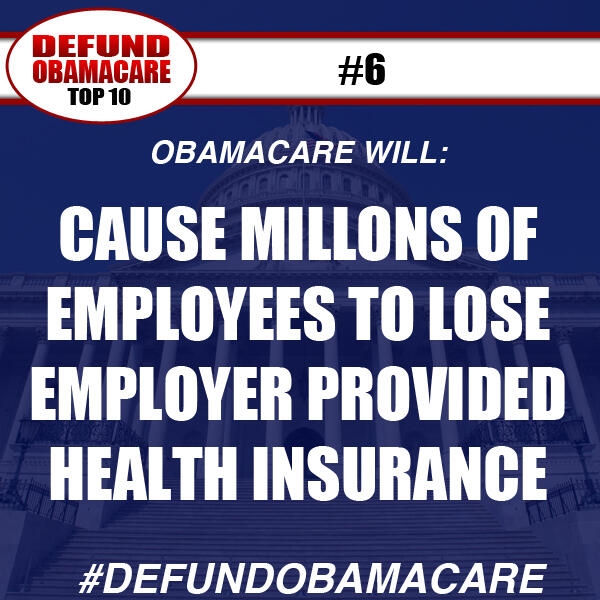
#6 reason to #DefundObamacare: If you like your health care plan, under Obamacare you may lose it pic.twitter.com/eRkuxhs6SW

Related:

Welcome to Budget Week in DC! Like Shark Week, Only with More Blood, Tears, and Chum

How serious is Paul Ryan's new budget when it calls for repealing 'Obamacare'?

Wednesday, March 6, 2013

GOP senators introduce amendment to defund Obamacare

Washington Examiner: Senator Ted Cruz, R-Texas, introduced an amendment this morning to the continuing resolution, which would keep the government funded past March 27, that would defund Obamacare.

Obamacare has already damaged the economy by reducing employee hours, forcing employers to drop health insurance coverage and creating a drag on job creation, Cruz said.

“If Obamacare is fully implemented, it will create an even further drag on the economy, killing jobs and making it harder for those struggling to climb the economic ladder,” he said in a statement.

The amendment would delay funding for Obamacare until economic growth returns to historic averages.

“In my view, Obamacare should be fully repealed, and I have introduced legislation to do so,” he said. “At a minimum, however, it should not be implemented at time when our economy is struggling so mightily, at a time when its implementation could push us into a full recession.”

Sen. Mike Lee, R-Utah, joined Cruz in calling for a delay in Obamacare funding.

“I will join Senator Cruz in objecting to Senate consideration of any Continuing Resolution without a vote on delaying funding of Obamacare,” he said in a statement. “Defunding Obamacare is essential to restoring economic growth. At this time of fiscal turmoil, Congress shouldn’t borrow more money to pay for something we cannot afford.”

Thursday, January 17, 2013

States’ refusal to establish exchanges could undo Obamacare

The Daily Caller:  The Obama administration is waiving the deadline for states to establish a health insurance exchange in accordance with Obamacare, reports The New York Times. But it should not be taken as a sign of deference to the states, or a willingness to be flexible; it should be taken as a sign of desperation.

The announcement is in fact an attempt by the administration to shore up the health care law’s inherent weaknesses and to cajole states into enacting a federal scheme. Contrary to what the feds now claim, the latest and most glaring weakness of Obamacare is that it was crafted to depend on states to establish health insurance exchanges. These exchanges are meant to be the vehicles for the distribution of tax credits and subsidies to buy qualified health insurance plans.

If a state refuses to set up an exchange, and so far 25 have refused,the federal government must step in and create one. However, the law does not authorize tax credits and subsidies to flow through federally created exchanges, only those created by states. An Internal Revenue Service (IRS) rule issued in May 2012 attempted to fix this problem — initially dismissed as a “drafting error” — by extending credits and subsidies to federal exchanges and so-called “partnership exchanges,” which a number of states have indicated they will adopt.

But the law’s plain meaning, and Congress’ intent, cannot be swept aside by a rule issued by the IRS. Oklahoma Attorney General Scott Pruitt is challenging the IRS in federal court over the rule and the case will likely end up before the U.S. Supreme Court. It has huge implications. If federal exchanges cannot facilitate tax credits and subsidies, they also cannot be used to impose penalties on employers that fail to comply with the law’s “employer mandate” — a fine of $2,000 per employee per year. States that refuse to set up an exchange could therefore shield thousands of their residents and small businesses from onerous federal taxes and penalties.

The Cato Institute’s Michael Cannon has made this argument forcefully and in great detail, and it seems to be gaining ground. Cannon, along with Jonathan Adler, a law professor at Case Western Reserve University, have authored what will likely be the definitive argument against the legality of the IRS rule in a forthcoming Health Matrix article.

They argue that once it became clear that a significant number of states were not going to set up exchanges, the IRS sought to fix the problem by regulatory decree. However, by stipulating that tax credits and subsidies would be available only through state-created exchanges, Congress sought to create an incentive for states to set up their own exchanges — because it could not simply order states to create them without overstepping constitutional boundaries. It seems that it did not occur to Obamacare’s authors that many states would simply refuse, or that offering tax credits and subsidies would not be sufficient inducement for them to comply. It was a gross miscalculation, and could mean the undoing of Obamacare.

Seen in this light, this week’s announcement by HHS Secretary Kathleen Sebelius looks more like a plea to recalcitrant states to cooperate and set up exchanges so the feds won’t have to. Sebelius was supposed to determine by January 1 whether states were prepared to run an exchange, but she knew as far back as Nov. 15 that Texas, at least, would not establish one.

Waiving the deadline isn’t a deferential gesture by HHS to the states; it is the latest attempt by the federal government to deputize states into implementing federal policy, and a desperate attempt at that.

Texas and other states should remain steadfast in their resolve not to become tools for Washington, D.C. If the feds want Obamacare exchanges, let them set up those exchanges themselves. Americans would be much better off with weak federal exchanges than they would with the state-based exchanges Congress first envisioned in the law.

John Davidson is a policy analyst for the Center for Health Care Policy with the Texas Public Policy Foundation, a non-profit, free-market research institute based in Austin. He may be reached at jdavidson@texaspolicy.com.  -  Cross-Posted at AskMarion

Tuesday, December 11, 2012

ObamaCare fee of $63 per person to begin in 2014 (Just for pre-existing conditions) - Hang onto Your Hats Folks the ObamaCare Fees Are Just Beginning!

Monday, December 10, 2012 11:04:23 PM · by 2ndDivisionVet The Washington Times / The Associated Press ^ Ricardo Alonso-Zaldivar, AP

Your medical plan is facing an unexpected expense, so you probably are, too. It’s a new, $63-per-head fee to cushion the cost of covering people with pre-existing conditions under President Obama’s health care overhaul.

The charge, buried in a recent regulation, works out to tens of millions of dollars for the largest companies, employers say. Most of that is likely to be passed on to workers.

Employee benefits lawyer Chantel Sheaks calls it a “sleeper issue” with significant financial consequences, particularly for large employers.

“Especially at a time when we are facing economic uncertainty, [companies will] be hit with a multimillion-dollar assessment without getting anything back for it,” said Mr. Sheaks, a principal at Buck Consultants, a Xerox subsidiary.

Based on figures provided in the regulation, employer and individual health plans covering an estimated 190 million Americans could owe the per-person fee.

The Obama administration says it is a temporary assessment levied for three years starting in 2014, designed to raise $25 billion. It starts at $63 and then declines.

Most of the money will go into a fund administered by the Health and Human Services Department. It will be used to cushion health insurance companies from the initial hard-to-predict costs of covering uninsured people with medical problems. Under the law, insurers will be forbidden from turning away the sick as of Jan. 1, 2014.

The program “is intended to help millions of Americans purchase affordable health insurance, reduce unreimbursed usage of hospital and other medical facilities by the uninsured and thereby lower medical expenses and premiums for all,” the Obama administration says in the regulation. An accompanying media fact sheet issued Nov. 30 referred to “contributions” without detailing the total cost and scope of the program.

Of the total pot, $5 billion will go directly to the U.S. Treasury, apparently to offset the cost of shoring up employer-sponsored coverage for early retirees.

The $25 billion fee is part of a bigger package of taxes and fees to finance Mr. Obama’s expansion of coverage to the uninsured. It all comes to about $700 billion over 10 years, and includes higher Medicare taxes effective this Jan. 1 on individuals making more than $200,000 per year or couples making more than $250,000. People above those threshold amounts also face an additional 3.8 percent tax on their investment income.

But the insurance fee had been overlooked as employers focused on other costs in the law, including fines for medium and large firms that don’t provide coverage.

“This kind of came out of the blue and was a surprisingly large amount,” said Gretchen Young, senior vice president for health policy at the ERISA Industry Committee, a group that represents large employers on benefits issues.

Word started getting out in the spring, said Ms. Young, but hard cost estimates surfaced only recently with the new regulation. It set the per-capita rate at $5.25 per month, which works out to $63 a year.

America’s Health Insurance Plans, the major industry trade group for health insurers, says the fund is an important program that will help stabilize the market and mitigate cost increases for consumers as the changes in the Obama law take effect.

But employers already offering coverage to their workers don’t see why they have to pay into the stabilization fund, which mainly helps the individual insurance market. The redistribution puts the biggest companies on the hook for tens of millions of dollars.

Elections have consequences and this is only one of many that are coming.  But, if you voted to re-elect Obama because you wanted ObamaCare or because you didn’t inform yourself before voting, you can only blame yourself.  The information was all out there and plenty of people were trying to warn what was coming.  This is only a small fee, wait until the real fees and surprises hit.

Wednesday, November 28, 2012

Liberty Counsel Victory: High Court Breathes New Life Into ObamaCare Lawsuit

This ruling breathes new life into the challenge to ObamaCare

Liberty Counsel: At issue is the constitutionality of the employer mandate and also whether ObamaCare's forced funding of abortion is unconstitutional under the First Amendment Free Exercise of Religion Clause and the federal Religious Freedom Restoration Act (RFRA).

US Supreme Court

US Supreme Court

Washington, DC (Liberty Counsel) On Monday, November 26, 2012, the U.S. Supreme Court granted Liberty Counsel's Petition for Rehearing in the ObamaCare case of Liberty University v. Geithner. Liberty Counsel filed the petition for rehearing on behalf of Liberty University and two private individuals.

The ruling breathes new life into the challenge to ObamaCare. The Court directed that the case be reheard at the federal court of appeals in Richmond. This may pave the way for the case to return to the High Court in 2013.

At issue is the constitutionality of the employer mandate and also whether ObamaCare's forced funding of abortion is unconstitutional under the First Amendment Free Exercise of Religion Clause and the federal Religious Freedom Restoration Act (RFRA).

In 2010, Liberty Counsel filed the first private lawsuit against ObamaCare on the day it was signed by President Obama. In 2011, an appeals court in Richmond, VA, ruled that the Anti-Injunction Act (AIA) barred the court from addressing the merits in the Liberty University case, which challenged the individual mandate (Section 1501) and the employer insurance mandate (Section 1513) of ObamaCare.

In addition to the constitutional arguments that Congress lacked authority to pass the law, the suit also raised the Free Exercise of Religion and the RFRA claims because of the forced abortion funding.
The first day of oral argument was dedicated to the AIA, the issue that Liberty University's case placed before the High Court.

In June, the Supreme Court ruled that the AIA does not apply to ObamaCare. Therefore, Liberty Counsel asked the Court to grant its petition (because Liberty University prevailed on the AIA claim), vacate the ruling of the court of appeals, and remand (send back) the case to the court of appeals to consider the Free Exercise claim and the employer mandate, neither of which were decided by the High Court.

"I am very pleased with the High Court's ruling. This ruling breathes new life into our challenge to ObamaCare. Our fight against ObamaCare is far from over," said Mat Staver, Founder and Chairman of Liberty Counsel and Dean of Liberty University School of Law.

"Congress exceeded its power by forcing every employer to provide federally mandated insurance. But even more shocking is the abortion mandate, which collides with religious freedom and the rights of conscience," Staver said.

Liberty Counsel is an international nonprofit, litigation, education, and policy organization dedicated to advancing religious freedom, the sanctity of life, and the family since 1989, by providing pro bono assistance and representation on these and related topics.

- - -
Liberty Counsel is a nonprofit litigation, education and policy organization dedicated to advancing religious freedom, the sanctity of human life and the traditional family. Established in 1989, Liberty Counsel is a nationwide organization with offices in Florida, Virginia, and Washington, D.C., and hundreds of affiliate attorneys across the Nation.

Saturday, June 9, 2012

Tax cut ahead if high court voids health care law

Tax cut ahead if high court voids health care law

By Tom Curry, msnbc.com National Affairs Writer

Expectations in Washington have reached feverish heights as supporters and foes of the Affordable Care Act fret about a Supreme Court ruling in the next few weeks that will decide its fate – and potentially set off a cascade of policy reverberations.

If the justices strike down the law in its entirety, for example, they would do away with $1.4 trillion in planned spending over the next ten years. Since there would be no expansion of Medicaid eligibility and no creation of insurance subsidies for middle-class people, the money for those benefits wouldn’t be spent.

A ruling which invalidated the law would also cancel more than $400 billion in tax increases between now and 2021 that Congress designed to help pay for the expansion of insurance coverage.

The last time the Supreme Court struck down budget legislation was in 1998 when it ruled the Line Item Veto Act unconstitutional. Before that, one has to go back to the 1930s and the high court’s clash with President Franklin Roosevelt and the Democratic Congress to find the justices striking down a major revenue measure.

If the justices do hold that the ACA is unconstitutional, the tax revenue that would be cancelled is significant, but more important from health care policy makers’ point of view is the type of taxes that would killed.

As Congress was writing the law in 2009 and 2010, a recurring theme among health care reformers such as MIT economist Jonathan Gruber and former Congressional Budget Office director Alice Rivlin was that any overhaul should reduce the tax code’s subsidization of unnecessary health care. Gruber and other reformers wanted to begin to limit the tax-free status of employer-provided health insurance.

The law that President Obama signed on March 23, 2010 moved in that direction. It relied heavily on taxing benefits that go mostly to well-off people to help raise the money to insure the uninsured.

By 2019, once all the tax provisions take effect, more than two-thirds of the new tax revenues to pay for the Affordable Care Act will come from just two taxes: the increased Medicare tax on upper-income people and the tax on so-called “Cadillac” employer-provided insurance plans.

The Medicare tax increase is set to take effect on Jan. 1 of next year, while the tax on Cadillac health plans is not slated to begin until 2018.

The Medicare tax increases the tax rate on wages to 2.35 percent on earnings over $200,000 for individuals and $250,000 for married couples filing jointly. It also creates a new 3.8 percent tax on investment income for those same taxpayers. The thresholds are not indexed to inflation so in time they would begin to affect more and more middle-income people.

The 40 percent tax on Cadillac plans will apply to coverage that costs more than $10,200 for individuals and more than $27,500 for family coverage. After 2020, the tax thresholds would be indexed to the inflation rate – but since health insurance costs have risen faster than the overall inflation rate, over time the tax would likely begin to bite a greater and greater percentage of those with insurance.

The tax on Cadillac plans drew adamant opposition from labor unions and from some Democratic members of Congress, who despite their final votes for the ACA, might be happy to see the tax on Cadillac plans eliminated.

As Sen. Debbie Stabenow, D- Mich., said at a meeting of the Senate Finance Committee when it was writing the bill, the criticism of Cadillac plans “really doesn't hold true for many, many working Americans, who over the years have given up salary increases to get their increased (health insurance) benefits….and they are now because of cost increases, the same cost increases we are trying to address overall and reform, they are seeing their co-pays and deductibles go up.”

She said, “I don't want to see them in addition to that have to add an additional tax” while “they are trying to figure out how to keep their health insurance.”

But Gruber said both in his testimony to the Senate Finance Committee in 2009 and in his book published last year, “Health Care Reform: What It is, Why It’s Necessary, How It Works,” that taxing high-cost plans was needed to contain costs.

“Folks are encouraged to use extra care by their overly generous, tax-subsidized insurance,” Gruber said.  The tax on Cadillac plans, he said, is “not really a new tax on insurance. It’s an attempt to offset the existing unfair and inefficient tax break we now provide.” By taxing Cadillac plans, “We stop subsidizing employers from buying overly generous insurance that induces wasteful medical spending.”

Although House Budget Committee chairman Paul Ryan and Mitt Romney support a tax overhaul that would combine lower tax rates with fewer tax preferences, they haven’t specified whether the current tax-free status of employer-provided insurance is one tax preference they’d seek to limit or eliminate.

Romney does say in his economic blueprint that “The approach taken by the Bowles-Simpson Commission is a good starting point for the discussion.”

The Bowles-Simpson commission’s report suggested that one option for reducing deficits and creating a simpler tax system would be to phase out the tax-free status of employer-provided insurance. And Congress took a step in that direction by passing the Affordable Care Act, but in the wake of a Supreme Court decision, it may need to begin with a clean sheet of paper and redesign both tax policy and health care policy.

Gruber said Monday he thinks that Congress would not likely take on the tax-free status of employer-provided insurance outside the context of the ACA.

On policy grounds he said, limiting the tax break for insurance “makes a huge amount of sense when folks can access well-functioning non-employer markets, as they will be able to under ACA.  If they can't, there are risks in employers scaling back coverage, as might happen under a Cadillac tax.”

He added, “This is a policy that health policy experts have been fighting for over decades, and we were only able to get it in the context of the larger ACA. I highly doubt it could survive as a stand-alone.”

If Not…   Yes, the IRS Can Use Liens and Incarceration to Enforce ObamaCare’s Individual Mandate

Here’s a poor, unsuccessful letter I sent to the editor of the Washington Post:

A recent article [“Could the health-care law work without the individual mandate?”, Mar. 28, A8] claims the IRS “will be barred from using … collection tools such as placing liens or threatening incarceration” to enforce compliance with the requirement that Americans obtain health insurance. Not so.

Suppose the IRS assesses me a $1,000 penalty for failing to obtain health insurance. It is true that the law prohibits the IRS from using liens or incarceration to collect that $1,000. But, money being fungible, the IRS may simply deem my first $1,000 of income-tax withholding to be payment of that penalty. As a result, I would owe an additional $1,000 in income tax at the end of the year, and the IRS could come after me with every tool at its disposal, including liens and incarceration.

Repeat after Me: There Is No Health Reform but ObamaCare

Here’s a poor, unsuccessful letter I sent to the editor of Politico:

An item in Politico’s health care newsletter Pulse [“Today: Christie Vetoes Exchange Or Else,” May 10] told readers that, because I oppose ObamaCare, I am a “health reform foe.”

Is that what Politico gleans from my conversations with its reporters about the need for health care reform, and how I would go about it? From the hundreds of articles and opeds and speeches and blog posts in which I detail my preferred reforms? And from the book I coauthored about how to reform health care? Is it Politico’s editorial policy that one cannot support health reform without supporting ObamaCare?

Suppose the IRS assesses me a $1,000 penalty for failing to obtain health insurance. It is true that the law prohibits the IRS from using liens or incarceration to collect that $1,000. But, money being fungible, the IRS may simply deem my first $1,000 of income-tax withholding to be payment of that penalty. As a result, I would owe an additional $1,000 in income tax at the end of the year, and the IRS could come after me with every tool at its disposal, including liens and incarceration

Other news organizations, moreover, avoid describing ObamaCare as “reform,” a term that connotes improvement. Is it Politico’s editorial policy to convey to readers that ObamaCare is an improvement?

How to Recognize a Government Contractor, or a Federal Takeover

Here’s a poor, unsuccessful letter I sent to the editor of the Washington Post:

GOP stalls on insurance marketplaces” [May 12] reports that “the conservative firm Leavitt Partners…is working with a number of states on their plans” to create the government bureaucracies that the new health care law calls insurance “exchanges.”

The article should have informed readers that this “conservative firm” (whatever that means) is a for-profit government contractor that makes money by helping states create those exchanges, and is acting against the advice of the nation’s leading conservative think tank. The Heritage Foundation counsels states not to create exchanges, and to send all related funds back to Washington.

Finally, the article claims states can avoid a “federal takeover” by creating an exchange. On the contrary, the law requires state-run exchanges to obey all federal edicts, just as a federal exchange would. The federal takeover has already happened. States that create their own exchanges merely pay for the privilege of losing their sovereignty.

Michael F. Cannon – Townhall Columnist

Thursday, June 7, 2012

The Patient OPTION Act: True Patient-Centered Care

FreedomWorks

As we eagerly await the upcoming Supreme Court decision here at FreedomWorks, we’ve been reviewing our favorite bills to repeal and replace ObamaCare.

One of the most comprehensive “replace” bills we’ve seen so far is the Patient OPTION Act (H.R. 4224) introduced by Congressman Paul Broun, M.D. (R-GA). The Patient OPTION Act fully repeals and replaces ObamaCare with a system that puts more choice and freedom in the hands of the patient. Rather than focusing on “expanding coverage”—a goal that puts policymakers in a trap that inevitably leads to more centralized government control, a la ObamaCare—this plan focuses on two commonsense goals: (1) reduce costs through greater choice and competition, (2) expand individual liberty.

For more information about this bill, including a summary of its major provisions, you can view our guide to the Patient OPTION Act.

TAKE ACTION: Urge your Members of Congress to cosponsor the Patient OPTION Act!

application/pdf iconPatient_OPTION_Act_Summary.pdf - 657.14 KB


Sunday, April 22, 2012

Barney Frank: Obamacare Was a 'Mistake'

As far back as Fall 2011 Liberals were saying: Obamacare was a mistake

Via Noel Sheppard at News Busters comes word that Chris Matthews asked panelists on some round table show he runs, “What has been President Obama’s biggest mistake in his two and a half years so far?” Readers already knew the answer. Obamacare. Barack Obama wasted political capital on this half-baked attempt to have the government take over health insurance. I have said this repeatedly. But now it is dawning on the political insiders that maybe instead of playing hardball with the opposition, Barack Obama should have tried to swing a few Republican votes his way.

From News Busters, the transcript:

CHRIS MATTHEWS, HOST: This week we want to do something slightly different with our “Tell me Something” segment. Let me ask you all, all four of you, what has been President Obama’s biggest mistake in his two and a half years so far? Howard.

HOWARD FINEMAN, HUFFINGTON POST: Chris, on things under his control, not the wars so much because they were built in, his decision to spend all of his political capital in a year and a half of his time on the health-care reform law I think was his biggest political mistake.

MATTHEWS: Wow. Smart statement.

And then there was this exchange with another panelist:

DAVID IGNATIUS, WASHINGTON POST: I would agree with Howard. The idea of launching a major change in social legislation without having a consensus in the country and in Congress about what that should look like was a mistake. That’s just not how a president makes good policy.

MATTHEWS: Wow.

Wow indeed. What does Obama have to run on next year? The economy? Foreign policy? I suppose. One thing he cannot run on is the centerpiece of his domestic policy: Obamacare. Suddenly Obamacare vindicated the late Roberto Goizueta — the CEO who gave the world New Coke.

h/t to Don Surber  -  September 6, 2011

Forbes:

Barney Frank

Well now Rep. Barney Frank (D., Mass.), who is retiring from the House this year, now says that President Obama made a “mistake” in pushing for his signature health law. “I think we paid a terrible price for health care,” he told Jason Zengerle of New York magazine. “I would not have pushed it as hard. As a matter of fact, after [Republican] Scott Brown won [Sen. Kennedy’s old seat in Massachusetts], I suggested going back. I would have started with financial reform but certainly not health care.” But Frank’s reasoning carries pitfalls for conservative reformers as well as liberal ones.

Frank explains that it’s difficult to enact reforms that threaten to disrupt the arrangements of those who already have health insurance and are happy with the care they get. “Obama made the same mistake Clinton made,” says Frank. “When you try to extend health care to people who don’t have it, people who have it and are on the whole satisfied with it get nervous.” (h/t Jim Geraghty.)

Obama, says Frank, over-interpreted his mandate from the 2008 election. “The problem with health care is this: Health care is enormously important to people. When you tell them that you’re going to extend health care to people who don’t now have it, they don’t see how you can do that without hurting them. So I think he underestimated, as did Clinton, the sensitivity of people to what they see as an effort to make them share the health care with poor people.”

Let’s leave aside Frank’s accusation that the reason Obamacare is unpopular is because the middle class doesn’t want to “share the health care with poor people.” (The middle class does plenty of sharing already.)

Huffington Post’s Howard Fineman and the Washington Post’s David Ignatius also both agree with the majority of Americans that socialist ObamaCare was President Downgrade’s biggest mistake.  See Video

Wouldn’t it be fascinating if media members that helped this President pass ObamaCare against America’s wishes came to the conclusion this was his biggest mistake?


On Sunday’s “The Chris Matthews Show,” the Huffington Post’s Howard Fineman and the Washington Post’s David Ignatius both told a somewhat startled host that Obama spending so much of his time and political capital on passing healthcare reform was his worst decision to date. 

Love Chris Mathews at the end, “wow.”

Two other Democrats not runing re-election came out this week and announced that voting for ObamaCare was a mistake.  And even AARP admitted that supporting ObamaCare was a mistake for its members. Members' premiums up 8-13% for just next year. Spokesman on Fox twisting and squirming, admitting supporting ObamaCare might have been a mistake.

But before Republicans start chortling at Barney Frank’s admission of Obamacare’s unpopularity, it’s worth remembering that the overall problem he identifies makes sweeping market-oriented reforms difficult too.

That’s why, for example, Democrats go on about Republicans supposedly “ending Medicare as we know it,” even though that is patently dishonest, and why the new Republican plan for Medicare, endorsed by Paul Ryan and Mitt Romney, (1) doesn’t affect anyone over the age of 55, and (2) retains an option for people to stay on traditional Medicare if they so choose.

Many Republicans have aggressively pushed the critique that Obamacare prevents people from keeping their current arrangements, if they like them. But that critique would also apply to any plan that, say, eliminated the tax exclusion for employer-sponsored insurance, in order to help fund universal coverage (an idea favored by people like me).

If Republicans are lucky enough to gain power in November, they will face two challenges. Democrats will instinctively push back on any changes to our three health-care entitlements: Medicare, Medicaid, and the employer tax exclusion. In addition, much of the conservative base does not appreciate that health care reform is urgently needed, because conservatives tend to be the people who are happiest with their current arrangements.

What’s the solution? The solution has two parts. First, any proposals to replace Obamacare must be implemented gradually, over time, so as not to overly disrupt the arrangements that many Americans like. Secondly, the solution ought to be bipartisan, by pairing free-market reforms with expansion of coverage (a liberal priority).

For all the partisan bluster right now, if Obamacare is overturned or repealed, it’s hard for me to see centrist Democrats voting against a significant expansion of coverage sponsored by Republicans, out of spite. But I could be wrong.