Monday, January 13, 2014

If You MUST Vaccinate, Aim for This Body Part

Story at-a-glance

  • Thousands of cats – from 1 to 10 out of every 10,000 vaccinated – develop vaccine-associated sarcomas each year. This malignant form of cancer is linked primarily to rabies and feline leukemia virus (FeLV) vaccines.
  • Because of the risk of sarcomas at injection sites, it is customary for veterinarians to give feline rabies vaccines in the right rear leg and FeLV vaccines in the left rear leg. The injection sites are below the knee joint so that amputation of the lower part of the leg can provide a treatment option in the event a tumor develops. The majority of cat owners, however, when faced with a VAS on their pet’s lower leg, refuse to amputate to avoid pain, disfigurement, and the costs associated with the procedure.
  • A recent pilot study at the University of Florida suggests that tail vaccinations are a good alternative to rear leg vaccinations in cats. Study results indicate there are no significant differences in the behavior of the cats that receive vaccinations below the knee and in the tail. All but one cat that received the tail vaccines developed protective antibody titers. The researchers concluded that tail vaccination was well tolerated by the cats in the study and was as effective as vaccines injected in the lower rear legs.
  • The researchers believe tail vaccinations could make surgical treatment of vaccine-associated sarcomas easier and less disfiguring, which could in turn encourage more owners to have their cats treated for cancer.
  • Rather than evaluating which body part is best for feline vaccinations, Dr. Becker recommends first focusing on the necessity for the vaccine at all. She offers guidelines to help you make sound vaccination decisions for your cat.
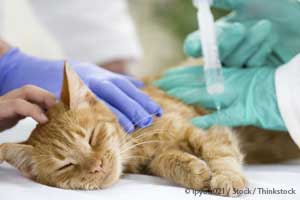
Cat Vaccination

By Dr. Becker – Cross-Posted at Just One More Pet

It is estimated that from one to 10 cats out of every 10,000 vaccinated will develop cancer at the vaccine injection site, also known as vaccine-associated sarcoma (VAS). A sarcoma is a type of cancer resulting from changes in connective tissue cells. Feline vaccine-associated sarcoma is a malignant tumor that is primarily associated with two vaccines: the rabies vaccine, and the feline leukemia virus (FeLV) vaccine.

For several years, it has been customary for feline rabies vaccines to be given in the right rear leg and FeLV vaccines in the left rear leg. The injections are made below the knee joint so that amputation of the lower portion of the leg can be offered to cat owners as a cancer treatment option. However, many owners of cats with VAS refuse amputation of their kitty’s leg because it’s painful, disfiguring and costly.

Pilot Study Suggests Tail Vaccinations Are Effective and Well-Tolerated

A research team from the University of Florida, Operation Catnip in Florida, Cornell University’s College of Veterinary Medicine, and Kansas State University’s Rabies Laboratory set out to evaluate alternatives to customary vaccine injection sites in the lower legs of cats. The results of their pilot study were published recently in the Journal of Feline Medicine and Surgery.1

The researchers surveyed oncology practitioners to learn their preference for vaccination sites based on ease of tumor removal. The preferred sites by 94 oncology practitioners were below the knee (41 percent), and the tip of the tail (30 percent).

Study results also indicated there were no significant differences in the behavior of the cats that received vaccinations below the knee and in the tail. All but one cat that received the tail vaccines developed protective antibody titers. The researchers concluded that tail vaccination was well tolerated by the cats in the study and was as effective as vaccines injected in the lower rear legs.

The researchers believe tail vaccinations could make surgical treatment of vaccine-associated sarcomas easier and less disfiguring, which could in turn encourage more owners to have their cats treated for cancer.

My Guidelines for Vaccinating Cats

As a holistic veterinarian, I’m much less interested in which body parts are best for vaccine injections than I am in determining which vaccines an animal truly needs based on established immunity, age, lifestyle, and other factors. This is especially true of cats, in light of the potential for vaccine-associated sarcomas.

If possible, I recommend you find a holistic or integrative vet to care for your cat. Non-traditional veterinarians are generally very cautious vaccinators. If your cat is strictly an indoor housecat with no exposure to other cats or the outdoors, the risks of annual vaccines far outweigh the benefits, in my opinion.

Ask for a vaccine titer test, which will measure your cat’s immunological protection against diseases for which he has already been vaccinated via his kitten shots. You can’t add protection to an already immunized pet, so don’t keep vaccinating.

If your pet truly needs a booster of a certain vaccine or a vaccine she’s never received, make sure that 1) the vaccine is for a serious disease (this eliminates many on the list immediately), 2) your cat may be in a position to be exposed to the disease (indoor cats have little to no exposure to most diseases), and 3) the vaccine is considered both safe and effective.

If your cat is an indoor/outdoor cat (in a high risk category for disease exposure) and must receive a booster vaccine, ask your vet to provide a homeopathic detox remedy called Thuja, which will help neutralize the effects of any vaccine other than the rabies vaccine. Rabies vaccines are required by law. There are two varieties of the same vaccine – the one-year type and the three-year type. Insist on the thimerosal-free, three-year rabies vaccine, and ask your vet about the homeopathic rabies vaccine detoxifier called Lyssin. If your pet is a kitten, ask to have the rabies vaccine given after four months of age, preferably closer to six months, to reduce the potential for a reaction.

If your cat lives entirely indoors, I recommend she not be vaccinated again after a full set of kitten shots in her first year of life. Her indoor-only lifestyle eliminates her risk of exposure to infectious diseases. Keep your unvaccinated indoor cat away from all other cats and your pet’s risk is virtually nonexistent.

Do not vaccinate your cat if he has had a serious vaccine reaction in the past.

Avoid veterinary practices that promote annual or more frequent re-vaccinations. Try not to patronize any boarding facility, groomer, or other animal care service that requires you to vaccinate your cat more than necessary.  

Dog and Cat Vaccines are Not Harmless Preventive Medicine  

The Pets Most Likely to Suffer from Vaccine Adverse Reactions 

Don’t Be Duped By the True Intent of This Media Blitz

Sunday, January 12, 2014

Judge Jeanine Pirro – Obamacare lies – How Many More People Will Lose Coverage?

Video: Judge Jeanine Pirro - Obamacare lies - How Many More People Will Lose Coverage

?

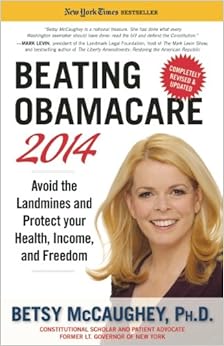
Book: Beating Obamacare 2014: Avoid the Landmines and Protect Your Health, Income, and Freedom (Kindle)

Cross-Posted at AskMarion

The GOP’s Grandfather Weapon

Daily Caller: ‘If You Like Your Obamacare, You Can Keep Your Obamacare’: I don’t quite understand the new, near-unanimous Dem line on Obamacare – which is that because it has signed up a few million people, many previously uninsured, it is now somehow invulnerable to repeal. From WaPo:

“A fundamental political shift happened on January 1 because millions of Americans now have health insurance,” said Dan Pfeiffer, an Obama senior adviser. “The Republican strategy now means taking that insurance away. It was all theoretical until now, and the Republican repeal plan is no longer politically viable.” [E.A.]

It may be true, as the New York Times hopefully declared, that “[o]nce a benefit has been bestowed, it is nearly impossible to take it away” (though there are a million or so Americans who’ve been receiving long-term unemployment benefits who might want to argue the point). But there’s a traditional political solution to this Take Away Problem, namely the “grandfather clause.”

It wouldn’t be hard for Republican repealers to write a law that got rid of Obamacare while somehow keeping those few million who’ve signed up on some form of similar insurance. “If you like your Obamacare you can keep your Obamacare.” Exchange policies could be converted to non-exchange policies in a special, no-new-enrollments program, for example. Over time, attrition would whittle this grandfathered class down to trivial size–a process with which you’d think Obamacare’s architects would be familiar.

I don’t know if Obamacare will survive or not. Even its cockiest defenders, now whistling past the graveyard of missed deadlines, concede** that (as one of them, Josh Marshall, puts it) if “the mix of young and old people, healthy and sick” is “significantly out of whack you’ll have problems.”*** Problems that include, in Greg Sargent’s words, the possibility that “insurers pull out, and the exchanges collapse.”

But I do know that if Obamacare isn’t repealed it won’t be because two (or ten) million people in a country of 300 million have already signed up.

P.S.: Its also possible that Obamacare, instead of collapsing, will become a long term, slow-bleeding, painfully unpopular policy wound, as millions more middle class Americans who don’t qualify for subsidies get shunted into the individual market where they have to buy policies that offer them less for more. It’s not clear that this outcome is better, politically, for the Democrats.

P.P.S.: You want a health care benefit that would be nearly impossible to take away, or to grandfather? Extending Medicare to age 55 would have been more or less impossible to take away, even by grandfathering (i.e. by continuing Medicare for existing 55 year olds but denying it to new 55 year olds). Just sayin’.

_____

**– Marshall also downplays the non-payment problem –i.e. the possibility that many of the 2 million who’ve signed up on the exchanges “won’t end up paying their premiums.” He says GOPs who make this argument are “dead-enders” in an “intense form of denial.” But the non-payment threat seems like a reasonable worry for supporters of the law as well as a source of hope for opponents.

***– I favor a more panicked, pro-active approach that accepts the need for reasonably big fixes (e.g. fewer mandatory benefits). Letting Americans know improvements (if necessary) are planned might in turn help build confidence and boost enrollment.

Thursday, January 9, 2014

ISSA Warns Sebelius That She Could Face Perjury Charges Over Obamacare Testimony - Rep Trey Gowdy


Video: ISSA Warns Sebelius That She Could Face Perjury Charges Over Obamacare Testimony - Rep Trey Gowdy

Washington Examiner: Health and Human Services Secretary Kathleen Sebelius could face perjury charges over her congressional testimony on Obamacare, House Oversight and Government Reform Committee Chairman Darrell Issa, R-Calif., warned in a letter calling for Sebelius to correct the record.

“Witnesses who purposely give false or misleading testimony during a congressional hearing may be subject to criminal liability under Section 1001 of Title of 18 of the U.S. Code, which prohibits ‘knowingly and willfully’ making materially false statements to Congress,” Issa wrote in a Wednesday letter. “With that in mind, I write to request that you correct the record and to implore you to be truthful with the American public about matters related to Obamacare going forward."

Issa focused on Sebelius' testimony about launching the healthcare.gov federal exchange website despite the existence of technical problems that marred the Obamacare rollout.

“Providing false or misleading testimony to Congress is a serious matter,” Issa writes. “Documents and testimony obtained by the Committee, including information provided by Teresa Fryer, the Chief Information Security Officer at the Centers for Medicare and Medicaid Services (CMS), and the MITRE Corporation, a contractor hired by HHS to conduct security assessments of healthcare.gov, show that your testimony was false and misleading.”

HHS promised to respond to the letter. "Regarding the issues raised in the partial transcript excerpts referenced in the letter—as we have said repeatedly, including when these issues were first reported several weeks ago—the HealthCare.gov components that are operational have been determined to be compliant with the Federal Information Security Management Act, based on standards promulgated by the National Institutes of Standards and Technology," Joanne Peters, the national press secretary for health care at HHS, told the Washington Examiner in an email.

Sebelius' claim that MITRE conducted "ongoing testing" of the Obamacare website was false, Issa said, citing Fryer's testimony to committee staff that the company only did testing by rounds, with the last pre-launch round taking place on Sep. 20. The next round did not begin until Dec. 10.

Issa also said that Sebelius' claim that MITRE recommended HHS proceed with the launch of the website was also false, because MITRE says it was never consulted.

The Republican investigator also disputes Sebelius' statement that “no one… suggested that the risks outweighed the importance of moving forward."

"[Fryer] was very concerned about the problems raised by MITRE during its security testing of the system," the letter states.

Issa also quotes from a Sep. 24 memo written by Fryer, who concluded that the health care website "does not reasonably meet the CMS security requirements," adding that "there is also no confidence that Personal Identifiable Information will be protected."

"There have been no successful security attacks on Healthcare.gov and no person or group has maliciously accessed personally identifiable information," Peters countered in her email. "An independent security control assessor tested each piece of the Healthcare.gov system that went live Oct. 1 prior to that date with no open high findings. All high, moderate and low security risk findings listed on the SCAs for the portions of the website that launched Oct. 1 were either fixed, or have strategies and plans in place to fix the findings that meet industry standards."

Related:

Is This the Alarming Reason Kathleen Sebelius Hasn’t Been Fired?

Wednesday, January 8, 2014

Vermont plots course for single-payer health care system

Here we go… down the road to single-payer… socialized medicine… the plan all along~

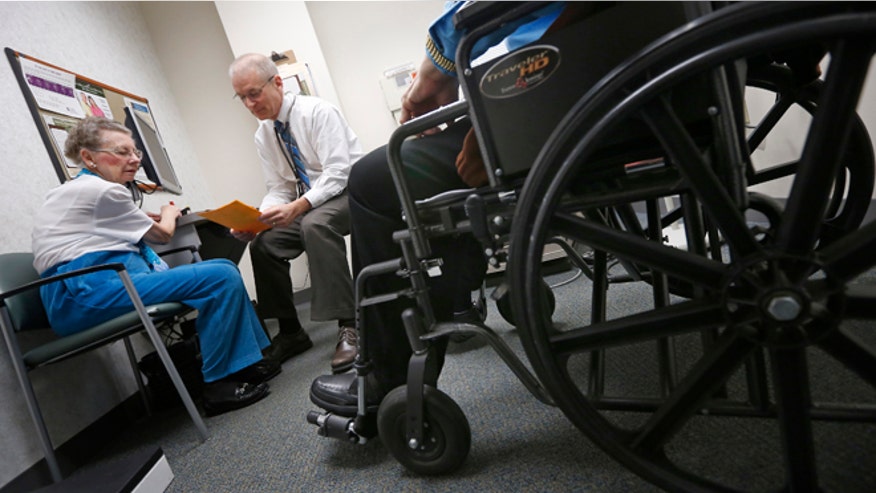
doc_office_112613.jpg

Nov. 26, 2013: A doctor speaks to patients at his office in Peoria, Ill.Reuters

Fox: WASHINGTON –  While all eyes are on the ObamaCare rollout, an ambitious health care experiment is going forward in Vermont that would create a government-run alternative know as a "single-payer" system -- and it's starting to attract more attention from liberals frustrated with the Affordable Care Act's implementation.

Democrats' faith in ObamaCare has been shaken by the technical failures of the federal and state insurance exchanges as well as, in some cases, premium increases. In Vermont, however, they see a potential first step toward the kind of national government-run health care system some have advocated for years. Filmmaker Michael Moore, in a column last week blasting ObamaCare, said Vermont's plan could "change everything."

But critics say the proposal goes too far and would kill thousands of jobs. "It’s not practical,” Vermont state Rep. Patti Komline, who voted against the plan, told FoxNews.com. “There are too many complications involved.” 

A single-payer plan would largely sideline the insurance industry, and instead set up a government-managed insurance system to collect all health care fees and pay out all health care costs.

Full implementation of Vermont’s single-payer plan could be held up for another three years, at least. In order for Green Mountain Care to fully launch in 2017, the health care exchange would have to get approval from the federal government to use federal money to fund the state program.

State law would also require Vermont to define the benefits of the single-payer program and provide a three-year budget that clocks in less than current health care costs.

University of Virginia public policy professor Raymond Scheppach said it will take another half decade to determine whether Vermont’s controversial plan even works and if there are any real benefits associated with it. He also says that regardless of outcome, Vermont’s political makeup differs from other states and therefore would not provide an accurate view of what’s to come.

The single-payer debate recently resurfaced in national headlines following the Dec. 31 op-ed piece in the New York Times by Moore. In it, Moore called ObamaCare “awful” and said liberals have avoided speaking in public about the problems with it because they didn’t want to provide the president’s critics with additional ammunition.

Moore went on to sing the merits of a single-payer system and said that the real problem with ObamaCare is that it is a “pro-insurance-industry plan implemented by a president who knew in his heart that a single-payer, Medicare-for-all model was the true way to go.”

Supporters say the single-payer system would cut down on the administrative waste and complications associated with having multiple billers and billing systems. Opponents say such a widespread overhaul would be bad for business.

Vermont became the first state in the country to lay the groundwork for single-payer health care. Gov. Peter Shumlin, a Democrat, signed the plan into law in May 2011.

The initiative, which was approved by the Democratic-controlled House and Senate, promises to extend coverage to all of Vermont’s 620,000 residents, of which around 47,000 residents are uninsured and 150,000 are underinsured.

"This law recognizes an economic and fiscal imperative," Shumlin said during a press conference when he signed the bill. "We must control the growth in health care costs that are putting families at economic risk and making it harder for small employers to do business.”

The exchange, Green Mountain Care, will set reimbursement rates for health care providers and streamline administration into a single, unified system.

Some experts say a revised system would save an estimated $580 million annually, and $1.9 billion by 2019. But the single-payer system’s creator, Harvard economist William Hsiao, says it could generate even greater profits for Vermont.

Hsiao predicts his plan would save the state 25.3 percent a year in total health care spending, lower household and employer health care spending, boost job growth and create a higher economic output for the state.

The savings, he said in a 2011 Health Affairs article, would come from tort reform for malpractice suits, better governance and lower administrative expenses. Vermont would rack up $4.6 billion in savings during the first five years of the program which he says would be used in part to cover the state’s uninsured as well as to expand benefits and services.

Vermont’s health care spending runs about $5 billion annually, with costs rising between 6.5 percent and 8.5 percent in recent years.

But not everyone is on board with the plan. It is still unknown how Vermont will pay for the plan and whether that money will come from additional taxes on its residents.

Komline says despite the plan's passage, she doesn’t see Vermont residents warming up to the idea of a single-payer system any time soon. She also said that Vermont, because of its small size and political makeup, is open to influence from special interest groups.

“It doesn’t take much money for special interest groups to come in and influence votes,” she said. “That’s why Vermont was among the first to legalize pot and same-sex marriages.”

Calls to the governor's office for comment were not returned. 

Here comes Obama’s solution to the disastrous Affordable Care Act: National Health Care a.k.a. the Single Payer System

Monday, January 6, 2014

Judge Jeanine Pirro Opening Statement - Justice Resolutions - Obama Admin Vs Little Sisters 1-4-2014

Video: Judge Jeanine Pirro Opening Statement - Justice Resolutions - Obama Admin Vs Little Sisters 1-4-2014

Pirro On Obamacare Contraception Mandate: YOU LIED!

“And yet, you as a former constitutional professor, refuse to exempt them from the contraception mandate. You, the same guy who grants exemptions and waivers left and right to unions, political buddies, bundlers, but not to the women who have devoted their lives to God and caring for the sick?” – Judge Jeanine Pirro

By Caleb Howe

On Fox News’ Justice With Judge Jeanine on Saturday, host Jeanine Pirro in her opening statement addressed the Obamacare contraception mandate and the nuns made famous recently by Justice Sotomayor.

It seems all to obvious, and Pirro puts it in stark terms. But this is a clash of religions and those are rarely settled easily. On one side, the Catholic Church and their fundamental religious objection to providing contraception. On the other, the Liberal Church and their fundamental religious devotion to giving every single living human being on the planet some form of contraception.

The Obamacare acolytes do not care about religious freedom. Well, not Christian religious freedom anyway. It is merely an inconvenient part of American life they tolerate so long as it doesn’t get in their way. But when that free exercise clashes with their fervent devotion to contraception and abortion, you can bet they won’t be willing to budge an inch. Lip service only lasts as long as the lips have nothing to yell about.

Pirro lays the fight right at President Obama’s feet, where it belongs. Here is the transcript of the above clip:

I want a government that respects religious freedom. Mr. President, now that you’re back from your Hawaiian vacation … how’d you hitt them? How’s that handicap? You come back and you try to take away from the Little Sisters of the Poor, a 175-year-old religious organization that cares for low income elderly who are dying, their right to exercise their First Amendment freedom of religion. You promised the Catholic Church you would not, under Obamacare, force those with religious objection to provide contraception to employees, which of course is contrary to their fundamental beliefs and their exercise of their religion.

In spite of your promise, you are spending millions in legal fees to force the Little Sisters of the Poor who spend their lives serving the sick and the elderly to provide contraception, sterilization and abortifacients to their employees? Pray tell, Mr. President, might you have lied to the Catholic Church? And now you’re going to court to sanction one home $6,700 a day? What don’t you understand about the Little Sisters of the Poor? Now, I don’t care if you’re pro-choice or pro-life, you have a fundamental right to practice your religion. You have a fundamental right to the First Amendment, freedom of religion.

And yet, you as a former constitutional professor, refuse to exempt them from the contraception mandate. You, the same guy who grants exemptions and waivers left and right to unions, political buddies, bundlers, but not to the women who have devoted their lives to God and caring for the sick? Hell, even a convicted muslim felon in federal prison can exercise their freedom of religion. They can’t be punished for exercising their religion. And you go after these nuns to force them to violate their religion or put them out of business? Am I asking for too much? We’re only talking about your word. Religious freedom, the First Amendment. Mr. President. It’s 2014, and we are not getting off to a good start.


Obamacare Is A Disaster & A Train Wreck… Sarah Palin Delivers Passionate Response

Video: Gov. Sarah Palin dropped by 'The Real Story With Gretchen Carlson'

Sunday, January 5, 2014

HEALTHCARE REFORM'S FIRST BIG TEST

“The portion of this email which I have highlighted in red is what HMO's have been doing all along. I watched a 2020 televised  expose on Humana doing this 20 years ago (but this is the first time I've seen it in print). All the money they don't spend to treat us they get to divide  up among themselves. Does that sound like an incentive to give us the healthcare many older Americans will/may need?? Not in my book.” Deonia Copeland

PEORIA, Illinois (Reuters) - By all accounts, Sandy Wright of Mackinaw, Illinois, is a challenging patient. The spunky 69-year-old with a rare autoimmune disease has been in the hospital more than a dozen times since she was first diagnosed in 1997.

"You name it, I've had it," Wright says. "I'm a very hard case."

Now, patients like Wright are at the forefront of an experiment, under way in Peoria, Illinois, and hundreds of other U.S. cities, that could transform the way doctors, nurses and hospitals deliver care to patients. Amid the barrage of criticism over the rollout of Obamacare, groups known as Accountable Care Organizations (ACOs) are quietly going about the business of testing the potential for healthcare reform.

The efforts, born of President Barack Obama's Affordable Care Act, are part of the biggest experiment yet to fix the costly and error-plagued U.S. healthcare system. The new models of care, which encourage providers to form networks to coordinate care and cut costs, involve close monitoring of the sickest patients to address budding health problems before they cause a costly trip to the emergency room or an extended hospital stay. Providers that succeed in keeping patients healthy and cutting costs are rewarded with a portion of the savings.

In Peoria, a city of 116,000 that is often seen as the archetypal middle American community, two hospital systems - OSF Healthcare and UnityPoint Health - are taking on the challenge.

Progress so far is largely anecdotal, but early data showing declines in readmissions and emergency room visits offers a tantalizing glimpse into the potential for reform. Still, there are no guarantees that the savings will exceed the costs.

OSF is in its second year of participating in the federal Pioneer Accountable Care Organization, a pilot program involving 32 hospital systems across the country that aims to improve quality while cutting costs in the government's Medicare insurance program for the elderly.

The program rewards doctors and medical centers that show gains on 33 measures of quality, including routine cancer and depression screenings, while still managing to cut overall costs. In its first year, 13 hospitals reported savings. OSF was not one of them, but it came close.

The Centers for Medicare and Medicaid Services has not allowed providers to disclose their full first-year results, but Tara Canty, chief operations officer of OSF's Accountable Care Organization, said the hospital system saw a 30 percent drop in emergency room admissions and a 20 percent drop in inpatient stays among Medicare participants.

Canty sees the first two years as a learning process but says she will be "upset personally" if OSF is not achieving savings by year three.

Dr. Keith Knepp, chief information officer at UnityPoint Health-Methodist, says reforms are needed, but he sometimes finds it hard to stay optimistic. "Will there be reimbursement to reward the improved quality, or will we spend more money to take in less?"

Success may depend on controlling costs among high-use patients like Wright. She is among the 5 percent of OSF patients who consumes more than 50 percent of the care delivered by the system.

FOCUS ON THE 5 PERCENT

Wright spends most of her days in her tidy home in Mackinaw, outside Peoria, tooling around in a motorized wheelchair. Her legs swell up, making her prone to blood clots. Two years ago in November, she had a major complication from her blood thinner drug, Coumadin.

"My brain started bleeding. They had to drill holes in my head," Wright recalls of the ordeal, which kept her in the hospital for nearly a month. "I nearly died twice."

Wright was among the first of OSF's Pioneer patients to be assigned a care manager, a nurse charged with keeping her healthy and out of the hospital.

"The theory here is if you focus on the people with chronic disease who are your highest utilizers of care … and make a better outcome for those patients, you are able to invest that savings into some of the care for the larger population of patients," said Michelle Conger, OSF's chief strategy officer.

Like most providers across the country, Peoria's hospitals have been hit by federal budget cuts and burdened by an outdated reimbursement system focused on how many services they perform rather that quality.

OSF, a system of eight acute-care hospitals with $6 billion in annual patient revenue, needs to cut $200 million over the next five years in response to reimbursement cuts from Medicare and other payers. It has adopted the ACO model to help it get there.

An actuarial firm is combing through claims data for the 34,000 Medicare patients in OSF's ACO to help identify patients like Wright, whose high-risk conditions are likely to require more emergency room visits or admissions. The system assigned 35 care managers to work with these patients and come up with ways to prevent more acute health crises.

Sometimes that means simply helping patients keep track of their medications or arranging transportation to a pharmacy, said Priscilla Romans, a nurse who works in OSF's call center.

It also means routine checks on high-risk patients. During a call last month, a heart failure patient complained of shortness of breath and a headache. Romans asked whether she could put her shoes on that day. She was only able to get one on, a sign of fluid buildup, and she couldn't wear her rings.

Romans had the woman take her blood pressure, which was too high, and reported the findings to her doctor. The physician doubled the patient's dose of Lasix to cut the swelling in her hands and feet, and started her on a blood pressure medication.

When Romans called the next day, a Friday, the woman felt much better. Romans believes the time she spent on the phone with this patient helped avert a much more costly ER visit.

Often, the issues driving health costs are social. In one case, OSF discovered that a patient who kept getting readmitted to the hospital for emphysema had not been taking her medication.

"She was squirreling away her money to fix her roof," said Dr. Stephen Hippler, OSF's senior vice president for clinical excellence. The Catholic hospital system tapped into a charity program and made the repairs.

'GREAT SIGNALS'

UnityPoint Health-Methodist, Peoria's second-biggest provider, has been taking part in Medicare's Shared Savings ACO, a transitional program in which hospitals assume less risk than in the Pioneer ACO but have fewer potential rewards.

The hospital has cared for about 10,000 Medicare ACO patients since July 2012.

In November, UnityPoint acquired the 220-bed Procter Hospital, Peoria's third-largest provider, giving it access to new addiction recovery services and skilled nursing care. The Procter deal follows Methodist's decision in 2011 to join Iowa-based UnityPoint Health, the 13th-largest non-profit health system in the United States with annual revenue of $2.7 billion.

The moves are part of a national consolidation trend among hospitals trying to fill out their menu of services and bring costs under centralized control.

"There is a need for size and scale in the new environment," said Terry Waters, vice president for strategy and development at UnityPoint Health. "You have to be able to diversify your financial risk over a larger patient population."

According to the Henry J. Kaiser Family Foundation, an estimated 14 percent of the U.S. population is covered by some form of accountable care organization, including 4 million Medicare beneficiaries.

WILL IT WORK?

OSF could not say whether it has saved money on Wright's care in the two years since she has been in care management because the system does not release financial information about individual patients.

But Canty said the system "has seen significant and sustained declines in the cost of care for patients in care management."

As for Wright, she appreciates the quick access she now has to her doctors, but she still needs a lot of care.

In May, a hip implant had become infected and had to be replaced. While recovering, Wright developed a bothersome cough that turned out to be pulmonary fibrosis, a dangerous scarring of the lungs. "Between May 21 and July 19, I had been released and admitted five times. Five times! It was dreadful."

Romans, who has helped coordinate some of Wright's care, said her job is to try to keep patients out of the hospital, but that's not always possible. "Here we are trying to be financially prudent with our dollars, but the patient needed the care."

Now, the goal is to stretch out the period between visits.

Wright went from July to September with only one hospitalization. "It was quick. She went back home, and she hasn't been back to the hospital since," Romans said.

(Reporting by Julie Steenhuysen; Editing by Michele Gershberg and Douglas Royalty)

Saturday, January 4, 2014

Eleven AGs slam Obama's healthcare fixes; Greg Abbot says Obama is acting like a king

Greta with Texas Attorney General Abbot:

Video: Eleven AGs slam Obama's healthcare fixes; Greg Abbot says Obama is acting like a king

Published on Jan 2, 2014

Eleven attorneys general slammed Obama, saying that he is breaking the law by repeatedly making changes to Obamacare without going through Congress. The AGs specifically criticize President Obama's executive action that allowed insurance companies to keep offering health plans that had been canceled for not meeting ObamaCare's more rigorous standards.
"We support allowing citizens to keep their health insurance coverage, but the only way to fix this problem-ridden law is to enact changes lawfully: through Congressional action," the attorneys general wrote in a letter to Health and Human Services (HHS) Secretary Kathleen Sebelius. "The illegal actions by this administration must stop." They say the healthcare fix was "flatly illegal under federal constitutional and statutory law."

West Virginia Attorney General Patrick Morrisey wrote the letter, which was signed by his counterparts in Alabama, Georgia, Idaho, Kansas, Louisiana, Michigan, Nebraska, Oklahoma, Texas and Virginia.

Signatories include Gregg Abbott of Texas — who's running for governor this year — and Ken Cuccinelli of Virginia.

James D. "Buddy" Caldwell of Louisiana was previously a member of the Democratic Party, but switched to the GOP in 2011.

The change, the Republican attorney generals argue, exceeds precedents set by Supreme Court decisions.

The officials point to the 1985 Heckler v. Chaney case, in which the Supreme Court concluded that some enforcement actions of laws might be subject to judicial review first.

Friday, January 3, 2014

Here comes Obama’s solution to the disastrous Affordable Care Act: National Health Care a.k.a. the Single Payer System

By: Nelson Abdullah -  Conscience of a Conservative  -  h/t to the NoisyRoom

Cancelled health insurance plans by the millions. Premiums rise 300%. Two million people enrolled in ObamaCare but most are low-income families covered under Medicaid, not the healthy, young, affulent Middle-Class families with incomes that were supposed to support the program. The so-called Affordable Care Act is already proving to be unaffordable with family deductibles averaging $10,000 or more. That means that even with the health insurance a family must pay out the first $10,000 in medical bills before the coverage starts. This plan is a disaster but it is so bad that it could not possibly be that way by accident. Even stupid people manage to do something right once in awhile. The Unaffordable Care Act was designed to fail from top to bottom.

Since the Democrats were the only ones who voted for ObamaCare they will be the only target of the expected backlash by millions of angry voters. The Democrat leaders who conceived and wrote the plan in secret, who told members of Congress they had to pass it before they could read it, are now facing the most frightening threat they have ever faced. But while conservatives are enjoying the prospect of voter revenge in the 2014 elections, only 11 months away, and the expected retaking of the Senate giving Republicans control of both houses of Congress, this may all be just a planned scenario scripted by the Marxist/Socialist leadership of the National Democratic Party. A perfect example of snatching victory from the jaws of defeat. While we watch images of a squirming and obviously uncomfortable Obama admitting that he screwed up, we may well be the ones in for the big surprise. This is because the Affordable Care Act is not the health plan that the Democrats had in mind, it was only a stepping stone to launch their valiant and heroic rescue effort to save America. And the solution to everyone’s problem will be a “new” compromise health care plan, the Single Payer System. The Single Payer System, otherwise known as National Healthcare is pure, outright socialized medicine. The following is a glossy explanation from Wikipedia that does little to explain the pitfalls of National Healthcare. It fails to warn of the long waiting lists for medical treatment or the low wages paid to Doctors or the full implementation of the Death Panels that consist of panels of bureaucrats who will be granting approval for medical procedures or denying them to the elderly who make no contribution to society.

From Wikipedia: http://en.wikipedia.org/wiki/United_States_National_Health_Care_Act

The United States National Health Care Act, or the Expanded and Improved Medicare for All Act (H.R. 676), is a bill introduced in the United States House of Representatives by Representative John Conyers (D-MI). The bill had 88 cosponsors in 2009. The act would establish a universal single-payer health care system in the United States, the rough equivalent of Canada’s Medicare, the United Kingdom’s National Health Service…

Under a single-payer system, all medical care would be paid for by the Government of the United States, ending the need for private health insurance and premiums, and probably recasting private insurance companies as providing purely supplemental coverage, to be used when non-essential care is sought.

The national system would be paid for in part through taxes replacing insurance premiums, but also by savings realized through the provision of preventative universal healthcare and the elimination of insurance company overhead and hospital billing costs.

The leftist news media that has been covering up the problems with ObamaCare in order to protect the Democrats in the previous two national elections while the bill was being created and the 20,000 pages of new regulations were being written are now playing their part by reporting the disastrous effects to drum up support for some sort of needed relief. Even liberal web sites like Politico called Barack Hussein Obama’s promise that we could keep our insurance coverage, The Lie of the Year. They are all setting the stage for the White House to announce a viable solution to the millions of citizens suddenly finding themselves with no health care coverage and the millions more who have found they cannot afford the coverage they signed up for. Look for Barack Hussein Obama calling on Congress to voluntarily repeal ObamaCare and replacing it with a National Health Care Single Payer System. The law they wanted all along.

And there goes one third of the U.S. economy right down the tubes.

My name is Nelson Abdullah and I am Oldironsides

Thursday, January 2, 2014

Eight Ways to Opt Out of ObamaCare -> Ron Paul Says It Will Totally Self-Destruct

With the deadline to sign up for Obamacare having come and gone, many Americans have decided to “opt out” of President Obama’s signature health care reform law, choosing instead to pay the $95 penalty for sidestepping the individual mandate.

“For many Americans opting out of Obamacare is the best decision they can make, but it's important that they do it the right way—just refusing to buy health insurance and not having another way to pay for catastrophic medical expenses is a mistake,” Sean Parnell, author of the newly-released The Self-Pay Patient, told Breitbart News. “People who want to opt out should be looking at alternatives to conventional health insurance, such as joining a health care sharing ministry or purchasing a fixed benefits policy."

Parnell also strongly advises Americans against opting out and simply paying the “list” price for medical visits and prescription drugs without shopping around, or by relying solely on the local hospital emergency room for routine medical care.

“This approach leaves people who opt out vulnerable to sky-high medical expenses at inflated ‘list’ or ‘chargemaster’ rates, and can result in an inability to obtain needed care because of cost,” Parnell writes on his blog, selfpaypatient.com.

Instead, Parnell recommends the following eight options for those who have opted out of ObamaCare:

1. Join a health care sharing ministry, which are voluntary, charitable membership organizations that share medical expenses among the membership.

Parnell states that Samaritan Ministries, Christian Healthcare Ministries, and Christian Care Ministry are open to practicing Christians, while Liberty HealthShare is open to those who are committed to religious liberty.

Healthcare sharing ministries “operate entirely outside of ObamaCare’s regulations, and typically offer benefits for about half the cost of similar health insurance,” says Parnell. “Members are also exempt from having to pay the tax for being uninsured.”

2. Purchase a short-term health insurance policy.

“These policies usually last between one and 11 months and are not regulated under ObamaCare, and, therefore, don’t offer the same high level of benefits that can drive up costs,” writes Parnell.

3. Buy alternative insurance plans such as fixed-benefit, critical illness, or accident insurance.

“These policies pay cash in the event you are diagnosed with cancer, spend a night in the hospital, or need some other medical treatment,” Parnell says. “They cost a fraction of what health insurance costs under ObamaCare, and by giving you cash directly you aren’t locked in to any particular provider network.”

Parnell also recommends maxing out medical and uninsured/underinsured driver coverage amounts under an auto insurance policy, which can help pay for medical bills in the event of injury in an auto accident.

Once major medical insurance is arranged, Parnell suggests shopping around for health care providers and services.

4. Visit cash-only doctors and retail health clinics for primary care. If you usually visit a doctor more than a couple times per year, consider joining a direct primary care practice which will give you access to nearly unlimited primary care for a modest monthly fee.

5. Sign up for a telemedicine service—lower-cost options in which doctors treat relatively simple medical issues via phone calls, email, or a video connection. Telemedicine especially works well, Parnell says, for common injuries, conditions, and illnesses.

6. Use generic prescription drugs whenever possible, and compare prices between pharmacies. Less expensive options are sometimes available at large chain pharmacies such as Walmart and CVS, and online sites such as GoodRx.com and WeRx.org allow patients to view the best deals on medications.

7. For surgery, Parnell recommends going to a facility that offers up-front “package” prices for self-pay patients, such as the Surgery Center of Oklahoma and Regency Healthcare, where prices are typically much less than what is charged at most hospitals. In addition, sites such as MediBid, where doctors bid on providing your surgery or treatment, will often yield substantially less expensive costs coupled with high quality medical care. Yet another option is to become a medical tourist.

8. When a hospital visit becomes necessary, Parnell suggests working with a medical bill negotiation service to get the best price available rather than accept the wildly inflated “chargemaster” prices, usually three to five times more than what insurers pay for the same service or treatment. Patients who wish to negotiate on their own will likely need to put in a significant amount of time and effort, but can use the Healthcare Blue Book or Pricing Healthcare as a starting point to help them find out what insurers are paying for medical services.

“Many Americans say they would prefer free market healthcare, and they don't have to wait for Congress to repeal, replace, or reform Obamacare to have that,” Parnell told Breitbart News.

“Simply by opting out and doing things like visiting cash-only doctors, becoming a medical tourist, shopping around for the best prices on prescription drugs, and obtaining an alternative type of coverage they can enjoy all the benefits of free market healthcare today including access to affordable, quality care and getting government and insurance company bureaucrats out of the doctor-patient relationship.”


Ron Paul: 'Conceivable' In Next Years ObamaCare Will 'Totally Self-Destruct'

Daily Caller:

Former Republican lawmaker and presidential candidate Ron Paul said it’s “conceivable” Obamacare will “totally self-destruct,” declaring it will “eventually end because it’s such a disaster.”

The libertarian icon spoke with Fox News’ Stuart Varney Thursday about whether the net loss of nearly 4 million private health plans under Obamacare “spells the end of activist government.”

“I wish,” Paul quipped. “No, there’s a lot of diehards out there. There’ll be excuses made and politicians will spend it a certain way. But it’ll eventually end because it’s such a disaster. This a sign that the delivery of healthcare will even be worse than signing up for the healthcare.”

Paul predicted that the total cost of medical care in the U.S. under Obamacare “is going to be huge. It’s going to be a tax, and the quality of care and what people are going to get — everybody’s tells me, ‘They’re canceling me, they’re charging me more, I’m getting less,’ and they’re furious. It’s going to be the biggest political issue in this year’s campaign.”

Despite the problems, Paul noted that a political solution is nearly impossible. “You’re not gonna get rid of it, you’re right about that,” he told Varney. “They’re gonna limp along. If Republicans win in the fall, they may tamper it a bit and tinker with it and change it.”

But that doesn’t necessarily mean we’re stuck with Obamacare forever. “The only way it’s going to disappear quickly is if it totally self-destructs, which is conceivable,” he claimed. “Everybody just quits because they’re getting nowhere with it… One day it’s going to be so bad, people are just going to opt out on their own.”

“All we need to do is have the right to opt out and have a little bit of competition,” Paul concluded.

(Obamacare debuts with more canceled plans than enrollments)

Content created by The Daily Caller News Foundation is available without charge to any eligible news publisher that can provide a large audience. For licensing opportunities of our original content, please contact licensing@dailycallernewsfoundation.org.

*If you can wait and avoid signing up for ObamaCare it is certainly something to consider.  The fewer people that sign-up, especially the fewer healthy and young people who will not use the system but will help pay for it, the better chance there is that the entire system implodes or that the we can repeal and replace it… that is if we elect the right people in 2014 and 2016.  Vote out anyone up for re-election in either of those two elections that voted for ObamaCare at any point in the process.  Also… No Hillary Clinton and no Chris Christie. Nobody that mentions the word Progressive or follows that ideology!  Time to elect people who care about the common man… the common average American.  We are all ‘TAXED ENOUGH ALREADY’ and nobody can afford ObamaCare… MORE EXPENSIVE FOR MOST… FOR LESS SERVICES, LESS FREEDOM, and MORE BIG BROTHER!

Tuesday, December 31, 2013

Happy New Year 2014 From True Health Is True Wealth

Happy New Year 2014_thumb[1]

Take a moment to enjoy the beautiful photographic train ride and the accompanying words: HERE. <– 

At the end of the year it has become a journalistic tradition to recap the year’s top stories, to recall the highlights and low points of the months and to remember those who have left us.  It is also a time to look forward with hope… This year that reach for hope and improvement seems more difficult than at anytime in my memory.

“It’s Auld Lang Syne time again. Robert Burns is credited with "collecting" the lyrics for the old Scots’ drinking and dancing ballad that’s become a traditional part of New Year festivities. The most memorable verses: "Should old acquaintance be forgot and never brought to mind?" and the chorus, "For auld Lang Syne, my dear, for auld Lang Syne, we’ll take a cup of kindness yet, for auld Lang Syne," are oft’ described as reminders of "the good old times" amidst new beginnings. That’s a tough task this year. Saying goodbye to 2013 won’t be hard. But looking forward with hope for a better year in 2014 is a bit of a challenge!”

Happy New Year!

Saturday, December 28, 2013

Are Young Americans Signing Up For Obamacare?

Video: Are Young Americans Signing Up For Obamacare?

Scottie Nell Hughes (News Director of Tea Party News Network) joins FBN's Charles Payne and Josh Nass (Voices of Conservative Youth Chairman) to discuss the reasons behind lack of enthusiasm by young Americans to sign up for Obamacare.

Friday, December 27, 2013

A Failing Grade for Obamacare

By: Zack Slingsby  -  The Forge

GK Chesterton once said, when asked to describe what it was about the world that made him believe in a divine creator, that he regrettably found himself dumbstruck, ill-prepared, at a loss for words. When he surveyed his surroundings, he explained, it was not that one thing pointed toward a celestial hand; it was that everything did.

Politicians and pundits of verifiable eloquence have similarly found themselves humbled before the mountain of evidence towering in tribute to President Obama’s calamitous Affordable Care Act. The heap has grown at such a rate that it is getting difficult to stand back far enough to see it all at once. How can anyone squeeze the multitude of weekly revelations into a digestible sound bite?

It is not merely the premise of redistribution at issue, not merely the suffering the law has inflicted on the populace directly (via policy cancellation and the structured marginalizing of small business interests), not merely the constitutional flippancy with which the Executive has unilaterally amended and implemented the bad law at will, but rather the coalescence of all these factors, and their myriad implications, that confounds opponents when asked, Well, what is so wrong with Obamacare?

The case for repeal is made plain by the simple fact that the law sold to us as a magical fix-all has thus far rendered every step of the healthcare insurance process completely broken.

The immense failure of the Obamacare rollout has evidently emboldened the media to use a painless litmus test for its success. If the administration’s tech savvies can catch up to the flaws of the website, if they can sign people up and stifle the groans of cancellation, and really make a go of the exchanges, then all is well and all is bright. This is the wrong test.

From the moment of the bill’s inception, the President has claimed his signature overhaul will improve the essence of healthcare for the people of America. Not simply make it as good. The numbers he has to compete with have been plainly recorded. In 2009, the Washington Post conducted a survey revealing that approximately 81% of US citizens were satisfied with their health insurance coverage and 88% were satisfied with the quality of the healthcare they received.

If the President wants to remake the economy under the guise of providing coverage to 15 million uninsured Americans—a goal that could have been reached through the tested-means of capitalism—his program will have to produce satisfaction returns that not only meet but exceed the statistical enthusiasm of 2009 (and do so, as he promised, without contributing to the reckless tax-and-spend trend of new progressivism). As it stands today, on the precipice of full-scale implementation and with the administration’s arbitrary revision tactics quickly become a new fact of governing, the President must contend with seven in ten Americans who, at minimum, would like to see the law’s one-year delay.

He will have to ignore them all to stay the course. And that he will. So when the White House wishes you a Merry Christmas via press conference, pundit promise or passing pop-up ad, remember to thank them for Obamacare: the gift that keeps on giving, whether you want to return it or not.

Time to Stock Up on Incandescent Bulbs Before They Go Out Permanently

If your New Year’s resolution is to change your light bulbs, don’t worry — the federal government’s here to help.

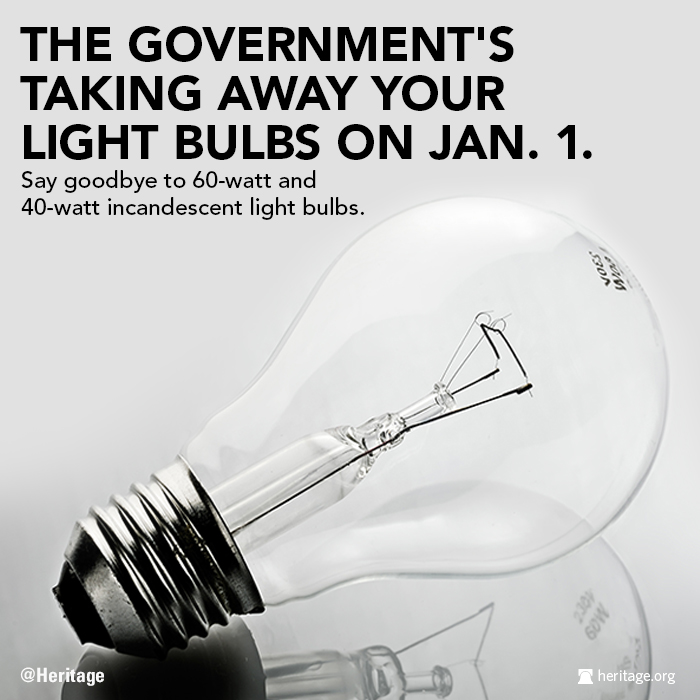
Beginning January 1, 2014, the federal government will ban the use of 60-watt and 40-watt incandescent light bulbs. The light bulb has become a symbol in the fight for consumer freedom and against unnecessary governmental interference into the lives of the American people.

In 2007, Congress passed and President George W. Bush signed into law an energy bill that placed stringent efficiency requirements on ordinary incandescent bulbs in an attempt to have them completely eliminated by 2014. The law phased out 100-watt and 75-watt incandescent bulbs last year.

Proponents of government-imposed efficiency standards and regulations will say, “So what? There are still plenty of lighting options on the shelves at Home Depot; we’re saving families money; and we’re reducing harmful climate change emissions.”

The “so what” is that the federal government is taking decisions out of the hands of families and businesses, destroying jobs, and restricting consumer choice in the market. We all have a wide variety of preferences regarding light bulbs. It is not the role of the federal government to override those preferences with what it believes is in our best interest.

Families understand how energy costs impact their lives and make decisions accordingly. Energy efficiency has improved dramatically over the past six decades — long before any national energy efficiency mandates.

If families and firms are not buying the most energy-efficient appliance or technology, it is not that they are acting irrationally; they simply have budget constraints or other preferences such as comfort, convenience, and product quality. A family may know that buying an energy-efficient product will save them money in the long term, but they have to prioritize their short-term expenses. Those families operating from paycheck to paycheck may want to opt for a cheaper light bulb and more food instead of a more expensive light bulb and less food.

Some may read this and think: Chill out—it’s just a light bulb. But it’s not just a light bulb. Take a look at the Department of Energy’s Federal Energy Management Program. Basically anything that uses electricity or water in your home or business is subject to an efficiency regulation.

When the market drives energy efficiency, it saves consumers money. The more the federal government takes away decisions that are better left to businesses and families, the worse off we’re going to be.

Why do you think they call him "kill"-o-watt

All our lives, we had fluorescent in school, at work and in many public places. No one said boo. All of a sudden, people are throwing up, have headaches....etc etc because of the mercury contaminated curly craps. So, we are saving money and we’re reducing harmful climate change emissions?  But the new bulbs are making us sick and contain mercury?  So what is wrong with that picture?

There are some alternatives:

A Manufacturer Found a Loophole Around That Incandescent Light Bulb Ban

Home Depot’s Cree 60W Equivalent Soft White (2700K) A19 Dimmable LED Light Bulb

Obamacare and Review of 2013 Should Remind Us We Are Not 'Subjects'; We Are People

By Laura Hollis, CP Op-Ed Contributor to the Christian Post writes:

The unveiling of the dictatorial debacle that is Obamacare absolutely flabbergasts me. It is stunning on so many levels, but the most shocking aspect of it for me is watching millions of free Americans stand idly by while this man, his minions in Congress and his cheerleaders in the press systematically dismantle our Constitution, steal our money, and crush our freedoms.

The President, Nancy Pelosi and Harry Reid (with no small help from Justice John Roberts) take away our health care, and we allow it. They take away our insurance, and we allow it. They take away our doctors, and we allow it.They charge us thousands of dollars more a year, and we allow it. They make legal products illegal, and we allow it. They cripple our businesses, and we allow it.They announce by fiat that we must ignore our most deeply held beliefs – and we allow it.

Where is your spine, America?

Yes, I know people are complaining. I read the news on the internet. I read blogs. I have a Twitter feed. So what? People in the Soviet Union complained. People in Cuba complain. People in China complain (quietly). Complaining isn't the same thing as doing anything about it. In fact, much of the complaining that we hear sounds like resignation: Wow. This sucks. Oh well, this is the way things are. Too bad.

Perhaps you need reminding of a few important facts. Here goes:

1. The President is not a king. Barack Obama does not behave like a President, an elected official, someone who realizes that he works for us. He behaves like a king, a dictator – someone who believes that his own pronouncements have the force of law, and who thinks he can dispense with the law's enforcement when he deigns to do so. And those of us who object? How dare we? Racists!

And while he moves steadily "forward" with his plans to "fundamentally transform" the greatest country in human history, he distracts people with cheap, meaningless trivialities, like "free birth control pills"! (In fact, let's face it: this administration's odd obsession with sex in general - Birth control! Abortion! Sterilization! Gay guys who play basketball! -- is just plain weird. Since when did the leader of the free world care so much about how people have sex, who they have it with, and what meds they use when they have it? Does he have nothing more important to concern himself with?)

2. It isn't just a failed software program; it is a failed philosophy. People are marveling that Healthcare.gov was such a spectacular failure. Well, if one is only interested in it as a product launch, I've explained some of the reasons for that here. But the larger point is that it isn't a software failure, or even a product failure; it is a philosophy failure.

I have said this before: Obama is not a centrist; he is a central planner. And this – all of it: the disastrous computer program, the hundreds of millions of dollars wasted, the lies, the manipulation of public opinion, the theft of the public's money and property, and freedom (read insurance, and premiums, and doctors) -- IS what central planning looks like.

The central premise of central planning is that a handful of wunderkinds with your best interests at heart (yeah, right) know better than you what's good for you. The failure of such a premise and the misery it causes have been clear from the dawn of humanity. Kings and congressmen, dictators and Dear Leaders, potentates, princes and presidents can all fall prey to the same imperial impulses: "we know what is good the 'the people.'

And they are always wrong.

There is a reason that the only times communism has really been tried have been after wars, revolutions, or coups d'état. You have to have complete chaos for people to be willing to accept the garbage that centralized planning produces. Take the Soviet Union, for example. After two wars, famine, and the collapse of the Romanov dynasty, why wouldn't people wait in line for hours to buy size 10 shoes? Or settle for the gray matter that passed for meat in the grocery stores?

But communism's watered-down cousin, socialism, isn't much better. Ask the Venezuelans who cannot get toilet paper. Toilet paper. ¡Viva la Revolución!

Contrary to what so many who believe in a "living Constitution" say, the Founding Fathers absolutely understood this. That is why the Constitution was set up to limit government power. (Memo to the President: the drafters of the Constitution deliberately didn't say "what government had to do on your behalf.") They understood that that was the path to folly, fear, and famine.)

3. Obama is deceitful. Just as the collapse of the computer program should not surprise anyone, neither should we be shocked that the President lied about his healthcare plan. Have any of you been paying attention over the past few years? Obama has made no secret of his motivations or his methods. The philosophies which inspire him espouse deceit and other vicious tactics. (Don't take my word for it: read Saul Alinsky.) Obama infamously told reporter Richard Wolffe, "You know, I actually believe my own bullshit." He has refused to be forthcoming about his past (where are his academic records?). His own pastor, Rev. Jeremiah Wright, told author Ed Klein, that Obama said to him, "You know what your problem is? You have to tell the truth."

Did Obama lie when he said dozens of times, "If you like you plan, you can keep it"? Of course he did. That's what he does.

4. The media is responsible. And had the media been doing their jobs, we would have known a lot of this much, much earlier.

The press is charged with the sacred responsibility of protecting the people from the excesses of government. Our press has been complicit, incompetent, or corrupt. Had they vetted this man in 2008, as they would have a Republican candidate, we would have known far more about him than we do, even now. Had they pressed for more details about Obamacare, Congress' feet would have been held to the fire. Had they done their jobs about Eric Holder, Fast and Furious, Benghazi, the IRS scandal, NSA spying - or any of the other myriad betrayals of the public trust that this administration has committed, Obama would likely have lost his 2012 reelection campaign. (A fact that even The Washington Post has tacitly acknowledged. Well done, fellas! Happy now?)

Instead, they turned a blind eye, even when they knew he was lying, abusing power, disregarding the limits of the Constitution. It was only when he began to spy on them, and when the lies were so blatant that the lowest of low-information voters could figure it out that they realized they had to report on it. (Even in the face of blatant, deliberate and repeated lies, The New York Times has the audacity to tell us that the President "misspoke.") They have betrayed us, abandoned us, and deceived us.

5. Ted Cruz was right. So was Sarah Palin. The computer program is a disaster. The insurance exchanges are a disaster. What's left? The healthcare system itself. And this, of necessity, will be a disaster, too.

Millions of people have lost their individual insurance plans. In 2015, millions more will lose their employer-provided coverage (a fact which the Obama administration also knew, and admitted elsewhere).

The exorbitant additional costs that Obamacare has foisted on unsuspecting Americans are all part of a plan of wealth confiscation and redistribution. That is bad enough. But it will not end there.

When the numbers of people into the system and the corresponding demand for care vastly exceed the cost projections (and they will, make no mistake), then the rationing will start. Not only choice at that point, but quality and care itself will go down the tubes. And then will come the decisions made by the Independent Payment Advisory Board about what care will be covered (read "paid for") and what will not.

That's just a death panel, put politely. In fact, progressives are already greasing the wheels for acceptance of that miserable reality as well. They're spreading the lie that it will be about the ability of the dying to refuse unwanted or unhelpful care. Don't fall for that one, either. It will be about the deaths that inevitably result from decisions made by people other than the patients, their families, and their physicians. (Perhaps it's helpful to think of their assurances this way: "If you like your end-of-life care, you can keep your end-of-life-care.")

6. We are not SUBJECTS. (or, Nice Try, the Tea Party Isn't Going Away). We have tolerated these incursions into our lives and livelihoods too long already. There is no end to the insatiable demand "progressives" have to remake us in their image. Today it is our insurance, our businesses, our doctors, our health care. Tomorrow some new crusade will be announced that enables them to take over other aspects of our formerly free lives.

I will say it again: WE ARE NOT SUBJECTS. Not only is the Tea Party right on the fiscal issues, but it appears that they are more relevant than ever. We fought a war once to prove we did not want to be the subjects of a king, and the Boston Tea Party was just a taste of the larger conflict to come. If some people missed that lesson in history class, we can give them a refresher.

The 2014 elections are a good place to start. Call your representative, your senator, your candidate and tell them: "We are not subjects. You work for us. And if the word "REPEAL" isn't front and center in your campaign, we won't vote for you. Period."

Marion Algier at Ask Marion Added:

Along with the ever worsening travesty and lies of ObamaCare, Americans are awakening to the nightmare of the Federal government’s ever-growing stranglehold that is destroying wealth-creation and promoting skyrocketing debt. The Fed’s central bank—no longer tied to a gold standard—channels low interest rates and trillions of dollars to Goldman Sachs et al., while the rest of America is jobless, under-employed, owing staggering college loans with more people than ever without healthcare is given a bag of broken glass.

Peggy Noonan recently summarized much of what is wrong this holiday season…. beginning with:  What's the political word of the year? For months journalists couldn't settle on how to describe the rollout of ObamaCare. "Failed," disastrous," "unsuccessful." In the past few weeks they've settled on "botched." References to the botched rollout have appeared in this paper, The Hill, NBC, Fox, NPR, the New Republic, the Washington Post and other media outlets. A botch, according to the Shorter Oxford English Dictionary, Sixth Edition, is a "bungled piece of work"—to botch is... Or, as JT McFarland recently mentioned on Redeye, is it really just going as they planned… creating total chaos and destroying what was the best healthcare system in the world so they can then install a single-payer socialized medicine system to pretty much cement their (Progressive) control of every every aspect of our lives?!?  I vote it is the latter.

The Christmas Classic, ‘Twas the Night Before Christmas’ was completely reworked for our current national predicament by our friend Rock Peters Western Journalism. It is guaranteed to make you laugh and cry.

Video:  Twas the Night Before Christmas - 2013 Version

Lies of the Year… ‘If you like your insurance, you can keep your insurance’ and ‘If your doctor, you can keep your doctor’ 

Whistle BLOWER- President Obama’s HALF sister comes FORTH!

Obamacare Should Remind Us We Are Not 'Subjects,' We Are People

Wednesday, December 25, 2013

Healed After 19 Years: A Christmas Eve Miracle

CBN.com/700Club: Easter weekend 1993, Ema McKinley lost her balance and fell from a storage loft at work. Her foot was lodged between boxes and her body hung upside down until a coworker found her and called 911. “My head hit something very hard and I did not come to until the next day.” remembers Ema.

As Ema healed from the wounds she received in the fall, she developed widespread reflex sympathetic dystrophy, known as RSD, a chronic and progressive nerve disorder that left her entire body in severe pain.  “I partnered up with God because this accident was bigger than I could handle and I knew that I needed to know Jesus more in my life now than ever before,” says Ema.

Eventually Ema was bound to a wheelchair. Cathy Ruggeberg has been her caregiver for the last 18years. “She could not walk at all she was in her wheel chair 24/7 with the exception of toileting and she’s been like that for many, many years.”

“Eventually that pain got so bad in that foot and in the left hand that the foot started to grow crooked.” says Ema.

Ema’s left hand closed into a fist she was unable to open. Her neck and spine twisted to the left leaving her body in an awkward and painful position.  Her son Jason, saw how hard life had become for his mother. “It was difficult to see her just doing daily things. You could see the pain in her face,” says Jason. “It’s hard to see somebody go through that, much less a family member.”

Through the years Ema maintained a positive attitude despite her painful situation. Cathy Ruggeberg remembers, “No matter how rough her life was physically she’s always had a bright smile on her face and always been so warm and encouraging and the other thing I’ve never seen waver is her faith.”

“I kept pressing forward each and every day, knowing that Jesus was going to give me that strength; that He was going to be there for me and He never let me down. He was there for me,” says Ema.

Blood clots formed in her legs, which posed life threatening issues. Doctors wanted to amputate both of  her legs, but Ema refused. “I never gave up. I kept praying and thanking God for my healing because I had that much faith in my Jesus to know that someday He was going to give me that healing.”

The night before Christmas Eve 2011, Ema fell out of her wheelchair. For eight hours she lay on the floor in excruciating pain, crying out to Jesus for help. Ema says that Jesus came into her room and reached out to touch her. 

“What I saw was the most awesome white robe,” says Ema. “I knew Who that was. Our human eyes can hardly look at it, it’s so bright white. I couldn’t see it, but I could feel that left foot going from this position to this position. Jesus was straightening out that crooked foot. I knew my neck was being straightened. My spine was being straightened. That left hand that had been a clinched fist for over 18 years – Jesus started to take those fingers and open them up. I could take that hand and I could flex it and use my fingers. Jesus was now kneeling on one knee right beside me and He extended His hand out to me, asking for mine.”

“And then we stood up together and even though the bones were sounding and cracking like crazy He still had a hold of my hands. Then I knew I had to start walking and use those feet and legs. And I did.”

Just a few hours later, Ema’s two sons and her grandchildren came over to celebrate Christmas Eve, unaware of the miracle their mother just experienced.
Jason remembers that day clearly. “I could see down the hallway a little bit, and here she comes walking and it’s like, ‘No way.’” “I hadn’t seen my mom out of a wheelchair since my wedding in 1993. At that moment everything I knew was different because she’s supposed to be in the chair but she’s walking.  It was a surreal moment seeing her walk. It’s like, it’s a miracle. There’s nothing else it could be.”

“We kind of got through hugging my two sons. I went over and grabbed those two grandsons, and I gave them a big hug for the first time in all those years,” says Ema.

That night Ema and her family were in awe of God’s love and power as they celebrated her Christmas miracle. Ema says the being able to stand and walk on her own has changed her life forever. Although she still has RSD symptoms, she and her family believe that God is in control.

Today with her son Jason, Ema joyfully shares her story of how Jesus heard her prayers and forever changed her life on Christmas Eve.

“This is such a story of hope. This miracle is not just for my mom; not just for our family, but it’s for everybody,” says Jason. “Whatever difficulties people may be facing, there’s always hope.”

“Jesus has never let me down,” says Ema. “He has always been there for me. In His Word it says He will never leave us or forsake us and I knew that and I trust His word. I’m no longer the crooked lady with the broken body in the wheelchair. I’m known as the lady with the Christmas miracle!”