Showing posts with label women. Show all posts

Friday, May 9, 2014

The Obama Administration’s Deserving Victims | National Review Online

The campus sexual-assault controversy is of liberal higher ed’s own making

National Review Online:

For decades, universities have nurtured the most lunatic forms of feminism, denying the biological differences between males and females, promoting the idea that Western civilization is endemically sexist, and encouraging in their students ever-more-delusional forms of victimhood. It is therefore deeply gratifying to see these same universities now impaled by the very ideology that they have so assiduously promoted.

The Obama administration has released the names of 55 colleges and universities that it is investigating over their sexual-assault policies, part of an accelerating campaign against universities for allegedly turning a blind eye to the purported epidemic of campus rape. The list is top-heavy with the elite of the elite — Harvard, Princeton, UC Berkeley, Swarthmore, Amherst, and Dartmouth, among others. A more deserving group of victims would be hard to find.

Parroting over 20 years worth of feminist propagandizing, the White House claims nearly 20 percent of female college undergraduates are sexually assaulted during their college years. To put that number in perspective: Detroit residents have been fleeing the city for years due to its infamous violent crime. And what constitutes an American urban crime wave? In 2012, Detroit’s combined rate for all four violent felonies that make up the FBI’s violent-crime index — murder, rape, robbery, and aggravated assault — was 2 percent. The rape rate was 0.05 percent. And yet, despite an alleged campus sexual-assault rate that is 400 times greater than Detroit’s, female applicants are beating down the doors of selective colleges in record numbers.

Harvard this year received over 34,000 applications, about half from females, for a freshman class of about 1,600; every other elite college was similarly swamped with female applicants. According to the White House Council on Women and Girls, “survivors” of the alleged campus sexual-assault epidemic “often” experience a lifetime of physical and mental infirmity that includes depression and post-traumatic stress syndrome. How could highly educated baby-boomer mothers, who have spent their maternal years fending off phantom risks to their children from pesticides and vaccines, suddenly send their daughters off to a crime scene of such magnitude, unmatched even in the most brutal African tribal wars? What happened to the Sisterhood? Shouldn’t it be warning its members and forming alternative structures for educating females? Instead, every year, millions of girls walk into this alleged maelstrom of violence like innocent lambs to slaughter. Even more puzzling, every year those same girls graduate from that cauldron of predation in ever more disproportionate numbers, and go on to lead highly lucrative careers.

It should not be necessary to tell a feminist that rape is the most violent crime — with the emphasis on crime – that a woman can experience, short of murder. The FBI’s Uniform Crime Reports list rape as the second most serious violent felony. If the campus feminists really believed that campuses are experiencing an epidemic of criminal sexual assault, they would demand that every campus sexual-assault allegation be brought in criminal court, where the assailant can be sentenced to years in prison if convicted. Instead, they favor secret proceedings before an increasingly byzantine set of campus tribunals made up of judicially clueless bureaucrats and professors whose most severe punishment is expulsion. Imagine if a stranger broke into a female’s dorm room at night and raped her at knifepoint. Would that case be taken to the campus Title IX gender-bias tribunal? Unlikely. If someone were merely robbing females of their iPads at gunpoint around the campus library, that case, too, though far less serious than rape, would most certainly be prosecuted criminally.

There are several reasons why no one is pushing to bring campus sexual-assault cases to court. It certainly helps that the procedures before college gender tribunals are egregiously stacked against defendants. The Obama administration recently recommended that campuses deny students facing sexual-assault charges the right to cross-examine their accuser, a trend already well underway on campuses across the country. It also wants campuses to use a flimsy preponderance-of-evidence standard for guilt, and to allow repeated proceedings against a student after an initial acquittal, as KC Johnson and Hans Bader have explained.

The campus sexual-assault tribunal also has a performative aspect: It dramatizes the patriarchy before a sympathetic audience of adults. “Our task is to give voice to the daily forms of violence we too often accept as inevitable,” a Harvard graduate student recently told the New York Times, describing her work protesting Harvard’s sexual-assault policies. The campus sexual revolution began with students’ demand to be free of any intrusive parietal oversight from college officials; now, in a bizarre turnaround, the children of that revolution want colleges to actually write rules for sex and police their enforcement. The colleges are only too happy to comply. In 2013, Yale came up with an embarrassingly graphic set of hypothetical sexual scenarios between gender-unidentifiable students, in an effort to delineate what constitutes permissible sex. One would have hoped that a world-class academic institution would have better things to do. Meanwhile, here is a message to girls: This is sex that we’re talking about, the very realm of the irrational and the uncontrolled. See Ovid’s Metamorphoses, Boccaccio’s Decameron, and Euripides’ The Bacchae (if those texts are still available at your school). Norms of chivalry, courtship, and modesty once tried to channel this primal drive; with those conventions now demolished as sexist, females (and males) are on their own — and often at sea. A highly legalistic definition of consent — the current desideratum of campus sex bureaucrats — is hardly a sufficient substitute for traditional social checks on the sexual instinct and will never be able to regulate the inexpressible and often conflicting emotions around intercourse.

But the main reason “survivors” don’t demand to bring their cases to criminal court is that they know that what they have experienced is something far more complex and compromised than criminal sexual assault, almost invariably involving mixed signals, ambiguity, and a large degree of voluntary behavior on their part.

Girls often drink themselves blotto both before and during parties precisely to lower their sexual inhibitions. The authors of campus-rape surveys discovered early on that when the students whom the pollsters deem rape victims are asked if they think they have been raped, the “victims” overwhelmingly respond in the negative. In the 1986 Ms. survey that sparked the campus-rape industry, 73 percent of respondents whom the study characterized as rape victims said that they hadn’t been raped when asked the question directly. Forty-two percent of these supposed victims had intercourse again with their alleged assailants.

The alleged campus-rape epidemic could be stopped overnight if women’s advocates sent a simple message to girls: Don’t get drunk and get into bed with a guy whom you barely know. Keep your clothes on and go home to your own bed at night. And most controversially: Demand that any boy court you long enough to reveal his character and his respect for yours before you even think about having sex with him. The feminist advocates are more interested in preserving the principle of male fault, however, than in protecting females from regretted sex. And so rather than sending an unequivocal message of personal empowerment and responsibility, they put the entire onus of sexual responsibility on males, treating females as the invariably helpless victims of the male libido.

The colleges under investigation by the Department of Education may have sustained a public-relations black eye, but sadly, they will suffer not the slightest drop in their endowments or enrollments. They will even continue to coddle their students’ melodramatic oppression fantasies. The Title IX investigations, triggered by student complaints, are premised on the preposterous conceit that colleges are creating so hostile an environment for females that those females are actually prevented from learning. Here’s how the colleges should respond:

“Are you kidding me? Get a grip. This is the most welcoming, safe, lavishly endowed community ever created in human history, where students with the desire to absorb wisdom can do so in leisure, surrounded by supportive faculty and well-meaning administrators. There are millions of girls in Asia who are studying ten hours a day to gain the privilege of learning on an American campus; if they were to come to this ‘hostile’ environment, they would seize every educational opportunity available to them.”

Instead, however, the colleges’ student-services deans and rape counselors, who live precisely for these moments of conflict, will grovel before their accusers and promise to make amends. The New York Times has been hawking an article from Columbia’s student newspaper that purported to expose the college’s inadequate response to sexual assault. The original article triggered campus protests against the administration and penitence from the grown-ups. What it mostly showed, however, was the hold of the gender-studies mentality on far too many students. The student journalists were outraged that the school’s sexual-assault policies refer to “rape” “euphemistically” as “non-consensual sexual intercourse,” and to alleged “rapists” as “respondents.” One “survivor” — “Natalie” (a pseudonym) — complains that a Title IX investigator used abbreviations in taking down her story, resulting in “holes” that made her account not “sound like a strong case” (it probably wasn’t) and keeping her “from having ownership over the retelling of her history with emotional and sexual violence.” Natalie had been in a “fragile state” from a previous “emotionally abusive relationship,” and promptly entered into another “‘destructive and unhealthy’ physical relationship” with another male that was “confusing at best.” That male, the article explained, “often forcefully pinned [Natalie’s] arms back against the mattress during sex; [she] would cry during and after they slept together. Not until months after their break up did Natalie recognize this as non-consensual intercourse.” If Natalie was unhappy with their sexual relationship, she would have been wise to have put an end to it. The Columbia student article provided no evidence of flawed assault policies, beyond the mere fact that the school did not issue guilty findings in Natalie’s case (which she did not fully cooperate with) and one other. The article did, however, reveal the chaotic state of campus couplings in the absence of any normative restraints on casual intercourse, a situation that will claim only female emotional victims.

While the legal risks regarding regretted sex are increasingly stacked against male students, it is hard to shed a tear for them, either. They may not be guilty of rape, but they are almost certainly guilty of taking full advantage of the sexual caravansary on campus, and of acting as brutishly as females will allow them to. Males are the main beneficiaries of no-commitment sex, for males and females are not equals on the sexual battlefield. While there may be few actual rape victims on college campuses, there are undoubtedly thousands of girls feeling confused, betrayed, and exploited by callous partners who are blind to their ambivalence and who leave their bed with no emotional pang whatsoever. If male students respond to the one-sided distribution of risk and responsibility by becoming sexual prudes, society will have suffered no loss whatsoever. But don’t count on the male libido to do anything so sane.

Heather Mac Donald is a Thomas Smith Fellow at the Manhattan Institute and the author of The Burden of Bad Ideas: How Modern Intellectuals Misshape Our Society.

Monday, August 27, 2012

Studies Confirm Women Face Depression After Abortion, Other Problems

by Steven Ertelt -LifeNews.com Editor - September 28, 2010

Washington, DC (LifeNews.com) – A new study with a very limited sample of women having abortions, just 69, has received considerable attention for supposedly disproving the plethora of peer-reviewed studies confirming women who have abortions face both depression and other mental health problems.

Other recent studies from the last two years provide nearly irrefutable evidence that abortion affects women in a myriad of ways — making it so they face everything from depression and relationship problems to PTSD and elevated risks for abusing drugs or alcohol.

An August study published in the Journal of Pregnancy and involving 374 women who had abortions — more than five times the number of women who appeared in the new study — found women having high rates of post-traumatic stress disorder (PTSD) symptoms for women having both early and late abortions.

Approximately 52 percent of the early abortion group and 67 percent of the late term abortion group met the American Psychological Association’s criteria for post-traumatic stress disorder symptoms (PTSD).

The authors of the study say those high rates are the result of women facing pressure or coercion to have an abortion or, at minimum, ambivalence about having it — showing more pre-abortion screening is needed to rule out abortion as an option for many women.

A May 2010 study put out by researchers at the University of Manitoba in Canada found women who have had abortions are about four times more likely to abuse drugs and alcohol as those who carried their pregnancy to term. The authors confirmed a link between abortion and the substance abuse issues.

The study appeared in the April issue of the Canadian Journal of Psychiatry and it showed women having abortions were 3.8 times more likely to have substance abuse disorders.

That was the case even when other factors such as exposure to violence were included that could have raised the risk outside of abortion.

The Canadian study also found abortion associated with other mental health conditions such as mood disorders, but substance abuse proved to be the strongest link when it comes to post-abortion problems for women.

Meanwhile, three studies alone published in peer-reviewed medical journals at the end of 2008 show abortion causes problems for women.

Dr. Priscilla Coleman, a professor of Human Development and Family Studies at Bowling Green State University, and her colleagues published a study in the Journal of Psychiatric Research showing an abortion-depression link exists.

The research team found induced abortions result in increased risks for a myriad of mental health problems ranging from anxiety to depression to substance abuse disorders.

The number of cases of mental health issues rose by as much as 17 percent in women having abortions compared to those who didn’t have one and the risks of each particular mental health problem rose as much as 145% for post-abortive women.

For 12 out of 15 of the mental health outcomes examined, a decision to have an abortion resulted in an elevated risk for women.

"What is most notable in this study is that abortion contributed significant independent effects to numerous mental health problems above and beyond a variety of other traumatizing and stressful life experiences," they concluded.

Researchers at Otago University in New Zealand reported their findings in the British Journal of Psychiatry and found that women who have abortions have an increased risk of developing mental health problems.

The study found that women who had abortions had rates of mental health problems about 30% higher than other women. The conditions most associated with abortion included anxiety disorders and substance abuse disorders.

Abortions increased the risk of severe depression and anxiety by one-third and as many as 5.5 percent of all mental health disorders seen in New Zealand result from women having abortions.

A third study, from a team at the University of Queensland and published in the December issue of the British Journal of Psychiatry, found women who have an abortion are three times more likely to experience a drug or alcohol problems during their lifetime.

The study showed that women who had experienced an abortion were at increased risk of illicit drug and alcohol use compared with women who had never been pregnant or who gave birth.

In 2009, a review of studies examining various types of prenatal loss and the effects on subsequent parenting has concluded that abortion may be "particularly damaging to the parenting process."

Thursday, July 26, 2012

Court orders Planned Parenthood to start telling the truth

Abortionists ordered to warn of serious suicide risk

120724abortiongriefz-340x170[1]

WND: A federal appeals court affirmed the last provision of a long-disputed informed consent law today, ruling that the state of South Dakota can require abortionists to inform women seeking to terminate the lives of their unborn baby that they face an increased risk of suicide.

Attorney Harold J. Cassidy called the decision of the full 8th Circuit Court of Appeals “a fabulous victory for the women of the state of South Dakota.”

Cassidy represents Leslee Unruh, president of the Alpha Center of Sioux Falls, and Stacy Wollman, president of Care Net of Rapid City. They were allowed in intervene in the case filed by Planned Parenthood against the state’s new law.

“This victory represents the fourth separate decision of the 8th Circuit reversing the district court in this one case, two decisions issued by en banc (full) courts four years apart – a rare occurrence that underscores the importance of the issues presented by the case,” said Cassidy.

“As a result of this case upholding all eight major provisions of South Dakota’s Abortion Informed Consent Statute, pregnant mothers will now be informed: 1) that ‘an abortion terminates the life of a whole, separate, unique, living human being;’ 2) that the mother’s ‘relationship with that second human being enjoys protection under the Constitution of the United States and the laws of South Dakota;’ 3) ‘that relationship and all rights attached to it will be terminated;’ and 4) the abortion places the mother ‘at increased risk for suicide ideation and suicide,’” he said.

The court’s opinion said even Planned Parenthood’s own testimony documented a link between abortion and suicide.

“Planned Parenthood’s own expert, Dr. Nada Stotland, admitted that one of the studies, which determined a suicide rate after abortion of 31.9 per 100,000 as compared to a suicide rate after live birth of 5.0 per 100,000, ‘indicates an association; not causation, but an association’ between abortion and suicide,” the judges wrote.

Commenting on the decision, Steven H. Aden of the Alliance Defending Freedom said “a woman’s right to make a fully informed choice is more important than Planned Parenthood’s bottom line.”

“If Planned Parenthood truly cared about the well-being of women, it would not try to prevent them from being informed of the well-documented risk of suicide that accompanies abortion,” he said. “The 8th Circuit has done the right thing in upholding a reasonable law that protects the well-being of women by making sure that the truth is not hidden from them.”

The Sioux Falls Alpha Center’s Unruh said the ruling “gives hope to the hopeless.”

“These are women who had abortions who were coerced, persecuted, broken. These women did a very courageous thing in going to the South Dakota legislature and telling their stories,” she said. “These judges have believed them, listened to their hearts and have ruled on their behalf.”

The lawsuit was brought by Planned Parenthood against the state after the legislature in 2005 adopted the new informed consent requirements for abortionists.

Cassidy noted that normally a statement of the importance of the decision would suffice.

“However, we feel that, in this instance, given the fact that South Dakota’s Informed Consent Statute, passed to protect the interests of pregnant mothers in South Dakota, was the subject of false claims and protracted litigation that took seven years to conclude, and required the intervenors to win four different appeals in the Eighth Circuit, requires further comment,” he said.

“Throughout the legislative processes, over the past eight years, and all during the pending of this litigation, as well as that of the new case now pending in the District Court (in which Alpha Center and Care Net are party intervenors), Planned Parenthood has threatened expensive litigation and counsel fees. Planned Parenthood has argued that they should be free to perform their radical abortion practices the way its New York City office prefers and that the people of the state of South Dakota should not impose regulations that reflect the values of the people of the state; and the people should not protect the interests of their pregnant mothers.

“Planned Parenthood has been proven completely wrong on every issue in the case. The state statute is a constitutionally valid method to protect pregnant mothers,” he said.

“The people of the State of South Dakota have stood up to the threats, false accusations and litigation tactics of Planned Parenthood. In the process, the people of South Dakota have shown that they will not be intimidated by threats of litigation, threats of payment of attorneys’ fees, and will hold fast to their conviction that a handful of people in New York, with a radical philosophy, will not dictate to the people of South Dakota, when, if, and how they will protect their women from harm, pressure, coercion and false and incomplete information when making the most important decision of their lives,” he said.

Another new law adopted in South Dakota is subject to a second challenge by Planned Parenthood. The law requires that a physician have a personal interview with a woman seeking an abortion. The woman must be offered counseling by state-approved counseling centers before the abortionist can schedule the procedure.

In South Dakota, Planned Parenthood flies abortionists in to a facility where they perform abortions. The law requires doubling the visits, because an abortionist could not interview a woman and perform an abortion on her during the same trip.

The law also requires that an abortionist determine whether the woman is being coerced into the abortion and imposes a waiting period.

Several of the requirements no longer are being challenged by Planned Parenthood, and they are going into effect in the state. Remaining under challenge is the counseling requirement along with the three-day waiting period.

The state recently announced: “Pursuant to the 2011 and 2012 legislation and the order, beginning July 1, 2012, doctors who perform abortions must assess each woman for pre-existing risk factors such as coercion and must advise the woman about the risk of adverse psychological outcomes.”

During the 2012 legislative session, South Dakotans amended several portions of the 2011 abortion law, and Planned Parenthood followed up with an amended complaint. Planned Parenthood dropped its challenge to the provisions regarding coercion and a risk-factor assessment but continued challenging requirements regarding the referrals to the pregnancy help centers and the three-day delay.

As a result, the two sides agreed to an order that the coercion and risk-factor assessment provisions could go into effect right away.

“The remaining challenged provisions – the requirement for involvement of the pregnancy help centers and the three-day delay – will continue to be enjoined pending the outcome of discovery, briefing and argument before the district court,” the state’s announcement said.

According to a statement by the Alpha Center of Sioux Falls and the Black Hills Pregnancy Center of Rapid City, two abortion alternative centers to which women may be referred, the decision from Judge Karen Schreier opens the door to substantial new requirements for abortions.

“Planned Parenthood can no longer have a clerk schedule abortion surgery – which has been its practice – without a physician first seeing a pregnant mother, compelling a change in the practices at the Planned Parenthood abortion facility,” the statement said.

“Only a physician can schedule an abortion, and only after the physician first performs an assessment, which includes an assessment to determine if the pregnant mother is being pressured or coerced into having an abortion. Until now, no such assessments were performed, and no physician saw the pregnant mother until after the surgery was scheduled and only after she was required to sign a consent for the abortion and only after she was required to pay for the abortion,” the statement continued.

In today’s decision over the 2005 law, the appeals court ruling said: “To succeed … Planned Parenthood must show that the [suicide-abortion link] disclosure at issue ‘is either untruthful, misleading or not relevant to the patient’s decision to have an abortion.’”

“The legislature expressly required the disclosure of an ‘increased risk,’ not a causal link. Based on the accepted usage of the term ‘increased risk’ … the usage of that term … does not imply a disclosure of a causal relationship,” the court said.

Instead, the section “requires a disclosure simply that the risk of suicide and suicide ideation is higher among women who abort.”

The judges also said, “We hold that the disclosure facially mandated by the suicide advisory is truthful.”

“The state legislature, rather than a federal court, is in the best position to weigh the divergent results and come to a conclusion about the best way to protect its populace. So long as the means chosen by the state does not impose an unconstitutional burden on women seeking abortions or their physicians, we have no basis to interfere,” the court said.

Understand Planned Parenthood’s agenda. Get “The Marketing of Evil: How Radicals, Elitists, and Pseudo-Experts Sell Us Corruption Disguised As Freedom

Sunday, July 15, 2012

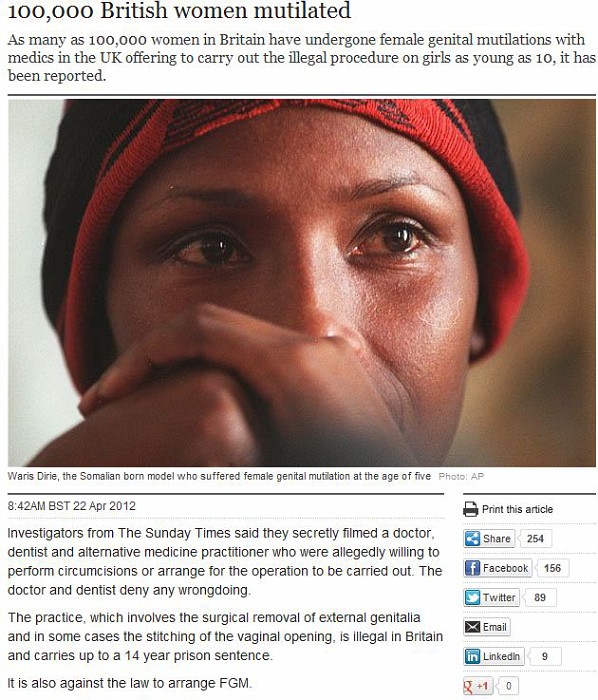
Medical experts agree, Egypt is the world leader in Female Genital Mutilation:

Even after Hosni Mubarak banned the barbaric practice of FGM four years ago, upwards of 90% of girls are still being mutilated in Egypt. And now that the Islamic fundamentalists of the Muslim Brotherhood are in power, we can expect that number to increase.

(barenakedislam - 14 Comments ») Mothers say FGM is necessary so girls don’t touch themselves “down there.” Or even worse so cousins (future husbands) won’t touch them “down there.” The cruel practice involves cutting off the clitorises and mutilating of the labia of young girls. It is carried out with the specific purpose of making sex painful for the girls. It is claimed that this will ensure the ‘purity’ of a girl before and throughout marriage.

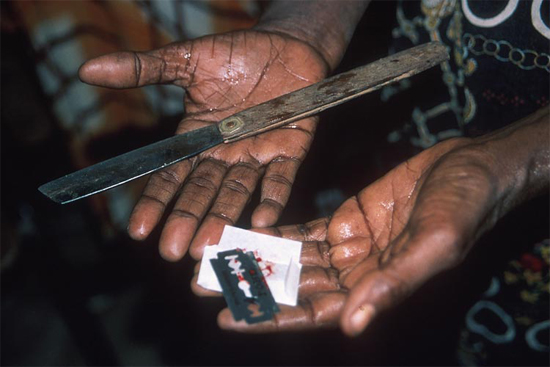
TYPICAL FGM INSTRUMENTS, UNSTERILIZED, UNSANITARY

The women who perform FGM do it for money, are often not medically trained, and don’t even sterilize their instruments. The lack of hygiene frequently leads to infection, sepsis and even death for the girls.

RELATED STORIES/VIDEOS:

islam-sanctions-female-genital-mutilation-of-young-girls-because-it-is-part-of-human-nature

egypt-hosni-mubarak-banned-female-genital-mutilation-but-now-the-muslim-brotherhood-is-trying-to-make-it-mandatory

france-devout-muslims-jailed-for-genital-mutilation-of-their-four-daughters

mayo-clinic-fires-female-genital-mutilation-supporting-muslim-pediatrician

british-muslim-leader-caught-on-camera-advocating-for-female-genital-mutilation

britain-cant-figure-out-how-eliminate-the-barbaric-practice-of-female-genital-mutilation

horrifying-muslim-girls-forced-to-undergo-female-genital-mutilation-with-no-anesthetic

listen-to-the-horrors-of-female-genital-mutilation-as-performed-on-young-british-muslim-girls

complete-guide-to-female-genital-mutilation-yes-its-a-muslim-thing

muslim-indonesia-issue-new-guidelines-for-genitally-mutilating-little-girls

clit-cutters-rejoice-iraqi-kurdish-imam-says-female-genital-mutilation-is-a-recommended-practice-of-islam

egypt-13-year-old-girl-dies-from-female-genital-mutilation-fgm

female-genital-mutilation-illegal-in-many-countries-it-is-more-popular-than-ever-in-the-muslim-world

And it isn’t just in Egypt

Tuesday, August 18, 2009

Who are Smarter -- Men or Women?

People like to think that men’s brains and women’s brains are fundamentally the same. But research indicates that men and women do in fact have different structures and wiring in the brain, and men and women may also use their brains differently.

Men do score better at tasks that involve orienting objects in space, while women do better at language tests.

Scientists have known for a while now that men and women have slightly different brains, but for many years they thought the changes were limited to the hypothalamus -- the part of your brain that controls sex drive and food intake.

In 2001, researchers found that certain parts of the brain were differently sized in males and females. The study found that parts of the frontal lobe, responsible for problem-solving and decision-making, and the limbic cortex, responsible for regulating emotions, were larger in women. In men, the parietal cortex, which is involved in space perception, and the amygdala, which regulates sexual and social behavior, were larger.

Men also have approximately 6.5 times more gray matter in the brain than women, and women have about 10 times more white matter than men do. This difference may account for differences in how men and women think -- gray matter is full of active neurons, while white matter consists more of connections between the neurons.

A woman's brain is a bit more complicated in setup, but those connections may allow a woman's brain to work faster than a man's.

However, average IQ scores are the same for both men and women.

Why Men Don't Live as Long as Women

Some believe that men are more likely than women to engage in risky behavior. While these photos are by no means proof, they certainly bear out the idea.

Why Men Don't Live as Long as Women

Some believe that men are more likely than women to engage in risky behavior. While these photos are by no means proof, they certainly bear out the idea.

Men

Men
Men
Men
Men
Men

Posted: True Health Is True Wealth

Saturday, March 21, 2009

Avoiding Diabetes Helps with Incontinence

Overweight women who suffer from pre-diabetes can lower their risk of developing urinary incontinence by preventing the onset of full-blown type 2 diabetes. That's the primary finding of a study published by the Diabetes Prevention Program Research Group based at Maryland's George Washington University School of Medicine. George Washington researchers pointed to past studies showing that type 2 diabetes can increase the risk of urinary incontinence among women. According to this study, efforts to control pre-diabetes through weight management and dietary modification can significantly reduce pre-diabetic women's incontinence risk. Women in the study who avoided the onset of full-blown diabetes were up to 30% less likely to develop incontinence than women who did not successfully manage their condition

Source:  LifeScript