Showing posts with label thimerosal. Show all posts

Monday, January 13, 2014

If You MUST Vaccinate, Aim for This Body Part

Story at-a-glance

  • Thousands of cats – from 1 to 10 out of every 10,000 vaccinated – develop vaccine-associated sarcomas each year. This malignant form of cancer is linked primarily to rabies and feline leukemia virus (FeLV) vaccines.
  • Because of the risk of sarcomas at injection sites, it is customary for veterinarians to give feline rabies vaccines in the right rear leg and FeLV vaccines in the left rear leg. The injection sites are below the knee joint so that amputation of the lower part of the leg can provide a treatment option in the event a tumor develops. The majority of cat owners, however, when faced with a VAS on their pet’s lower leg, refuse to amputate to avoid pain, disfigurement, and the costs associated with the procedure.
  • A recent pilot study at the University of Florida suggests that tail vaccinations are a good alternative to rear leg vaccinations in cats. Study results indicate there are no significant differences in the behavior of the cats that receive vaccinations below the knee and in the tail. All but one cat that received the tail vaccines developed protective antibody titers. The researchers concluded that tail vaccination was well tolerated by the cats in the study and was as effective as vaccines injected in the lower rear legs.
  • The researchers believe tail vaccinations could make surgical treatment of vaccine-associated sarcomas easier and less disfiguring, which could in turn encourage more owners to have their cats treated for cancer.
  • Rather than evaluating which body part is best for feline vaccinations, Dr. Becker recommends first focusing on the necessity for the vaccine at all. She offers guidelines to help you make sound vaccination decisions for your cat.
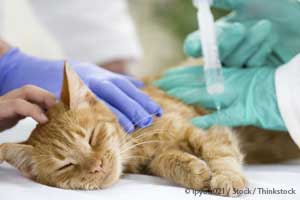
Cat Vaccination

By Dr. Becker – Cross-Posted at Just One More Pet

It is estimated that from one to 10 cats out of every 10,000 vaccinated will develop cancer at the vaccine injection site, also known as vaccine-associated sarcoma (VAS). A sarcoma is a type of cancer resulting from changes in connective tissue cells. Feline vaccine-associated sarcoma is a malignant tumor that is primarily associated with two vaccines: the rabies vaccine, and the feline leukemia virus (FeLV) vaccine.

For several years, it has been customary for feline rabies vaccines to be given in the right rear leg and FeLV vaccines in the left rear leg. The injections are made below the knee joint so that amputation of the lower portion of the leg can be offered to cat owners as a cancer treatment option. However, many owners of cats with VAS refuse amputation of their kitty’s leg because it’s painful, disfiguring and costly.

Pilot Study Suggests Tail Vaccinations Are Effective and Well-Tolerated

A research team from the University of Florida, Operation Catnip in Florida, Cornell University’s College of Veterinary Medicine, and Kansas State University’s Rabies Laboratory set out to evaluate alternatives to customary vaccine injection sites in the lower legs of cats. The results of their pilot study were published recently in the Journal of Feline Medicine and Surgery.1

The researchers surveyed oncology practitioners to learn their preference for vaccination sites based on ease of tumor removal. The preferred sites by 94 oncology practitioners were below the knee (41 percent), and the tip of the tail (30 percent).

Study results also indicated there were no significant differences in the behavior of the cats that received vaccinations below the knee and in the tail. All but one cat that received the tail vaccines developed protective antibody titers. The researchers concluded that tail vaccination was well tolerated by the cats in the study and was as effective as vaccines injected in the lower rear legs.

The researchers believe tail vaccinations could make surgical treatment of vaccine-associated sarcomas easier and less disfiguring, which could in turn encourage more owners to have their cats treated for cancer.

My Guidelines for Vaccinating Cats

As a holistic veterinarian, I’m much less interested in which body parts are best for vaccine injections than I am in determining which vaccines an animal truly needs based on established immunity, age, lifestyle, and other factors. This is especially true of cats, in light of the potential for vaccine-associated sarcomas.

If possible, I recommend you find a holistic or integrative vet to care for your cat. Non-traditional veterinarians are generally very cautious vaccinators. If your cat is strictly an indoor housecat with no exposure to other cats or the outdoors, the risks of annual vaccines far outweigh the benefits, in my opinion.

Ask for a vaccine titer test, which will measure your cat’s immunological protection against diseases for which he has already been vaccinated via his kitten shots. You can’t add protection to an already immunized pet, so don’t keep vaccinating.

If your pet truly needs a booster of a certain vaccine or a vaccine she’s never received, make sure that 1) the vaccine is for a serious disease (this eliminates many on the list immediately), 2) your cat may be in a position to be exposed to the disease (indoor cats have little to no exposure to most diseases), and 3) the vaccine is considered both safe and effective.

If your cat is an indoor/outdoor cat (in a high risk category for disease exposure) and must receive a booster vaccine, ask your vet to provide a homeopathic detox remedy called Thuja, which will help neutralize the effects of any vaccine other than the rabies vaccine. Rabies vaccines are required by law. There are two varieties of the same vaccine – the one-year type and the three-year type. Insist on the thimerosal-free, three-year rabies vaccine, and ask your vet about the homeopathic rabies vaccine detoxifier called Lyssin. If your pet is a kitten, ask to have the rabies vaccine given after four months of age, preferably closer to six months, to reduce the potential for a reaction.

If your cat lives entirely indoors, I recommend she not be vaccinated again after a full set of kitten shots in her first year of life. Her indoor-only lifestyle eliminates her risk of exposure to infectious diseases. Keep your unvaccinated indoor cat away from all other cats and your pet’s risk is virtually nonexistent.

Do not vaccinate your cat if he has had a serious vaccine reaction in the past.

Avoid veterinary practices that promote annual or more frequent re-vaccinations. Try not to patronize any boarding facility, groomer, or other animal care service that requires you to vaccinate your cat more than necessary.  

Dog and Cat Vaccines are Not Harmless Preventive Medicine  

The Pets Most Likely to Suffer from Vaccine Adverse Reactions 

Don’t Be Duped By the True Intent of This Media Blitz

Wednesday, April 4, 2012

78 percent increase in autism rates over past decade coincides with new vaccination schedules

Back in 1983, for example, the CDC recommended only ten vaccines for children from birth through six years old (http://www.cdc.gov/vaccines/pubs/images/schedule1983s.jpg). Today, that number has risen significantly to 29 vaccines and counting, many of which are now administered all at one time or in combinations like the measles, mumps, and rubella (MMR) vaccine (http://www.cdc.gov).

78 percent increase in autism rates over past decade coincides with new vaccination schedules

Jonathan Benson  -  Infowars.com  -  April 3, 2012 – h/t to MJ

The rate of autism among American children has nearly doubled over the past decade, according to a new report released by the U.S. Centers for Disease Control and Prevention (CDC), jumping from about one in 150 children back in 2000 to about one in 88 children in 2008, which is the last time official estimates were calculated. And interestingly, this steady rise in autism rates coincides directly with CDC-endorsed vaccination schedules that have also risen sharply since the 1980s.

Back in 1983, for example, the CDC recommended only ten vaccines for children from birth through six years old (http://www.cdc.gov/vaccines/pubs/images/schedule1983s.jpg). Today, that number has risen significantly to 29 vaccines and counting, many of which are now administered all at one time or in combinations like the measles, mumps, and rubella (MMR) vaccine (http://www.cdc.gov).

And yet the mainstream medical system and its allies in the government and media are willfully ignoring this glaring fact, blaming “unknown” causes and “genetics” for causing autism, which are the two most common catch-all scapegoats. And in explaining the drastic rise in autism rates over the years, the talking heads actually claim that there is no rise — the seemingly elevated autism rates are merely the result of improved autism screening methods that are now identifying more cases.


Vaccines, fluoride, MSG, GMOs, toxic chemicals, processed foods – the real causes of autism

Sadly, these laughably unscientific excuses for this epidemic condition are actually being taken seriously by many people, while the true causes of autism — vaccines, fluoridated water, monosodium glutamate (MSG), genetically-modified organisms (GMOs), toxic chemicals, and processed foods — continue to remain taboo subjects when talking about autism.

But any rational human being that takes the time to objectively investigate the science behind how autism spectrum disorders are, at the very least, spurred on by these and other toxins, will quickly realize that the ugly truth about autism is being concealed from the public. And while these factors may not cause autism symptoms in every single person that is exposed to them, they surely trigger it in many, especially when exposures are combined and persistent.

Vaccines, for instance, which the medical establishment have presumptuously declared to play absolutely no role in autism, continue to show up in independent, non-pharma-sponsored research as a cause of autism. Whether they contain thimerosal (mercury) or not, vaccines are definitively linked to neurological disorders that were largely non-existent prior to mass-vaccination campaigns.

Even the kangaroo “vaccine court” has quietly admitted this, having settled with several families whose children were injured by vaccines. Back in 2009, for instance, a vaccine court ruled that Bailey Banks, a young boy who suffered acute brain damage after getting the MMR vaccine, had indeed been injured by the vaccine. Special Master Richard Abell wrote at the time that “the MMR vaccine at issue actually caused the conditions from which Bailey suffered and continues to suffer” (http://www.ageofautism.com).

The case was one of several that has received little or no media attention, and yet it speaks volumes about the dangers associated with vaccines. It also exposes the lies of the deniers who have declared that vaccines are in no way related to autism — case closed.

And besides vaccines, fluoridated water, MSG (http://www.msgtruth.org/autism.htm), GMOs (http://www.ageofautism.com), toxic chemicals both in the environment and in the food supply, and processed foods in general have all been linked to autism spectrum disorders as well (http://www.tacanow.org/family-resources/living-in-a-toxic-world/).

Sources for this article include:

http://www.cnn.com/2012/03/29/health/autism/?hpt=hp_t1

This article was orinally published at Natural News.

Related:

Drug Companies Shift Emphasis to Vaccines

83 percent of brain injury vaccine compensation payouts were for autism caused by vaccines

More Doctors 'Fire' Vaccine Refusers

Popping the Vaccine Bubble

Sunday, April 1, 2012

FDA admits in court case that vaccines still contain mercury

(NaturalNews) It is a common myth today that the vaccines administered to children no longer contain the toxic additive thimerosal, a mercury-based preservative linked to causing permanent neurological damage. But a recent federal case involving the U.S. Food and Drug Administration (FDA) has revealed that, contrary to this widely-held belief, thimerosal is actually still present in many batch vaccines, including in the annual influenza vaccine that is now administered to children as young as six months old.
Filed by a citizen-backed coalition advocating vaccine safety, the lawsuit against the FDA alleged that the agency's continued endorsement and approval of thimerosal as a vaccine additive is a serious public health threat, especially since safer alternatives already exist and are widely used voluntarily by many vaccine manufacturers. But Judge Brett Kavanaugh, siding with antiquated pseudoscience, decided that thimerosal is not a health threat, and that those who wish to avoid it can simply choose thimerosal-free alternatives.

Ignoring the evidence of thimerosal's dangers brought before him on behalf of the millions of children across the country who continue to be injected with this mercury-based additive, Judge Kavanaugh declared that the plaintiffs, which include groups like the Coalition for Mercury-Free Drugs (CMFD), did not have proper standing to file the lawsuit. And in the process, both he and the FDA inadvertently admitted that thimerosal is still present in many childhood vaccines, which counters popular claims to the contrary.

FDA admits on its website that thimerosal is still in vaccines

The fact that Judge Kavanaugh refused to hear the case is tragic in and of itself, as thimerosal, which is composed of 50 percent mercury, has been proven to cause serious health damage. But what may be even worse is the fact that many people falsely believe that thimerosal is not even included in vaccines anymore, which is leading them to blindly allow them to be administered to their children. And the U.S. Centers for Disease Control and Prevention (CDC) and the FDA have continued to provide dubious and misleading information on the subject, which the mainstream media has been complicit in spreading over the years.

But the FDA explains, in no uncertain terms, directly on its website that thimerosal is still added to certain vaccines. For this reason alone, it is crucial that parents who choose to vaccinate their children ask for an ingredients list for each and every vaccine before allowing them to be administered to their children.

"While the use of mercury-containing preservatives has declined in recent years with the development of new products formulated with alternative or no preservatives, thimerosal has been used in some immune globulin preparations, anti-venins, skin test antigens, and ophthalmic and nasal products, in addition to certain vaccines," writes the FDA on its Thimerosal in Vaccines page (http://www.fda.gov).

h/t to AJ

Related

Media Blackout On Bill AB 2109 Threatening Vaccine Rights:

For The Record: Rockefeller Soft Kill Depopulation Plans Exposed – Many related links in this article

Vaccination Rights Attorney Patricia Finn Threatened with Criminal Charges; New York State Demands She Surrender Names of All Clients

Popping the Vaccine Bubble - Many related links in this article

More Doctors ‘Fire’ Vaccine Refusers

The Drug Story