Showing posts with label pet vaccines. Show all posts

Monday, January 13, 2014

If You MUST Vaccinate, Aim for This Body Part

Story at-a-glance

  • Thousands of cats – from 1 to 10 out of every 10,000 vaccinated – develop vaccine-associated sarcomas each year. This malignant form of cancer is linked primarily to rabies and feline leukemia virus (FeLV) vaccines.
  • Because of the risk of sarcomas at injection sites, it is customary for veterinarians to give feline rabies vaccines in the right rear leg and FeLV vaccines in the left rear leg. The injection sites are below the knee joint so that amputation of the lower part of the leg can provide a treatment option in the event a tumor develops. The majority of cat owners, however, when faced with a VAS on their pet’s lower leg, refuse to amputate to avoid pain, disfigurement, and the costs associated with the procedure.
  • A recent pilot study at the University of Florida suggests that tail vaccinations are a good alternative to rear leg vaccinations in cats. Study results indicate there are no significant differences in the behavior of the cats that receive vaccinations below the knee and in the tail. All but one cat that received the tail vaccines developed protective antibody titers. The researchers concluded that tail vaccination was well tolerated by the cats in the study and was as effective as vaccines injected in the lower rear legs.
  • The researchers believe tail vaccinations could make surgical treatment of vaccine-associated sarcomas easier and less disfiguring, which could in turn encourage more owners to have their cats treated for cancer.
  • Rather than evaluating which body part is best for feline vaccinations, Dr. Becker recommends first focusing on the necessity for the vaccine at all. She offers guidelines to help you make sound vaccination decisions for your cat.
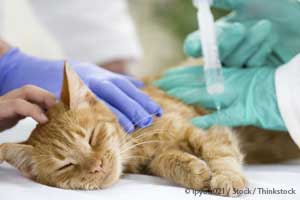
Cat Vaccination

By Dr. Becker – Cross-Posted at Just One More Pet

It is estimated that from one to 10 cats out of every 10,000 vaccinated will develop cancer at the vaccine injection site, also known as vaccine-associated sarcoma (VAS). A sarcoma is a type of cancer resulting from changes in connective tissue cells. Feline vaccine-associated sarcoma is a malignant tumor that is primarily associated with two vaccines: the rabies vaccine, and the feline leukemia virus (FeLV) vaccine.

For several years, it has been customary for feline rabies vaccines to be given in the right rear leg and FeLV vaccines in the left rear leg. The injections are made below the knee joint so that amputation of the lower portion of the leg can be offered to cat owners as a cancer treatment option. However, many owners of cats with VAS refuse amputation of their kitty’s leg because it’s painful, disfiguring and costly.

Pilot Study Suggests Tail Vaccinations Are Effective and Well-Tolerated

A research team from the University of Florida, Operation Catnip in Florida, Cornell University’s College of Veterinary Medicine, and Kansas State University’s Rabies Laboratory set out to evaluate alternatives to customary vaccine injection sites in the lower legs of cats. The results of their pilot study were published recently in the Journal of Feline Medicine and Surgery.1

The researchers surveyed oncology practitioners to learn their preference for vaccination sites based on ease of tumor removal. The preferred sites by 94 oncology practitioners were below the knee (41 percent), and the tip of the tail (30 percent).

Study results also indicated there were no significant differences in the behavior of the cats that received vaccinations below the knee and in the tail. All but one cat that received the tail vaccines developed protective antibody titers. The researchers concluded that tail vaccination was well tolerated by the cats in the study and was as effective as vaccines injected in the lower rear legs.

The researchers believe tail vaccinations could make surgical treatment of vaccine-associated sarcomas easier and less disfiguring, which could in turn encourage more owners to have their cats treated for cancer.

My Guidelines for Vaccinating Cats

As a holistic veterinarian, I’m much less interested in which body parts are best for vaccine injections than I am in determining which vaccines an animal truly needs based on established immunity, age, lifestyle, and other factors. This is especially true of cats, in light of the potential for vaccine-associated sarcomas.

If possible, I recommend you find a holistic or integrative vet to care for your cat. Non-traditional veterinarians are generally very cautious vaccinators. If your cat is strictly an indoor housecat with no exposure to other cats or the outdoors, the risks of annual vaccines far outweigh the benefits, in my opinion.

Ask for a vaccine titer test, which will measure your cat’s immunological protection against diseases for which he has already been vaccinated via his kitten shots. You can’t add protection to an already immunized pet, so don’t keep vaccinating.

If your pet truly needs a booster of a certain vaccine or a vaccine she’s never received, make sure that 1) the vaccine is for a serious disease (this eliminates many on the list immediately), 2) your cat may be in a position to be exposed to the disease (indoor cats have little to no exposure to most diseases), and 3) the vaccine is considered both safe and effective.

If your cat is an indoor/outdoor cat (in a high risk category for disease exposure) and must receive a booster vaccine, ask your vet to provide a homeopathic detox remedy called Thuja, which will help neutralize the effects of any vaccine other than the rabies vaccine. Rabies vaccines are required by law. There are two varieties of the same vaccine – the one-year type and the three-year type. Insist on the thimerosal-free, three-year rabies vaccine, and ask your vet about the homeopathic rabies vaccine detoxifier called Lyssin. If your pet is a kitten, ask to have the rabies vaccine given after four months of age, preferably closer to six months, to reduce the potential for a reaction.

If your cat lives entirely indoors, I recommend she not be vaccinated again after a full set of kitten shots in her first year of life. Her indoor-only lifestyle eliminates her risk of exposure to infectious diseases. Keep your unvaccinated indoor cat away from all other cats and your pet’s risk is virtually nonexistent.

Do not vaccinate your cat if he has had a serious vaccine reaction in the past.

Avoid veterinary practices that promote annual or more frequent re-vaccinations. Try not to patronize any boarding facility, groomer, or other animal care service that requires you to vaccinate your cat more than necessary.  

Dog and Cat Vaccines are Not Harmless Preventive Medicine  

The Pets Most Likely to Suffer from Vaccine Adverse Reactions 

Don’t Be Duped By the True Intent of This Media Blitz

Monday, August 13, 2012

Dog and Cat Vaccines are Not Harmless Preventive Medicine

The dangers of vaccines are surfacing for children, people in general, and now pets (below), See: New Organization VaxTruth Fights Vaccine Damages
Story at-a-glance
  • Vaccinosis is a condition recognized almost exclusively by the holistic veterinary community. It is not generally acknowledged by traditional veterinarians.
  • Dr. Richard Pitcairn defines vaccinosis this way: “Vaccinosis is to be understood as the disturbance of the vital force by vaccination that results in mental, emotional, and a physical change that can, in some cases, be a permanent condition.”
  • Vaccines are composed of modified live viruses, killed viruses and a number of potentially toxic substances. They also enter the body in an unnatural way (by injection) compared to real viruses. They bypass the body’s first lines of defense and are delivered directly to the blood and lymph systems.
  • Vaccine reactions, or vaccinosis, are wide-ranging. Some reactions are relatively minor, while others are life-threatening.
  • Fortunately, the traditional veterinary community is slowing becoming aware that vaccines are not the benign disease-prevention tools they were once thought to be.

Video: Vaccinosis and Your Pet

Download Interview Transcript

By Dr. Becker  -  Dr. Mercola.com – Cross-Posted at Just One More Pet

I talk a lot about vaccine dangers here at MercolaHealthyPets, and I often mention a condition called vaccinosis.

Since vaccinosis isn’t recognized by most traditional veterinarians and isn’t something many pet owners have ever heard of before, I thought it would be helpful to do a short video to explain the condition.

Vaccinosis Defined

First, let’s talk about what vaccinosis isn’t.

It isn’t an acute, often immediate adverse reaction to a vaccine. Adverse events, or hypersensitivities, whether mild (such as lethargy, flu-like symptoms, etc.), or severe (such as anaphylactic shock), that are clearly linked to a recent vaccination are widely acknowledged by the traditional veterinary community.

Unfortunately, these reactions are considered by traditional vets to be occasional aberrations of a basically safe procedure.

Vaccinosis, on the other hand, is a problem only holistic veterinarians seem willing to acknowledge. It is a reaction of a pet’s body to vaccines that have been injected without the pet having experienced a notable adverse event or hypersensitivity. These are chronic reactions to not only the altered virus contained in the vaccine, but also to the chemicals, adjuvants, and other components of tissue culture cell lines -- as well as possible genetic changes -- that can be induced by vaccines.

Dr. Richard Pitcairn, who holds a PhD in immunology, defines it this way: “Vaccinosis is to be understood as the disturbance of the vital force by vaccination that results in mental, emotional, and a physical change that can, in some cases, be a permanent condition.”

Dr. Pitcairn: Vaccines Create Chronic Disease

According to Dr. Pitcairn, vaccines intended to protect pets against acute natural diseases actually create chronic conditions with features of the disease the vaccine was supposed to prevent.

This transformation happens in the laboratory, where natural viruses are modified in order to make vaccines.

Where the natural virus would trigger a strong immune system response, the modified lab-created virus in the vaccine doesn’t elicit much of a reaction by the animal’s immune system. Instead, it creates chronic disease.

The delivery of a vaccine is also very different from how a natural disease develops in an animal’s body.
Vaccines contain a number of toxic substances, including viruses, mutated bacteria, immune irritants, foreign proteins, and chemical preservatives. All of these toxins are delivered by injection directly into the blood and lymph, bypassing the usual first line of defenses, including the skin, mucous membranes, saliva, and so forth. So not only is the virus in the vaccine unnatural, the way it enters a pet’s body is also very unnatural.

When you look at the situation from this perspective, it’s easy to see how abnormal immune reactions are triggered by vaccinations.

Your Pet’s Individual Risk of Vaccinosis

The strength and balance of every animal’s immune system is different, so there’s no way to predict – unless your dog or cat has had a reaction in the past -- how much danger your pet is in from exposure to the modified virus contained in any given vaccine or the many toxic ingredients it contains.

That’s why I strongly encourage pet owners to avoid all unnecessary vaccines and re-vaccinations.

Symptoms of Vaccinosis

Common vaccine reactions include:

  • Lethargy
  • Stiffness
  • Hair loss
  • Lack of appetite
  • Hair color change at injection site
  • Conjunctivitis
  • Fever
  • Sneezing
  • Soreness
  • Oral ulcers

More serious reactions:

  • Immunosuppression
  • Granulomas and abscesses
  • Behavioral changes
  • Hives
  • Vitiligo
  • Facial swelling
  • Weight loss
  • Allergic hypersensitivity
  • Reduced milk production (females)
  • Respiratory disease
  • Lameness
  • Allergic uveitis

Very severe illness:

  • Injection-site sarcomas (cancer)
  • Glomerulonephritis
  • Anaphylaxis
  • Myocarditis
  • Autoimmune arthritis
  • Encephalitis or polyneuritis
  • Polyarthritis
  • Seizures
  • Hypertrophic osteodystrophy
  • Abortion
  • Autoimmune hemolytic anemia
  • Congenital abnormalities
  • Immune-mediated thrombocytopenia
  • Embryotic (fetal) death
  • Thyroiditis
  • Infertility

Dog and Cat Vaccines: The Importance of Exercising Caution

Since the introduction of dog and cat vaccines, the traditional view of their use has been that they are safe and can be given as frequently as once or twice a year. This approach, tragically, has caused a tremendous amount of suffering for millions of pets.

As the truth about the dangers of vaccines slowly emerges, even traditional veterinary organizations and practitioners are acknowledging that vaccines are not the benign, “better safe than sorry” veterinary tools they were thought to be.

My recommendations for vaccinating your pet can be found in several videos, articles, and interviews here at MercolaHealthyPets. Most importantly, I don’t recommend automatic re-vaccinations at prescribed intervals for any pet.

If you believe your pet could be suffering from the negative effects of over-vaccination, I strongly recommend you work with a homeopathic or holistic vet to create a tailor-made vaccine detox program to assist your dog’s or cat’s body in recovering from vaccinosis.

Related:

Do Vaccinations Affect the Health of our Pets?

New Parasite Prevalence Maps Help Pet Owners Prepare