Showing posts with label pets good for health. Show all posts

Sunday, March 3, 2013

Pets Reduce Stress at Work… More Companies, Citing Benefits, Allowing Pets at Work

Recent study shows pets in the workplace can reduce employee stress… Hmmm, most pet owners knew that years ago without studies!
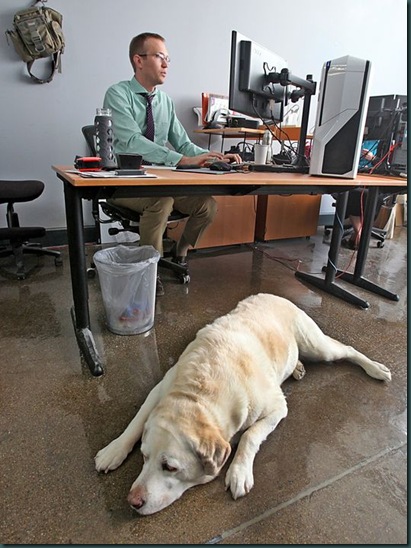
gan-pets-at-workUSAToday: INDIANAPOLIS -- Employers and employees are acknowledging the advantages and benefits of a growing office trend that allows pets in the workplace. And now there's research to support what some have known for years.

According to a Virginia Commonwealth University study, employees who bring their dogs to work produced lower levels of the stress-causing hormone cortisol.

Published in spring 2012, the study, led by Randolph Barker, a professor of management, was conducted at a dinnerware company in North Carolina, which sees 20 to 30 dogs a day on its premises. As the workday went on, research found average stress level scores fell about 11% among workers who had brought their dogs to work, while they increased 70% for those who did not.

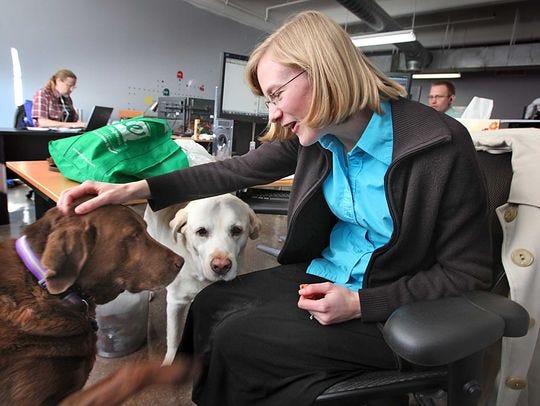
"When I'm stressed, I usually call Zoe (a chocolate Labrador retriever) over and rub her ear. That's my therapy," said Ann Marie DeLa Rosa, 26, who works at software design company Inverse-Square in downtown Indianapolis and appreciated the company's pet-friendly policy.

Not only does Zoe, who could be mistaken for a small grizzly bear with a smile, alleviate her stress, DeLa Rosa said, the dog also forces her owner to take a lunch break.

"Zoe gets me out," she said. "Otherwise, I tend to power through lunch when I want to get something done. Taking a 15-minute walk with her refreshes me, and I can focus easier."

According to a 2008 national poll of working Americans 18 and older by the American Pet Products Manufacturers Association, 17% reported their company permits pets at work. In 2012, the group reported in a separate study that workers surveyed brought their dogs with them to work 22 times in 2012, compared with 17 times in 2008.

Deb Havill, a clinical social worker and therapist, conducts client sessions along with her two rescue dogs. But David and Jai aren't trained therapy dogs; they just accompany their owner during therapy sessions.

"Dogs were domesticated to be attentive to us," said Havill, who keeps two couches in her Indianapolis office — one for clients and one for the dogs. "It is natural for us to be around them, so to not be around them would be unnatural. We would be in an unnatural state."

Havill explained that touching or petting an animal has been shown to lower the galvanic skin response much like the science behind the polygraph test, when measuring feelings such as fear, stress or anxiety.

"Reaching down and petting a dog is an easy way to ratchet things down when you need to."
None

Ann Marie DeLa Rosa is shown with her dog, Zoe, a chocolate Labrador retriever as Hoagey, a yellow lab that belongs to fellow worker, noses in for a little TLC. (Photo: Frank Espich, The Indiapolis Star)

Janet Myers travels all over the country with her Bernese mountain dog, advocating the benefits of pet therapy and animal-assisted activities in health care.

A nurse as well as the director of risk management at Schneck Medical Center in Seymour, Ind., Myers founded the hospital's pet-therapy program and next year will speak at the National Pediatric Nurses conference.

Bentley, her dog, is a popular therapy dog with his own children's book and schedule of special appearances. But his main job is still to be with his owner in her office at least three times a week.

"It's been proven that people are always more productive when they are happy," Myers said. "If Bentley is by my side, I am not thinking of needing to be home to care for him or that he's lonely. I often stay late at work with him snoozing away under my desk. He is a big part of my life."

The Centers for Disease Control and Prevention cites dozens of animal experts who report that pets can decrease blood pressure and cholesterol levels as well as increase opportunities for exercise and socialization.

Commercial developer Turner Woodard knows this better than anyone. He's the man who made it possible for employers at The Stutz business center in Indianapolis to have pet-friendly office policies — and about 25% of the tenants take advantage of the perk.

"We know it's a positive," he said. "We need to see more of it in the world."

However, if you're looking to implement a formal policy, there are several factors to consider, Barker said.

"You have to think about employee health (allergies), minimizing disruptions and keeping pets safe," he said.

Amazon and Purina, cited as two of the most pet-friendly companies in the country, don't allow pets because many factories and distribution centers can be dangerous workspaces.

Bob Baird, who brings his two dogs, Ruby and Hoagey to work, knows that when he makes a new hire at Inverse-Square, he might be excluding or discouraging potential applicants who might not like dogs.

"But having dogs here is indicative of our culture," said Baird, whose dog Hoagey, a 110-pound yellow Labrador retriever, is notorious for snoring too loudly during conference calls.

"For us, having dogs in the office is out of necessity," Baird said. "We love having them around because this is (a) home away from home. We work long hours, and it's nice to have them with us."

Related:

Dogs at Work Can Alleviate Employee Stress, Study Shows

Pets reduce stress at work

Video:  Study – Pets in the Work Place Reduce Stress

12 companies that let you bring your dog to work

Chapman University Hosts ‘Furry Friends For Finals’

Londonderry School Uses Therapy Dog in Classroom

Collar to Keep Track of Dogs’ Temperature is in the Works

Pet Therapy

Pets are way better than Therapy!

Can the U.S. Become a No-Kill Nation?

The Difference Between No Kill Nation & Other Animal Advocacy Groups

Cross-Posted at Just One More Pet

Wednesday, February 15, 2012

Londonderry School Uses Therapy Dog in Classroom

Southern New Hampshire Montessori Academy (SNHMA) has become one of the first schools in New England to bring in a therapy dog as a full time member of its community. Guardian, a Portuguese water dog, was chosen for his temperament, his silky soft hypoallergenic coat and teddy bear looks. While he’s in the process of completing his year-long training, Guardian is already having a positive impact in the classroom, where he is charged with being a calm, emphatic and steadfast best friend for little boys and girls.

Loundary School 1

“While school therapy dogs are still currently regarded as a cutting-edge educational tool, research is showing that dogs in the classroom can play a huge role in boosting students’ happiness, calmness, overall emotional well-being, and ability to learn,” explains Debra Hogan SNHMA’s Founder and Head of School.

Loundary School 2Guardian, who is always here to greet student with a wag and a lick in the mornings, has helped the younger pre-K students with separation anxiety as their parents drop them off in the morning. “He is happy to see the children come in in the mornings and offers a welcome huggable friend to little ones who are finding it hard to see Mom and Dad go,” says Hogan.

Guardian is also helping first graders hone in their reading skills, as Ms. Hogan explains: “Dogs are perfect listeners. They are not judgmental; they don’t care if you don’t get the words exactly right, and for most children, practicing reading aloud is all they need to become fluent readers.”

“Therapy dogs can have a positive impact on every aspect of the classroom from lessons planning, to teaching social skills and responsibility, to comforting students in a time of grief or personal crisis. They teach, they listen, they are unconditional friends. I have seen children who had attention deficit disorder become calmer. I have seen children with emotional difficulties lie down beside the dog and whisper things in his ear, things they’d never tell an adult, and then rise up ready to learn. Their self esteem really soared,” says Terri Hamilton, an Elementary Guidance Consultant and Parent-Child Connection Advocate.

Loundary School 3

Images courtesy of Tanya Swann Photography.

Southern New Hampshire Montessori Academy offers an academically focused education to children through an integrated curriculum. Concentration is given to educating the “whole child” (all facets of the child’s being, including: intellectual, physical, emotional, social and creative aspects) with a strong emphasis of hands-on and experiential learning where children develop their passion in technology, science, visual and performing arts, foreign language and physical education. Complementing a strong academic core, the school offers an enrichment program that includes elementary Latin, creative arts (visual and performing), daily physical education, technology and Spanish. For further information, please visit their website.

Source:  Londonderry News

Friday, September 26, 2008

Your Pet and Your Health

Many of us agree that we should do everything within our power to make sure that our companion animals enjoy the best possible health.  But did you know that simply by being a part of your life, your dog or cat could actually help you to be not only happier but healthier, too?

Of course you did.  It’s all part of the privilege (and fun!) of being a pet parent.  What you may not know is that there’s plenty of science to back it up.  A wealth of knowledge regarding the health benefits associated with having companion animals has been accumulated over the last two decades, including numerous research studies in the U.S. and abroad.

A study published in 
The British Journal of Health Psychology reports that people who have companion animals tended to be healthier than those who did not.  Additionally, when a dog was part of the family, the members had fewer minor ailments, lower blood pressure and lower cholesterol.  Although the explanation for these advantages is unclear, researchers speculated that all benefits could be accounted for by reduced levels of stress, possibly due to increased physical activity and levels of social interaction.

The positive effects of having a canine companion have also been chronicled in research published in the 
American Journal of Cardiology.  The year-long study documented the effect of having a canine companion in 369 patients who had suffered an acute heart attack.  The positive effects were nothing short of extraordinary!  The patients who had a dog in the home had a much better chance of survival.  Over 7% of patients without a dog died during the study, compared with only 1% of those who had a canine companion.

Researchers at the University of Leicester found that when pets are in a household, children six years and younger develop social skills at an accelerated rate.  Additionally, these children tend to have better coordination, improved confidence, superior communication skills and are even less likely to have allergies!

The British Medical Journal concluded that pets serve a vital need for socialization, especially for those at a higher risk for isolation, like those with physical limitations that might prevent opportunities for social interaction.  Most medical professionals agree that the broader the network of social contacts, the better we are able to deal with difficult life issues.  This study, and others like it, supports the idea that this need for social relations can be fulfilled equally well by companion animals as with people.

And a survey by the American Pet Products Manufacturers Association revealed that bringing a companion animal to the office resulted in higher worker productivity.

These and many other studies reinforce what we as pet parents have suspected all along … that our beloved four-footed companions are integral parts of our families, enriching our lives beyond measure.

Source:  Healthy Pet Net