Showing posts with label hospitals. Show all posts

Thursday, May 8, 2014

Where to Go When You Need a Hospital for Dad?

How to choose hospitals that fit the needs of your senior in care. by francy Dickinson

HospitalDear Francy; We just got through with a horrible experience at our local hospital. We live in a bedroom community and my dad had been having trouble with pain in his stomach area. He had trouble going to the bathroom and his back hurt. So, we finally took him to the ER at our larger local hospital. We have two hospitals in the area; one is smaller and other is a big trauma hospital with a big ER. We went to the larger hospital thinking they would have a better ER to treat him. When we arrived the ER was packed and we had to wait and wait.  Then when he was in the ER room…there was no room for him! So he was on a gurney in the outer area while a police officer was patrolling the ER. There had been gang trouble and they were trying to keep two rival gang members separated while they treated them. Poor dad, was confused, in pain and totally unable to process why the police were there. It was a nightmare. Why do they let seniors take back seats to these horrible gang people?

I can understand your distress and I assure you they did not take the gang members over your dad. They do Triage and the gang members were in more high risk condition, than your dad so they went first. The problem was that the hospital itself is a haven for high stress when it is a trauma center. So, lets talk about hospitals and get the idea of how to choose them in your mind. Next time when an emergency comes up…you will be prepared and be able to guide the ambulance driver to the right place for your special care.

Triage Means:
noun(in medical use) the assignment of degrees of urgency to wounds or illnesses
to decide the order of treatment of a large number of patients or  casualties. 
verb to assign degrees of urgency to (wounded or ill patients)

I will assume your dad had prostate or blocked bowel, correct? Those are conditions that older men have and they are very painful. Elders often do not talk about their private bathroom problems with their care givers or family…until the situation gets painful. I understand that and I’m sorry you all had to go through that sad emergency experience. But lets roll back the clock and see how it could have gone differently.

Both elder men and women need to have a verbal check each day. Care giving is part immediate and part prevention. So everyday( I usually do it while I am picking up their breakfast tray) talk to them. “Dad how was breakfast, I see you did not eat very much of your cereal. How is your stomach feeling?” Dad says; “Oh, fine, I was just not very hungry.” You say; “Oh, well lets talk about it. Are you feeling OK..when did you last go to the bathroom?”

Then you go down the list; are you in pain…if so 1-10 how does the pain feel? When did you have your last bowel movement, or – you are going to the bathroom more often..why is that?” It may not be a hit parade topic for a father-daughter subject…but it pays off. You do this day after day and then he will get used to it. The conversation and your voice tone stay quiet and you sound calm…so your senior feels the conversation is normal. Pretty soon, you learn to take note of changes and you can make a quick doctor or nurse practitioner appointment. When you do that, remember to write down the symptoms your senior has been showing or talking about. As you arrive to the appointment, hand the paper over to the office person checking you in and ask them to attach it to the file for the doctor’s review. It will make the appointment go faster and easier for everyone.

As one older, very experienced in-home nurse said to me…”Francy, stay out of the ER as much as you can. It will usually mean more trouble than it is worth for an elder senior.” So, I try hard to catch problems before they get out of hand…but falls and extreme illness do happen and we all have to face them and learn to use the hospital system and keep as informed as we can.

Now, what I found after years of hospital visits is how to choose a hospital in advance to a problem. The smaller hospitals are perfect for ER visits when you have non heart related issues. So, if the senior falls, or has bowel or urinary problems, even stomach pains…that is something a small hospital does best. ERs are always busy…but less stressful in smaller hospitals because the “trauma’” issues are brought to bigger specially designed Trauma Centers…so car accidents, gun violence or heart problems that require loads of equipment and team efforts to solve a problem are their specialty. This huge effort for big care issues is much different then the smaller hospital ERs. Not that smaller hospitals do not carry heart issue equipment, but its nothing like the big Trauma Centers.

Heart issues are always brought to the larger hospital centers that have special heart teams on staff, at all times. So, you know if you have a senior with any heart, stroke or related issues with blood thinning medications…you have a clear path to that large Trauma Hospital. When you get all of this in your mind ahead of time…when the emergency hits…you are prepared.

Share your choices with anyone that will be caring for your senior …so this is all figured out and runs smooth. Every emergency is stressful…so to know the direction to go for help is really a step toward faster care.

Now if your senior is having small elective surgery…you want to once again take on that smaller hospital. But here is where that changes. If your senior is in a questionable situation…or diagnosed with something complicated…you want to find a “teaching or specialty hospital”. Yes, this could mean a drive to a larger city…but the specialty hospitals are simply a godsend when you have a complicated diagnosis from a doctor. When you face a long-term battle like cancer…having a full service cancer center to go to is a super smart way to treat the issue.

So the example would be this. Your senior goes to the smaller local hospital ER and is treated for a blocked prostate. They come back and say that the prostate is showing cancer, what to do?

There are a lot of decisions to be made in case of a complicated diagnosis. Prostate has many different treatment options. My young niece was just diagnosed with leukemia. That was a two-week ride of trying to figure out what kind of leukemia she had, so they could treat it well. If she was in a small town, with a small hospital – I would have asked them to transfer her to a children’s hospital in a larger city. That specialty hospital is trained in children issues, has specialists that deal with leukemia on a daily basis..not every once in a while. She was lucky because she had a children’s hospital close. She is safe and getting a complicated treatment schedule that the “Hospitalists” are well-trained for and she is getting stronger.

Something to know: Hospitality are now the treating physicians in the hospitals. 
You will be using a general Hospital, not your own regular doctor  when your 
senior goes into the hospital. This is what I found for meaning: A Hospitality 
is a doctor who basically does nothing except take care of in-hospital patients. 
They do not have private    practices, they strictly do hospital work.

A senior with the prostate blockage and possible cancer would be best at a large hospital with a specialty of cancer or a teaching hospital. That way all the newer treatments are available for the senior and they can give you a full understanding of your choices in treatments. What I have found is that town doctors may be specialists, but in emergencies they stick to what they have done for years. They stay close to treatments and drugs that are comfortable within their experience. I do not want a complicated situation to be handled in an out of date or common way. I want a complicated issue to be handled with a group of specialists that are on the cutting edge and will use different services to make you and the senior informed of the options of care. I also like the idea that a “group” of doctors will be reviewing the situation and debating treatment for your senior patient.

If you are reading this and say…WOW, my dad is older and does not want to have fancy extended care. He wants to pass naturally and easily.

That is called Palliative Care. Here is what I found on the meaning: 
With palliative  care, there is a focus on relieving pain and other troubling 
symptoms and meeting your emotional, spiritual, and practical needs. In short, 
this new medical specialty aims  to improve your senior's quality of life -- 
however you define that for yourself.

What I feel is that the word Palliative Care is an important word for you and your elder/senior in care need to talk about. That is why everyone needs a Living Will/Medical Care Directive. As you make out this form, you will go through the different options of care giving with the senior. You will then know how to make a decision in the middle of a medical emergency. Do they want to be on long-term care? Do they want to have CPR…there are many different questions on the form and the senior will be able to design their own life care. If those decisions mean that they do not want to extend their lives you need to talk to a doctor and get a special paper that says “NO MEDICAL LIFE SAVING SERVICES”. This paper will be signed by the doctor and the senior. So when you call for help and the EMT team arrives they know the rule and the paper is posted and they then do not have to do “any or all to save a life”. This is important to have when your senior is in the last journey of their life. Lots of families do not understand this rule and do not take that extra step. When the EMT or ER people respond to the senior’s needs they can not…just let the senior go…they are legally bound to treat the senior. But if you have the paper that the doctor and senior have signed (its different – in different states) you can show it and the medical team can relax and make the passing comfortable.

Inform yourself on the forms to keep your senior from extreme life saving 
treatments. Its a form here is what I have found on it: What are “Medical
Orders for Life-Sustaining Treatment” (MOLST)?
The MOLST form is a standardized document containing valid medical orders about
life-sustaining treatment. It stays with the patient and is honored by health 
professionals across all health care settings.

My mother had the MOLST paper posted…but when she started to bleed from her mouth..I still took her into the hospital and they found she had an ulcer from her medications. They did a small procedure to stop the bleeding and changed her meds. I did not think we should have let her life go, under the situation. It was a small mend and she lived on another two years. You see I knew how to make that decision because we had talked about her care when we did her care directive and I got my name on the paper as her Power of Attorney for Medical issues. I know it sounds complicated…but I assure you…during the care process for a senior these issues will come up. Life is not always “passing away in your sleep”. It can get very complicated. So with my mother…she did not want any fancy testing or complicated or major procedures to extend her life. I knew that and my choices for her care were easier for me because of our talking over her wishes.

To download your state’s health care directive forms FREE click here.

I have put the hospital phone numbers of my city on my cell phone. I have also thought about when I drive or when I call 911 for help. When my husband George had pneumonia I called a friend to come and help me drive him to the hospital. When he had symptoms of a heart attack I called 911 for immediate help. If you take a few minutes to think over the idea of when to call for help or when to do take action on your own…you will find that you are prepared in your mind…when and if an emergency pops up.

I also have just done a review of how to make sure that you are prepared for the ER hospital trip and possible stay. Here is a link to that blog so you can pack and have your Emergency Kit all ready to go.

George on a rare out and about with me ;)

George on a rare ‘out and about’ with me ;)

I want to take time to thank you for the care giving you are doing for your senior. I know what a struggle it is to be a care giver and I appreciate all you are doing. Would you do me a favor and click on the “sign up” button on the right side of your screen. I am so busy with care giving for my Georgie (with Alzheimer’s and Parkinson’s) that my blogs are random…this way you will get an email with my new blog info. Blessings, francy

PS Thank you to all of you that are constantly supporting me during my care giving for George. He is getting much weaker with his Parkinson’s issues. So the care giving is more complicated and extended. But we did get out for dinner on Good Friday…to celebrate Easter. We met George’s son and his wife at a local restaurant and had a nice dinner. I picked a place that I could park and walk in on one level. George just wheeled up to the table and I did the running around the buffet to fill his plate. He had such a good time, but it took about three days for him to recover from the extended activity from the out and about. I think of our journey as “creative problem solving’ on a daily basis. I want George’s life to be as joy filled as possible. So, we make most quiet days into little celebrations of current events. He is happy and the care giving needed, is still within my range. Thanks again, francy


Friday, April 25, 2014

UK… Oregon… hospitals burn aborted babies for ‘green’ fuel

Addenbrooke's Hospital, with its incinerator chimney on the left.

Photo via Wikimedia  -  Addenbrooke's Hospital, with its incinerator chimney on the left.

Abortion -  By Daniel James Devine  -  Posted March 24, 2014, 02:20 p.m. -  World

Government-run hospitals in the United Kingdom have been burning the bodies of hundreds of aborted and miscarried babies in incinerators designed to heat their facilities. The practice of including fetal remains among trash dumped into “waste-to-energy” furnaces has gone on for several years, and was uncovered in a Channel 4 Dispatches television news investigation that will air Monday night.

The UK Department of Health on Sunday proclaimed an immediate ban on the fetal incineration practice, according to The Telegraph. A department health official and member of parliament, Daniel Poulter, called the practice “totally unacceptable.”

Ten medical facilities operated under the National Health Service admitted they burned fetal remains along with trash, and two hospitals used the bodies in waste-to-energy incinerators. The Telegraph said Addenbrooke’s Hospital in Cambridge incinerated 797 babies under 13 weeks of gestation at its waste-to-energy plant, and told the mothers the bodies had been “cremated.”

The Addenbrooke’s incinerator is part of the hospital’s “Think Green” program to reduce waste and cut carbon emissions. According to the hospital’s website, the ash from the incinerator was scheduled to be used as a concrete additive beginning in July 2013. Addenbrooke’s previously provoked criticism in 2006 after news broke that the hospital was saving money by cremating babies in the same incinerator used for trash.

Another hospital, Ipswich, in the county of Suffolk, incinerated 1,101 bodies in its own energy plant. The hospital said the fetal remains had been brought from other medical facilities by a private contractor. Ipswich cremates the remains of babies from its own facility, but does not incinerate them for energy, a spokeswoman said.

“While the vast majority of hospitals are acting in the appropriate way, that must be the case for all hospitals and the Human Tissue Authority has now been asked to ensure that it acts on this issue without delay,” Poulter told The Telegraph.

Channel 4 found that 27 UK medical facilities have incinerated at least 15,500 fetal remains following abortions or miscarriages in the past two years, either for cremation or fuel purposes.

The disposal of fetal tissue following abortions is a secretive practice in the United States as well. Medical waste companies often collect and dispose of the babies’ remains. In other cases, abortion center staffers may bag and dump the bodies into waste bins—or FedEx them overnight to processing centers where the tissue is sold or given to researchers, as WORLD reported in 2011.   

What has this world come to? First Flavor enhancers… now fuel? 

Aborted fetuses from Canada were burned at waste facility to power Oregon homes

Horrifying: Bodies of Aborted Babies Burned to Power Homes ...

Video: Oregon commission orders stop on using dead babies to generate power 

Boycott PepsiCo… Here Is Why and Why You Should Be Concerned For More Than One Reason! 

Senomyx: Pepsi Ignores Criticism on Use of Aborted Cells in Research

Sunday, February 23, 2014

Fourth Georgia hospital closes due to Obamacare payment cuts

President Barack Obama meets with newly-elected mayors about job creation in the Roosevelt Room at the White House in Washington, Dec. 13, 2013. (REUTERS/Jason Reed)

DailyCaller: The fourth Georgia hospital in two years is closing its doors due to severe financial difficulties caused by Obamacare’s payment cuts for emergency services.

The Lower Oconee Community Hospital is, for now, a critical access hospital in southeastern Georgia that holds 25 beds. The hospital is suffering from serious cash-flow problems, largely due to the area’s 23 percent uninsured population, and hopes to reopen as “some kind of urgent care center,” CEO Karen O’Neal said.

Many hospitals in the 25 states that rejected the Medicaid expansion are facing similar financial problems. Liberal administration ally Think Progress has already faulted Georgia for not expanding Medicaid as Obamacare envisioned.

But the reality is more complicated. The federal government has historically made payments to hospitals to cover the cost of uninsured patients seeking free medical care in emergency rooms, as federal law mandates that hospitals must care for all patients regardless of their ability to pay.

Because the Affordable Care Act’s authors believed they’d forced all states to implement the Medicaid expansion, Obamacare vastly cut hospital payments, the Associated Press reports.

The Supreme Court ruled that states could reject the Medicaid expansion in 2012, as part of the decision that upheld Obamacare generally. Since that decision, the Obama administration has so far instituted 28 unilateral delays and changes to the health care law’s implementation without congressional approval, Fox Business reports.

From verifying eligibility for subsidies to enforcing employer requirements, the Obama administration has already taken a hacksaw to the health care reform law, but it has made no changes to the provision raising problems for half the nation’s hospitals.

While the feds wait for financial pressure to force states to act, several state governments have been taking things into their own hands. Some have criticized these moves as “hospital bailouts.”

Follow Sarah on Twitter

Saturday, October 13, 2012

MARK OF THE BEAST IS COMING SOON ! - WIFE STANDS UP FOR JESUS AND AGINST THE RFID IMPLANT AT HOSPITAL -- GOD BLESS HER FOR HER STRENGTH OF CONVICTION

Oct 12, 2012

Steve Quayle: Today my wife went to the Doctors office for some check-ups and she was getting tired of being asked for her ID and insurance card as this was the third time in a month. They already have her name on file and the receptionist is familiar with her so she was a bit irate of this constant asking of her ID and she let it be known that she is getting tired of this police state of having to know who you are, and run your information again and again through the system. And the head receptionist leaned over and tapped the camera and said "pretty soon your not going to have to worry about those cards because you're going to have and RFID implant chip" and she was serious NOT JOKING!

My wife said "BS not this girl not ever, no way no how not happening" and then the receptionist said "WELL YOU MAY NOT KNOW WHAT YOU ALREADY HAVE IN YOUR BODY" and my wife said " well I know BETTER than to take INOCULATIONS OR FLU SHOTS ETC" but she still didn't seem convinced so my wife said " Your probably right Obama care will see to it that the majority gets chipped, but I'm here to tell you if it ever gets to that point and I am deathly ill with any kind of disease or any illness I won't seek treatment if it requires a chip , I will go and die in the wilderness like an animal" so my wife then asked her "what would you do if YOU have to take a RFID chip?" and she wouldn't answer her. So my wife asked again "I am serious what will be your response if you are forced to take one of those chips"? and the lady then did the "lips are seal gesture" and followed with saying " I have already said too much" and my wife said "yes you being in the public sector like this need to watch what you say to people" and she said "yes being in this office and also that I'm MILITARY I really need to watch what I say". My wife then said "military or not they won't tell me what to do ever, because there is only ONE person in this world that I will EVER BOW to and that is JESUS CHRIST HIMSELF AND NO OTHER MAN OR BEING"
My wife then said " I will die on my feet fighting this BS then begging for my life on my knees" and they all then shut up... But some of the girls in the office that worked in the office were concerned and said that this is all getting very scary. My wife then said it is BIBLICAL what is happening and people who don't understand it need to read the Bible because it is all in there.

My wife got so upset she almost walked out of the office, but she had to remain there to proceed with her test results.

This morning we were watching the video that was on your site Steve with Paul Begley about the implementation of the RFID and the School in Texas, and then this happened... To us it was AFFIRMATION from God that it is all getting very close as obvious as it is... This all happened in Colorado Springs. But we all know that Colorado Springs is home of the Military Industrial Complex. This is nothing new to both her and myself but to hear this from the doctors office was VERY TROUBLING....

God Bless and Praise the Lord Jesus Christ

You can see all the alerts here: tp://www.stevequayle.com/index.php?s=33

Related:

RFID Implant Law Hidden in Obummercare Implementation 2013

Did You Get Your ObamaCare Letter Yet?

All Americans Will Receive a Microchip Implant in 2013 Per ObamaCare

Christian Family Refuses Mandatory RFID Chip at Texas School

RFID Chip for all Americans in 2013 as Part of ObamaCare… See Biden Telling Fed Judge He Will Have to Rule on Implanted Microchips

Buying and Selling in an RFID Chip for the First Time – VeriChip Changes Its Name

Global Elite Using Obesity Vaccines to Alter Minds and Curb Consumption

The ‘new chip’… especially for you!

Buying and Selling in an RFID Chip for the First Time – VeriChip Changes Its Name

Verichip (RFID) Implants are coming, now they will have your credit and social security info connected to... part of HC Bill

Video: Smart card (made 2005)

Checkout: ObamaCare Survival Guide

Thursday, September 15, 2011

The Hospital Gestapo: You May Never See Home Again

Agenda 21 - seizing assets/ property…

The Hospital Gestapo: You May Never See Home Again
The PPJ Gazette  -  By Angela V. Woodhull, Ph.D./licensed private investigator

September 14, 2011

$ Predatory Guardians $

American hospitals have devised a scheme to guarantee they never get stuck with an unpaid bill.  It’s called guardianship.

Thinking of checking into a hospital?  Think again.  You may never see home again.

  • Michael Kidd, 72, of Richardson, Texas, fell in his yard and broke a hip.  Now, he is living in Countryside Nursing Home with his wife.  Both were removed from their home when the state of Texas petitioned the courts claiming that the Kidds were mentally incompetent.  Their house sits vacant and neglected, with rotting food still remaining in the refrigerator.  The Kidds have been confined to a single room in the nursing home, while the state appointed guardian burns through their money an gives them a mere $60 a month spending allowance which they have been using to buy “real” food.
  • Robert Milton (not his real name) was taken to the hospital because he fell “one time too many” at his home, and although his stepson had been given power of attorney to make all of his health care decisions, a court-appointed corporate guardian placed Milton against his will in a nursing home where he is now isolated from his family and friends.  Meanwhile, his money is being spent as quickly as possible by the Orlando-based guardian and her attorneys.

How It Commences

Joseph Niedesky (not his real name) was air lifted to a hospital in Orlando from Ocalaby helicopter after he was the victim of a motorcycle crash.  But something went terribly wrong during Niedesky’s surgery and he aspirated on his own vomit, causing some brain injury.  That’s when a corporate guardian was contacted by the hospital and appointed by the court as Niedesky’s full plenary, permanent guardian.

What Happens Next

The corporate guardian who petitioned the court stated in the court papers that Niedesky had no family.  In reality, Niedesky had been married for more than 20 years and had four teenage children.  It took more than two months for Niedesky’s wife to discover what had happened to her husband and where he was located.

The Family is Always Portrayed as the “Devil Incarnate”

What happened to Niedesky is becoming a commonplace occurrence in America.  A family member is rushed to the hospital.  Surgery occurs and something sometimes goes terribly wrong.  However, by quickly petitioning the courts for guardianship, the hospital avoids any kind of lawsuit for negligence or wrongful death.

Niedesky’s wife wanted to bring him home and get him out of the guardianship.  The guardian, however, kept moving Niedesky from location to location, city to city, until the statute of limitations for suing the hospital had expired.  Shortly after the statute of limitations ended, Niedsky just happened to die.

“The hospital saved itself millions in a lawsuit.  It is typical that shortly after the statute of limitations runs out, the ward just happens to suddenly die,” stated David Newman, Gainesville, Florida, a civil rights guardianship reform advocate.

Niedesky’s wife was portrayed in the court record as uncaring, incompetent, over-meddling, and negligent, and although these descriptors seem to be a contraction of terms, you will typically find the most cynical descriptions of family members in most court files where an involuntary guardianship has been granted by the courts to a total stranger.

For example, in Milton’s case, Milton’s stepson had been named long ago as his power of attorney and health care surrogate.  That designation, however, was destroyed by the court and the corporate guardian even accused the stepson of stealing several thousands over the years from his stepfather.

Today, Milton’s stepson, a 65 year old retired veteran, finds himself in a legal nightmare gathering bank records and hiring attorneys and forensic accountants to prove his innocence.  Meanwhile, the corporate guardian is spending Milton’s money like water.

The Other Scenario

Tom Griffith (not his real name) wonders why an Orlando-based corporate guardian would be interested in his father at all.

“He has no money.  All he gets is a small monthly cheque from Social Security of about $800.00.”

I explained to Griffith that his father has been marked for destruction and will mostly likely not be among the living in a very short period of time.  “We live in a country that is ruled by corporations, not the U.S. Constitution.  If there is not enough money for the nursing home to cover its expenses, there is ‘no reason’ to keep your father alive.”

I explained to Milton how Thomas Chada’s father was sent to him as a box of ashes and how other wards seem to always turn up “expired” shortly after a corporate guardian and her attorneys have burned through all of an elderly person’s money.

But in this case, Griffith said there was no reason to destroy his father.  “There is no money to gain.”

“Yes, but that is the point.  The corporate guardians have a symbiotic relationship with the nursing homes.  Sometimes, the nursing home gives them a wealthy resident that they can bilk.  At other times, the corporate guardian does them a favor by making premature end-of-life decisions when there is not enough finances to cover the elderly person’s day-to-day expenses.”

In the case of Griffith’s father, who just received quadruple open heart bypass surgery, it was determined that the ward, age 74, now needed dialysis, a very costly ongoing treatment.

“The doctors said my father does not want dialysis,”Milton stated.  “But I know my father wishes to live; he is only 74.”

“They probably got your father to sign such a statement without him even knowing what he was signing,” I explained.

Milton wanted to know what he could do to rescue his father out of this dangerous and life-threatening situation.

“You can hire an attorney, but you might end up spending more than $500,000.00 of your own money to become your father’s guardian.”

“I don’t have that kind of money,”Griffith declared, shocked.

It was obvious that the scenario I was describing was greatly upsetting Griffith.   Those of us who have already lived this scenario remember going through the predictable stage of “mental shock” followed by the overwhelming urge to seek justice—at any cost.  I explained to Griffith that he may find himself bankrupt as a result of trying to help his father out of this doomed guardianship situation.

My phone continues to ring as victims, desperate to find a solution, want to know what they can do.

In a country that is ruled by corporations and corporate greed, there will be no solution to The Guardianship Nightmare until a public uprising is so severe that these kinds of abominable– yet commonplace situations– will no longer be able to occur.

Angela V. Woodhull, Ph.D.  -  licensed private investigator

(352) 327-3665  -  angelavwoodhull@yahoo.com

Sunday, September 4, 2011

Hospital Mergers: A Result of Health Reform?

Hospital mergers are the latest trend in health care.

But far from a passing fad, the number of mergers and acquisitions are expected to rise as health systems adjust to the federal health care reform.

Locally, St. Benedicts Family Medical Center in Jerome announced last week it was discussing joining with St. Luke’s Health System. Many of the details of the deal have not been released, but one of the reasons spurring the merger is health care reform.

“For St. Luke’s, acquiring St. Ben’s has everything to do with reform,” said David Pate, chief executive officer of St. Luke’s Health System.

Under the Patient Protection and Affordable Care Act, health care systems will be required to reduce costs and improve their quality of patient care. However, this becomes difficult when hospitals face expensive technological upgrades paired with shrinking private and public reimbursements.

To find new ways to bear the costs, independent hospitals have increasingly signed on with larger health systems in the past year.

There were 27 merger deals across the nation in the second quarter of 2011, up from nine for those months of 2010, according to Irving Levin Associates, a health care industry merger and acquisition data publisher.

Partnering with a larger hospital affords providers more resources and distributes costs across both entities.

“Health care reform law is accelerating a trend that was already developing,” Pate said.

The reform puts financial incentive on preventive care actions. Unlike in the past, doctors will get paid for value, not volume.

St. Luke’s will benefit integrating with St. Benedicts because it will be able to coordinate care between the Twin Falls and Jerome areas, Pate said.

“Now it’s not just patients in our hospitals, but looking at the whole population and seeing how do we promote health,” he said.

Though some fear the changes resulting from health care reform will lead to employee layoffs as providers seek to meet costs, St. Luke’s will only consider cutting jobs as a last resort, Pate said.

“We feel especially sensitive to this issue. We are the largest employer in the state and we help drive the economy,” he said. “It’s important we recognize our role in the economy. We have the opportunity to look at care processes and find how we can prevent avoidable complications and preventable hospital admissions.”

Source: MagicValley.com

Friday, May 13, 2011

CREEPY CRAWLERS: BEDBUGS FOUND CARRYING ‘SUPERBUG’ GERMS

ATLANTA (AP) — Hate insects? Afraid of germs? Researchers are reporting an alarming combination: bedbugs carrying “superbug” germs.

Canadian scientists detected drug-resistant MRSA bacteria in bedbugs from three hospital patients from a downtrodden Vancouver neighborhood.

Bedbugs have not been known to spread disease, and there’s no clear evidence that the five bedbugs found on the patients or their belongings had spread MRSA or a second less dangerous drug-resistant germ.

However, bedbugs can cause itching that can lead to excessive scratching. That can cause breaks in the skin that make people more susceptible to these bacteria, noted Dr. Marc Romney, one of the study’s authors.

The study is small and very preliminary, “But it’s an intriguing finding” that needs to be further researched, said Romney, medical microbiologist at St. Paul’s Hospital in Vancouver.

The hospital is the closest one to the poor Downtown Eastside neighborhood near the city’s waterfront. Romney said he and his colleagues did the research after seeing a simultaneous boom in bedbugs and MRSA cases from the neighborhood.

Five bedbugs were crushed and analyzed. MRSA, or methicillin-resistant Staphylococcus aureus, was found on three bugs. MRSA is resistant to several types of common antibiotics and can become deadly if it gets through the skin and into the bloodstream.

Two bugs had VRE, or vancomycin-resistant Enterococcus Faecium, a less dangerous form of antibiotic-resistant bacteria.

Both germs are often seen in hospitals, and experts have been far more worried about nurses and other health-care workers spreading the bacteria than insects.

It’s not clear if the bacteria originated with the bedbugs or if the bugs picked it up from already infected people, Romney added.

The study was released Wednesday by Emerging Infectious Diseases, a publication of the U.S. Centers for Disease Control and Prevention.

Source:  The Blaze

Wednesday, September 3, 2008

Protect Yourself From Killer Hospitals... Part 3

"The main value of transparency is not necessarily to enable easier consumer choice or to give a hospital a competitive edge. It is to provide creative tension within hospitals so that they hold themselves accountable. This accountability is what will drive doctors, nurses, and administrators to seek constant improvements in the quality and safety of patient care. So, even if we can't compare hospital to hospital on several types of surgical procedures, we can still commend hospitals that publish their results as a sign that they are serious about self-improvement.” ...Brian Klepper

Precautions to Consider…


DO YOUR HOMEWORK AND RESEARCH HOSPITAL OPTIONS

Take a little time to research the hospitals in your area, or hospitals that are part of your medical coverage, before you need to go to one.  Sometimes just talking to people in your neighborhood or people where you work that have the same coverage will give you a lot of insight.  And always get a second opinion before having voluntary surgery and sometimes even a third opinion is a good idea.

And before having surgery of any kind, educate yourself about your condition and know your options, including alternative medical care.


MAKE NURSES AND DOCTORS WASH THEIR HANDS

Washing your hands is one of the best (and easiest) ways to prevent the spread of germs. Still, not enough doctors and nurses wash their hands when going from one patient to the next. I know you might feel uncomfortably asking this, but it's wise to ask whoever is going to touch you to wash their hands before they do so - in front of you, if necessary.  Or make sure you watched them put on new gloves in front of you.


BE SURE YOU'RE GETTING A FRESH NEEDLE

Again, one would assume that every hospital would follow what's really Rule #1 when it comes to syringes: that needles get used once and only once. But sadly, this is something you can't always assume. I told you recently about a Nevada clinic that routinely reused needles, which led to a hepatitis outbreak. 50,000 patients were notified and had to be tested for the disease. Don't be afraid to ask the obvious question: has that needle been used? Ask that the doctor to unwrap a fresh syringe in front of you.


BE READY FOR SURGERY

This is the big one. When you're opening up your body, all kinds of unwanted things can get in. Before the surgery, you should ask your doctor if you should prepare your skin with daily disinfectant washes. You should also request a skin or nasal swab test for the MRSA super bug - and if that test is positive, be sure that you're treated with antibiotics before your procedure. Don't let a nurse shave you - any small nicks are merely open access for bacteria to enter the bloodstream; be sure your hair is only clipped back. Double check that the doctor has ordered IV antibiotics on the day of the surgery (shockingly, this step is often forgotten).  

Giving your own blood for voluntary surgeries or giving blood regularly in case of  involuntary surgeries is also a great precaution.


STAY WARM

It's true: keeping warm can actually fight infection. If you're getting a hospital procedure in the winter, be sure you're dressing in warm clothes before and after the surgery, and riding around in a well-heated car.  Also, ask for plenty of blankets while you're in the hospital waiting for surgery - if necessary, bring some of your own. Your life is more in your own hands than you realize when you enter those so-called safe havens called hospitals. Victoria Nahum has learned the hard way that passivity can kill. "People need to start participating instead of just being spectators when it comes to their medical care," she said. At the end of the day, you've got to remember this common sense warning: steer clear of the hospital unless absolutely necessary. Shedding some light on not-so-hospitable hospitals, William Campbell Douglass II, M.D.

ALTERNATIVE HEALTHCARE OPTIONS:

There are many alternative healthcare options as well as preventative measures that I will cover in part 4 of this Protect Yourself From Killer Hospitals series, including non-traditional alternative medical centers.  One that I can recommend from personal knowledge as well as reputation is  Sanoviv Medical Institute, which I will also cover in more detail in part 4.

"I invite you to experience the innovative medical diagnostics and therapies, detoxification, nutrition and serenity that Sanoviv offers -and to partner with us in helping you achieve true health." …Myron Wentz, Sanoviv Founder, Ph.D., Microbiology and Immunology

Sunday, August 31, 2008

Protect Yourself From Killer Hospitals... Part I

“The only way to keep your health is to eat what you don't want, drink what you don't like, and do what you'd rather not.” …Mark Twain ;-)

(Although this is not 100% true, we are at least in part the authors to our own health or disease based on our choices.)

But, There's no place more deadly than a hospital...

This is a universal and unspoken truth in the health care community: hospitals can be lethal. The Centers for Disease Control and Prevention (CDC) estimates that 99,000 people die every year from hospital-acquired infections; and not just the sick, the elderly, or the very young.

Case in point: 27-year-old Joshua Nahum was injured during a skydiving accident. Considering he voluntarily jumped out of a perfectly good airplane, Nahum was probably considered very lucky to have escaped the incident with only fractures to his skull and femur. And over six weeks in a Colorado intensive care unit, Nahum slowly improved. Doctors declared that with a complete course of rehab, Nahum would be fully recovered in just two years. Yet just two weeks after the doctors gave him the good news, Nahum was dead. A bacterial infection he developed while in the hospital had killed him. In the wake of this devastating (and, if you ask me, needless) tragedy, Victoria Nahum, Josh's stepmother, founded the Safe Care Campaign, the goal of which is to stop health-care- and community-acquired infections.

According to the Safe Care Campaign's Web site, the organization seeks to "instigate a crucial culture change within the American health care environment with regard to comprehensive infection prevention and hand-hygiene compliance practices." It's shocking, but true - one of the biggest and most dangerous myths around is the sterility of hospitals. The places are awash in all manner of germs that can be devastating to people whose immune systems are compromised because they are recovering from illnesses or surgeries. Contrary to their squeaky-clean image, hospitals are far from sterile places. In fact, they're among the most hazardous with regard to infections. Remember, hospitals are where all the sick people are, which means they're where all the GERMS are.

But what's even more disturbing than this is the fact that hospitals can expose you to different germs than what you'd come into contact with in the outside world. Because bacteria can mutate so quickly, those that linger in hospitals can develop into distinct variants that can have a strong resistance to antibiotics. That makes them much more lethal than the garden-variety microbes you're exposed to every day out in the world.

Thanks to people like the Nahums and other concerned patient advocate groups, the word is getting out about the potential dangers that lie within hospitals. In addition to the Safe Care Campaign, there's also the Committee to Reduce Infection Deaths (CRID), which was begun by former lieutenant governor of New York, Betsy McCaughey. "You don't often come across such a big problem that you can prevent," McCaughey said.

These groups have a steep hill to climb. In addition to noncompliance to hygiene standards by hospital staffs and the bacteriological soup that's contained in hospitals, the dangers are not going away. So the Safe Care Campaign and the CRID have come up with a list of advice that patients can follow to help protect themselves when they head to the hospital.
Part II Continued Tomorrow....

Thursday, August 28, 2008

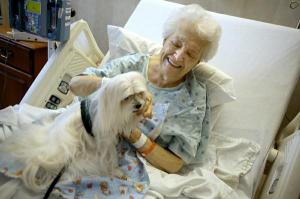
Animals Helping the Ailing, the Elderly, and the Young

Researchers are finding that animals, especially small ones, have shown promise in helping with many conditions, both social and physical:

A Naples Community Hospital has volunteers who bring their pets to visit patients. The animals are specially trained to remain calm and must pass a “Good Citizen” test before they are certified for hospital visits.

Here is a short list of conditions being helped by enlisting cats and dogs

  • Pets help Alzheimer’s patients by bringing them back to the present. Specially trained pups can also help alert others that an Alzheimer’s patient has wandered into harm’s way. “Pets can provide a measure of safety to people with the disease,” says Thomas Kirk, a vice president of a chapter of the Alzheimer’s Association.
  • Children who suffer from attention deficit disorder (ADD) are able to focus on a pet, which helps them learn to concentrate.
  • Mentally ill patients, or those with emotional problems, share a common bond when a cat or dog enters the room. Instead of reacting negatively to one another, it boosts morale and fosters a positive environment.
  • Pets are an antidote to depression. Life in a care facility can be boring. A visit from a therapy cat or dog breaks the daily routine and stimulates interest in the world outside.
  • Pets provide social interaction. In a health care facility, people come out of their rooms to socialize with the animals and with each other.
  • Everyone has the need to touch. Many humans are uncomfortable hugging or touching strangers, even those close to them. Some people are alone and have no hands to hold, no bodies to hug. But rubbing the fur of a cat or dog can provide a stimulation that is sorely lacking. The nonverbal connection is invaluable in the healing process.