Showing posts with label recusal. Show all posts

Saturday, December 3, 2011

Why Justice Clarence Thomas Should Not (Needn’t) Recuse Himself… and Why Justice Elena Kagan Should (Must)

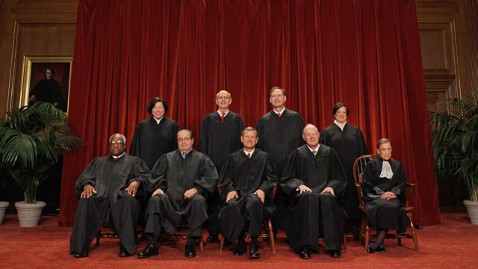
gty supreme court class thg 111116 wblog Groups Suggest Elena Kagan, Clarence Thomas Should Be Recused from Health Law Challenge

Chip Somodevilla / Getty Images

This question is all about politics, not ethics: If neither Thomas or his wife has a "fiduciary interest" in the case, Justice Thomas is in the clear, says Doug Mataconis in Outside the Beltway. But this isn't about legal ethics, it's an attempt to "deflect attention" from Sen. Orrin Hatch's call for liberal Justice Elena Kagan to recuse herself because of her previous work as Obama's Solicitor General. And unlike the Democrats' "phony" case against Thomas, Hatch has "at least an argument" that Kagan should sit this out.
"House Democrats call on Justice Thomas to recuse himself..."

Let's leave all spouses alone: "I get that this is mostly just rhetorical jousting," since Thomas won't recuse himself voluntarily and nobody can make him, says Kevin Drum in Mother Jones. But either way, "it's a bad idea" to argue that "judges' spouses need to be apolitical creatures or that judges are responsible for what their spouses do." That hurts women a lot more than men, and if it's true, why not ban all lawmakers' spouses from political activism, too?
"Keep spouses out of it"

Justice Elena Kagan was directly involved, herself, with ObamaCare. So, Justice Kagen Should Recuse Herself From ObamaCare Case This is 100% different from the Clarence Thomas situation.

Excerpt:

Federal law requires Supreme Court justices to recuse from a case if they had earlier "participated as counsel" in the case. Justice Kagan did just that when she was Obama's solicitor general, but has never explained why she believes she is nevertheless justified in sitting on the case under this standard.

Carlson: Ginni Thomas Will Not Interview Or Write About Business Clients

Last week Tucker Carlson, who just hired Ginni Thomas for staff on the Daily Caller, said the same thing on Hannity.  He said he saw no reason for Justice Thomas to recuse himself unless the Thomas’s are receiving fiduciary compensation. (In recent weeks, the site has picked up some high-profile new employees, including former Slate and Newsweek blogger Mickey Kaus.)

Thomas is no political shrinking violet. She’s made her name most recently as a conservative advocate and de facto lobbyist — publicly offering her services to clients of the advocacy group Liberty Central and its partner the Patrick Henry Center for Individual Liberty. She’s the wife of Supreme Court Justice Clarence Thomas, vocally opposes the health care reform law, and worked in 2010 to elect Republicans to Congress.  But many (maybe most) in Washington are married to people who are in one way or another involved or working either in one of the 3-branches of government, in support or lobbying concerns, CIA or FBI or security related departments or in the media.

The only way that Justice Thomas would be required to recuse himself under this canon would be if his wife has a fiduciary interest of some kind in the outcome of the litigation or if she falls under one of the provisions of subsection (d). The fact that she may be affiliated with a Tea Party group that has taken a position on the Affordable Care Act is not, in and of itself, sufficient to meet the requirements of Canon 3(C)(1), and anyone with a modicum of training in legal ethics would know that.

Recusal is on a case by case basis and unfortunately up to the judge to recuse themselves.  However in this case… the Obama administration knew of the conflict with Kagan and her recusal should have been provision of her confirmation.

The upcoming decision on ObamaCare is not only over changing the quality of healthcare in America, it is about how much power the government has (will have) over Americans to make us buy whatever they choose, if this is not over-turned. It will also give the federal government control over one-sixth of the budget of the United States. Look at their record… does anyone believe they are capable of that responsibility? Just like social security now… in the not so distant future there will be no money in the coffers for anyone’s (but a chosen few) to get healthcare… let alone decent healthcare or anything like what Americans have now.

Kagan was a guaranteed vote for the White House for the administration in case the constitutionality of the Affordable Care Act ended up there. Kagan is ineligible to vote on this case and the White House always knew that. But the Congress did not do their job….

Kagan should (must) recuse herself.  Thomas should (need) not. Some pressure from the other judges might help… Encourage them!

Ask Marion

Related:

The Agenda Project:  Supreme Control

Kagen: Liberal Supreme

Judiciary Committee Probes Kagan’s Role in ObamaCare at GOP’s Request

Elena Kagan Tied to Obama’s Birth Certificate

Papers Prepared to Disbar Kagan

Video: The Other Barak? (Aharon Barak)

Video: Kagan: Constitution Was Meant To Be "Interpreted Over Time" from RCP Video on Vimeo.

Every American Concerned With Health Care Needs to Read This Conversation

Thursday, December 1, 2011

Justice Kagan should recuse herself from Obamacare case

This spring the U.S. Supreme Court will decide what may well be the case of the century -- the constitutional challenge to Obamacare. But will the case be heard by eight or nine justices?

Before the health care law was even passed, the Department of Justice had been meeting to develop a strategy for defending the law from constitutional attack. Involved in this effort was none other than Elena Kagan, now the newest Obama appointee to the Supreme Court.

See Video at: ObamaCare: Recuse Kagan! - Dick Morris TV Lunch Alert

Federal law requires Supreme Court justices to recuse from a case if they had earlier "participated as counsel" in the case. Justice Kagan did just that when she was Obama's solicitor general, but has never explained why she believes she is nevertheless justified in sitting on the case under this standard.

One simply can't be the coach and referee in the same game. At best, knowing the playbook will color your judgment, and at worst, you'll be on the lookout for chances to give your former team an advantage.

Here are the facts. It took two lawsuits to get "the most transparent administration in history" to release emails detailing Kagan's involvement in the Obamacare defense. Those emails show that, in a highly unusual move, she ordered her staff to become involved in the defense before the law was even passed.

Perhaps this turn of events is explained by the fact that, upon passage of Obamacare, Kagan's reaction to a confidant was "I hear they have the votes, Larry!! Simply amazing."

Possibly most damning is the fact that Kagan received privileged internal strategy about the case. We know this because the Obama administration redacted portions of Kagan's emails under a Freedom of Information Act exemption that specifically prevents the disclosure of government deliberations.

Kagan is prohibited from sharing that privileged information even with her colleagues on the Supreme Court when they in turn deliberate on Obamacare.

In sum, Kagan's direction of the administration's defense, as well as her inclusion in "let's run this by the boss" discussions about the government's strategy, constitute more than enough participation as counsel to require her recusal under the law.

To be fair, as the calls for Kagan's recusal have intensified, some have rushed to her defense, suggesting that she had insulated herself sufficiently from her office's defense of Obamacare.

Her deputy at the Solicitor General's Office, Neal Katyal, has said that she was "walled off from Day One." Why anyone thought Obama's top lawyer had to be walled off of such a monumental case in the first place is revealing in itself.

In any event Katyal apparently breached that wall with impunity by suggesting that she attend Obamacare strategy meetings, by promising to bring her in such meetings "as needed," and by copying her on internal emails discussing defense strategies.

Or perhaps Katyal simply regarded "Day One" as occurring later in the process, such as after the Obamacare challenges were actually filed or after Kagan was put on the short list for a Supreme Court nomination.

But by those times Kagan was already too involved in the government's defense to later sit on the case as a judge. Legally speaking, pre-suit participation in a case still triggers recusal.

The stakes cannot be higher. The Supreme Court will determine whether the federal government has the power to mandate that every American purchase and maintain government-approved insurance from birth until death - all in the name of regulating interstate commerce.

With such a closely divided court, it may all come down to Justice Kagan's vote, but her vote is too tainted. To preserve the integrity of our Supreme Court on the most important case of the century, Justice Kagan should recuse.

Carrie Severino is policy director and chief counsel of the Judicial Crisis Network.


By:Carrie Severino | 11/27/11 8:05 PM l Op-Ed Contributor - Washington Examiner

Wednesday, November 16, 2011

Another ObamaCare Glitch

By JONATHAN H. ADLER AND MICHAEL F. CANNON

Even if ObamaCare survives Supreme Court scrutiny next spring, its trials will be far from over. That's because the law has a major glitch that threatens its basic functioning. It's so problematic, in fact, that the Obama administration is now brazenly trying to rewrite the law without involving Congress.

The Patient Protection and Affordable Care Act offers "premium assistance"—tax credits and subsidies—to households purchasing coverage through new health-insurance exchanges. This assistance was designed to hide a portion of the law's cost to individuals by reducing the premium hikes that individuals will face after ObamaCare goes into effect in 2014. (If consumers face the law's full cost, support for repeal will grow.)

The law encourages states to create health-insurance exchanges, but it permits Washington to create them if states decline. So far, only 17 states have passed legislation to create an exchange.

This is where the glitch comes in: ObamaCare authorizes premium assistance in state-run exchanges (Section 1311) but not federal ones (Section 1321). In other words, states that refuse to create an exchange can block much of ObamaCare's spending and and practically force Congress to reopen the law for revisions.

adler

Getty Images

The Obama administration wants to avoid that legislative debacle, so this summer it proposed an IRS rule to offer premium assistance in all exchanges "whether established under section 1311 or 1321." On Nov. 17 the IRS will hold a public hearing on that proposal. According to a Treasury Department spokeswoman, the administration is "confident" that offering premium assistance where Congress has not authorized it "is consistent with the intent of the law and our ability to interpret and implement it."

Such confidence is misplaced. The text of the law is perfectly clear. And without congressional authorization, the IRS lacks the power to dispense tax credits or spend money.

What about congressional intent? Law professor Timothy Jost suggests that since ObamaCare requires all exchanges to report information about premium assistance, and it would be silly to impose that requirement on federal exchanges if their enrollees were not eligible, that shows Congress could not have intended anything but to provide assistance in federal exchanges. At least, he argues, there's enough ambiguity here about Congress's intent that federal courts will permit the administration to resolve it.

Not so fast. The Supreme Court has increasingly limited such deference to cases where the text of the law—rather than Congress's intent—is ambiguous. In this case the language of the law is clear, as even Mr. Jost admits.

The health law's authors in Congress deliberately chose to pass the bill with known imperfections and to use the reconciliation process to make only limited amendments. Writing a perfect bill would have required too many votes and risked failure. If what they passed was an imperfect bill with no premium assistance in federal exchanges, then that is what Congress intended.

And there are plausible reasons why Congress may have wanted to limit assistance to state-run exchanges—including encouraging states to create exchanges so that the federal government doesn't have the burden.

Supporters of ObamaCare, including George Washington University's Sarah Rosenbaum, have argued that nobody will have standing to challenge the IRS rule in court. That's not the case.

Under the law, employers must pay penalties when their employees receive premium assistance—a measure designed to encourage employers to keep offering coverage. Any employer whose employees receive premium assistance through a federal exchange would therefore suffer harm from the IRS rule and would have standing to challenge these illegal tax credits and outlays.

Public-interest lawyers could file suit as soon as the IRS rule becomes final and they find an employer that will be harmed. Any firm that doesn't offer health benefits and that employs lots of full-time, low-skilled, young workers in a state that fails to create an exchange should suffice. A successful challenge would block the law's employer mandate in that state.

In addition, under the Congressional Review Act, a simple (filibuster-proof) majority vote in each chamber of Congress could send to President Obama's desk a resolution blocking this IRS rule. Even if Mr. Obama vetoed the resolution (taking personal responsibility for this assault on the rule of law), a future president could still rescind the rule. Quite a perilous situation in which to leave the president's signature accomplishment.

Like the rest of the nation, the Obama administration wants a different health-care law than the one we got. But that doesn't give it the authority to rewrite the law by fiat.

Mr. Adler is professor of law and director of the Center for Business Law and Regulation at Case Western Reserve University. Mr. Cannon is director of health policy studies at the Cato Institute.

Source: WSJ

PLAY:

The Supreme Recusal Question