
Story at-a-glance
- On March 15, the New Hampshire House of Representatives voted 253-23 in favor of mandating infant fluoride warnings on all water bills in fluoridated communities. The bill will now go to the Senate
- According to the text of the bill, the warning would read, in part: “According to the Centers for Disease Control and Prevention, if your child under the age of 6 months is exclusively consuming infant formula reconstituted with fluoridated water, there may be an increased chance of dental fluorosis.” But dental fluorosis is not “just cosmetic.” It can also be an indication that other tissues, such as your bones and internal organs, including your brain, has been overexposed to fluoride as well
- A repeated theme in recent cases where communities successfully removed fluoride from their water supply is the shifting of the burden of proof. Rather than citizens taking on the burden of proving that fluoride is harmful and should be removed, champions in positions of some authority have managed to end water fluoridation in their communities by demanding that any fluoride product used must be able to prove its compliance with the regulations, laws, and risk assessments already required for safe drinking water
By Dr. Mercola
The largest state legislature in the U.S. recently passed a bill mandating infant fluoride warnings on all water bills in fluoridated communities. On March 15, the New Hampshire House of Representatives voted 253-23 in favor of the bill.
Thanks to a 13-2 recommendation from the House Resources, Recreation, and Development committee, there was no debate over the bill on the House floor. The bill will now go to the Senate. According to the text of the billi , the warning would read:
"Your public water supply is fluoridated. According to the Centers for Disease Control and Prevention, if your child under the age of 6 months is exclusively consuming infant formula reconstituted with fluoridated water, there may be an increased chance of dental fluorosis. Consult your child's health care provider for more information."
Why Infants Should Not Drink Fluoridated Water
Two years ago, a study published in the Journal of the American Dental Association found that fluoride intake during a child's first few years of life is significantly associated with fluorosis, and warned against using fluoridated water in infant formulaii.
Dental fluorosis - a condition in which your tooth enamel becomes progressively discolored and mottled - is one of the first signs of over-exposure to fluoride. Eventually, it can result in badly damaged teeth, and worse... It's important to realize that dental fluorosis is NOT "just cosmetic."
It can also be an indication that the rest of your body, such as your bones and internal organs, including your brain, have been overexposed to fluoride as well. In other words, if fluoride is having a visually detrimental effect on the surface of your teeth, you can be virtually guaranteed that it's also damaging other parts of your body, such as your bones. After all, bone is living tissue that is constantly being replaced through cellular turnover.
Bone building is a finely balanced, complicated process and fluoride has been known to disrupt this process ever since the 1930s.
While generally supportive of water fluoridation, the Centers for Disease Control and Prevention (CDC) does admit that using fluoridated water to mix infant formula may not be in the best interest of your baby's developing teeth. According to their websiteiii:
"Recent evidence suggests that mixing powdered or liquid infant formula concentrate with fluoridated water on a regular basis may increase the chance of a child developing ... enamel fluorosis."
The CDC also states:
"In children younger than 8 years of age, combined fluoride exposure from all sources - water, food, toothpaste, mouth rinse, or other products - contributes to enamel fluorosis."
The lack of formal and easy-to-find warnings about the hazard of using fluoridated water to make infant formula has, and continues to be, a major source of contention. New Hampshire will set a marvelous example for other states if their bill mandating infant fluoride warnings on water bills in fluoridated communities is enacted.
Shifting the Burden of Proof
In writing this article, I was in contact with Jeff Green, National Director of Citizens for Safe Drinking Water, who kindly shared a couple of other success stories with me. A repeated theme in some of the recent cases where communities successfully removed fluoride from their water supply is the shifting of the burden of proof. Rather than citizens taking on the burden of proving that fluoride is harmful and shouldn't be added, a more successful strategy has been to hold those making claims accountable for delivering proof that the specific fluoridation chemical being used fulfills their health and safety claims, and is in compliance with all regulations, laws, and risk assessments already required for safe drinking water.
"It's important to accentuate that these strategic actions focused on the accountability for the actions surrounding the selection and use of the specific substance, rather than just opposition to the public policy where supporters routinely find cover for their actions," Green says.
The word 'Champion' may elicit reverie-like thoughts of a bygone era, but Champions—while rare—can still be found today. A true Champion can be defined as a person in a position of some authority who can reasonably make a probing request, and, most importantly, has the authority to declare that a distorted response—one that does not answer questions directly, or a non-response, simply isn't good enough.
Frank Mora, previous Chairman of a joimt water board in the State of New York, is one example of such a Champion. While neither 'easy' nor 'fast,' Mora's dedication to the ethics of stewardship eventually led to the discontinuation of the addition of fluoride to their water supply in October 2009. The water board, who originally supported the public policy of fluoridation based on endorsements, rejected the use of the hydrofluosilicic acid fluoridation chemical without taking any stance on whether or not it might do harm... Rather the rejection was based on the Board's inability to confirm the compliance of the product with already established laws and regulations for safe drinking water.
Ironically, water fluoridation continued for about a month after the Board made their decision. The reason for this was because the hydrofluosilicic acid they still had on hand would have to have been disposed of as hazardous waste. The cost of proper disposal was considered excessive, so they used up their last reserves before discontinuing it. It's rather amazing to consider that the hazardous waste facility was more committed to identifying the contents and contaminants of the product before they would accept it for treatment than water departments are before adding it to our drinking water!
Endorsements Versus Due Diligence...
A town in Tennessee also found a Champion in its Mayor Robinson, and the town, while keeping its resolution to fluoridate intact, unanimously ended its use of its chosen hydrofluosilicic acid fluoridation substance a couple of years ago, and as of yet have not found a product that is compliant. According to a press release dated June 10, 2011:
"The shift was to a process of sequentially challenging various authorities to dig deeper into the factual basis for endorsements and assurances, and to provide specific documents.
... The Town exchanged letters with the Tennessee Municipal League Risk Management Pool (TML) explaining the Town's inability to extract information on the content and impurities of the product, the refusal of the chemical supplier to provide specific documents required for compliance with law, and evidence that contaminants such as lead and arsenic are admittedly a part of the product. This resulted in TML's lawyerly response that they wouldn't be able to answer with any certainty what liability coverage the Town could count on until TML received a claim.
Not good enough.
"A point that had to be considered," said Robinson, "is that all of these endorsements, and even assurances and guidance from health agencies, doesn't alter the fact that we as the water operator are the only ones that can select and ultimately be responsible for the benefits or harm from consumption of the product. So while it might be nice to take potshots from the sideline, or to repeat the assurances from someone who has no accountability, if we are going to take our role as stewards of the water supply seriously, we don't get to substitute endorsements for due diligence."
What You Might Find if a Champion Performs Due Diligence
Mayor Robinson makes an excellent point, which is that the stewards of the water supply cannot simply substitute endorsements of safety, effectiveness, and regulatory compliance for the public policy, for due diligence on the actual product used. Questions must be asked, and answers must be provided. Ditto for proof in terms of documentation. If it's all on the up-and-up, this should be a fairly straight-forward process. However, those who have taken on the task of performing due diligence on the actual fluoridation chemical have been surprised by the lack of responsiveness and clarity from the very sources of the safety claims. In addition, in the case of the joint water board in New York, they couldn't even get a single straight answer from the chemical manufacturer about their own product.
This isn't surprising when you consider that there's virtually no evidence supporting the safety or effectiveness of the fluoridation chemical used.
"I don't believe we would have known how to navigate through this process without guidance from someone who is fully informed of all of the regulations that should be considered in our decision-making, as even though we are in the business of delivering water, we were not aware of all of the factors, which were not divulged by the sources we usually rely upon," stated Robinson.
First of all, swallowing fluoride provides little or no benefit to your teeth. It works topically, and not particularly effectively at that. According to the findings of a groundbreaking 2010 study published in the journal Langmuiriv, the benefits of even topical application of fluoride are highly questionable. The study discovered that the fluorapatite layer formed on your teeth when you apply fluoride is a mere six nanometers thick. To put that into perspective, you need 10,000 of these layers to get the width of a strand of your hair! Scientists now question whether this ultra-thin layer can actually protect your enamel and provide any discernible benefit, considering the fact that simple chewing will quickly eliminate it.
Secondly, swallowing fluoride exposes every tissue in your body to both a drug and a toxic substance.
There is pharmaceutical-grade fluoride, which is used in certain drugs, and adding it to the public water supply equates to forcing a medication on the entire population, without regard for dose or frequency. However, pharmaceutical grade fluoride is not typically what's added to water supplies... No, the fluoride added to municipal water supplies is the toxic byproduct from the fertilizer industry—a rarely-discussed fact that effectively nullifies most if not all studies pertaining to fluoride—they simply have not studied the correct type of fluoride being added to our water.
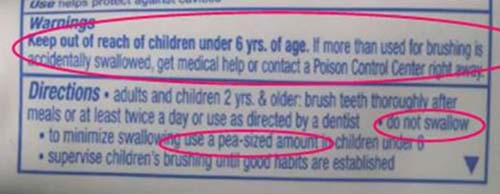
Another eye-opening fact is that a pea-sized dollop of fluoridated toothpaste contains about the same amount of fluoride as a large glass of water. The difference is that if you swallow more than a pea-sized amount of toothpaste, you're instructed to immediately contact Poison Control, while there are no warnings issued for fluoridated water, even though there's no way to control the dose any given person will receive on any given day or throughout their lifetime.
Often Overlooked
Advisory from Jeff Green: One element to be addressed is that many of us who are first exposed to issues such as this enter into a world of anger at injustice, where we see the problem so passionately and so clearly that we carry the burden of proof and are in a hurry to tell others to set it right, viewing anyone who does not immediately agree with our view as opposition that must be overwhelmed with facts and a list of "shoulds."
In this state we look angry, and are easily characterized as a zealot, probably because we are. Asking someone without our passion to join us may not be that inviting.
Should we expect that this would be any different when speaking to authorities and asking them to act?
If you are able to suspend your anger at injustice, able to switch your focus from stating the problem to addressing solutions, there are avenues available.
If you would like to elevate your discussions from the argumentative "he said, she said" to letting the facts declare themselves, and you are in a position of authority from which you can champion the performance of due diligence, contact us for access to guidance and further information.
If you are capable of being an advocate of safe drinking water and would like to assist in identifying a champion for due diligence in your community, contact us for approaches and further information.


10 Facts About Water Fluoridation Everyone Should Know
- Bottle-fed infants receive the highest doses of fluoride as they rely solely on liquids for food, combined with their small size. A baby being fed formula receives approximately 175 times more fluoride than a breast-fed infant
- There is not a single process in your body that requires fluoride
- A multi-million dollar U.S. National Institutes of Health (NIH) -funded study found no relation between tooth decay and the amount of fluoride ingested by children
- Water fluoridation cannot prevent the oral health crises that results from inadequate nutrition and lack of access to dental care
- Water fluoridation is a violation of your individual right to informed consent to medication
- Forty-one percent of all American children aged 12-15 are now impacted by dental fluorosis, rising to more than sixty percent of children in fluoridated communities
- The chemicals used to fluoridate water supplies are largely hazardous by-products of the fertilizer industry and have never been required to undergo randomized clinical trials for safety or effectiveness by any regulatory agency in the world
- The U.S. FDA classifies ingested fluoride for purposes of reducing tooth decay as an "unapproved drug"
- Ingesting fluoride has been found to damage soft tissues (brain, kidneys, and endocrine system), as well as teeth (dental fluorosis) and bones (skeletal fluorosis). There are also 24 studies demonstrating a strong relationship between fairly modest exposure to fluoride and reduced IQ in children
- Fluoridation discriminates against those with low incomes. People on low incomes are least able to afford avoidance measures, such as reverse osmosis filters or bottled water
Dr. Mercola - April 24 2012
References:
- i HOUSE BILL 1416-LOCAL, AN ACT relative to a required fluoride statement
- ii Journal of the American Dental Association October 14, 2010; 141(10):1190-1201
- iii CDC May 28, 2010
- iv Langmuir. 2010 Dec 21;26(24):18750-9
Source: New Hampshire State Legislature


