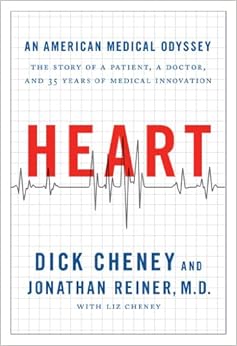
Hardcover: Heart: An American Medical Odyssey / Kindle
Former Vice President Dick Cheney and his longtime cardiologist, Dr. Jonathan Reiner, share the story of Cheney’s thirty-five-year battle with heart disease—providing insight into the incredible medical breakthroughs that have changed cardiac care over the last four decades.
For almost as long as he served at the highest levels of government and business, Dick Cheney has been one of the most well known cardiac patients in the world. When he suffered his first heart attack in 1978, Cheney received essentially the same treatment as President Eisenhower did after his heart attack in 1955. Since then, coronary care has undergone revolutionary changes. The story of these changes is told through the chronicle of Cheney’s own heart disease and the treatments he received.
In Heart, for the first time ever, Dick Cheney shares the very personal story of his health struggles. Heart traces the history of cardiology over the past forty years through the alternating narratives of Cheney and his longtime cardiologist Dr. Jonathan Reiner. In their voices, readers will learn about Cheney’s personal experiences, get a glimpse into the all-important doctor-patient relationship, and learn about the cutting-edge science that has radically changed the way we think about and treat the disease. By revealing the intimate details behind his five heart attacks and most recently, his heart transplant, Cheney offers hope to the millions struggling with cardiovascular disease around the world.

Video: Health concerns loomed over Dick Cheney while in office
CBSNews: Dick Cheney called his current health "a miracle" in a frank discussion of the heart disease he suffered over his entire political career and especially when he served as the vice president. In his first interview about his new book, "Heart," he speaks to Dr. Sanjay Gupta, discussing for the first time the revelation that the defibrillator implanted in his chest could be used by terrorists to kill him and was altered to prevent that. Cheney's 60 Minutes interview aired on Sunday, Oct. 20 at 7:30 p.m. ET/PT.
Before he had a heart transplant 20 months ago, Cheney was a seriously ill man who had undergone several life-saving procedures, including the implantation of a defibrillator. Cheney had that replaced in 2007 and his doctor, cardiologist Jonathan Reiner, with whom he wrote the book, had the device's wireless function disabled so a terrorist couldn't send his heart a fatal shock. Some years later, Cheney was watching an episode of the SHOWTIME hit "Homeland," in which that terrorist scenario was woven into the plot. "I was aware of the danger...that existed...I found it credible," he responds to Gupta when asked what went through his mind. "I know from the experience we had and the necessity for adjusting my own device, that it was an accurate portrayal of what was possible," says Cheney.
Cheney suffered five heart attacks requiring multiple angioplasties and catheterizations, plus a quadruple bypass operation. Still, he says his health troubles never impacted his performance in his job as the second most powerful man in the world. Nor did the stress on the job contribute to his disease, says the former two-term vice president. "I simply don't buy the notion that it contributed to my heart disease," he tells Gupta. "In fact...getting back to work...was important enough that I, in fact, kept them separate...I always did what I needed to do in order to deal with the health crisis in the moment," says Cheney.
At arguably one of the most stressful times for him, making decisions on 9/11 while President Bush was at an appearance in Florida, he says his health did not even occur to him. "I didn't think about my health. I was thinking about the problem we were dealing with," says Cheney. What he didn't know was that a blood test result seen the morning of 9/11 made Dr. Reiner afraid for the vice president's life. It showed a surge of potassium in his blood, a condition called hyperkalemia that could be fatal. Reiner tells Gupta, as he watched 9/11 television coverage that night, he was thinking, "Oh great, the vice president is going to die tonight from hyperkalemia."
Two years ago, Cheney was gaunt, carried a sallow complexion and needed a cane to walk. Today, he says he's a new man and feels "fantastic." At 72, he says he has no real physical limits. "I fish. I hunt...I don't ski, but that's because of my knees, not my heart. So, it's been a miracle," he tells Gupta.
Cheney had his first heart attack over 35 years ago and has been the recipient of many modern heart treatments that seemed to come along at just the right time. He even had a pump attached directly to his heart while awaiting a transplant. He knows luck played a big role in his life. He says Dr. Reiner once made an analogy between the course of Cheney's health and treatment and a person who gets up late and drives to work, but he sees all the traffic lights ahead are red. "'Cheney,'" he says the doctor told him, "'when you get to them, they all turn green.' And that's... a pretty good description," says Cheney.
Gupta quipped that miracle, fantastic and wonderful were not words normally heard out of Cheney’s mouth… Cheney came back with… “You mean from Darth Vader?”

Full 60 Minute Segment Video: Dick Cheney's heart

