Showing posts with label Supreme Court. Show all posts

Thursday, July 31, 2014

The Absence of Obamacare Credits in Federal Exchanges WAS INTENTIONAL – Designed to Force Compliance

Health Care Exchange

By Tom White  –  VA Right  -  Cross-Posted at Ask Marion:Two recent court cases came to two different conclusions in the battle against Obamacare. The question was concerning the language of the bill when it comes to credits in Health Care Exchanges set up by the Federal Government when states decide not to set up State Health Care Exchanges.

The language is pretty clear in the fact that it does create credits for Exchanges set up by the states. These credits are substantial and are the only part of the entire Affordable Care Act that actually addresses affordability. Sadly, this is done by redistributing the wealth. By taxing the productive earners in order to subsidize non-productive earners.

Monthly premiums for silver plans – the standard insurance policy sold on the exchanges – cost an average of $345 a month this year for people who did not qualify for subsidies, a new analysis from the administration shows.  – See more at: http://www.thefiscaltimes.com/Articles/2014/06/18/Average-Obamacare-Subsidy-3312-Paid-Date-47-Billion#sthash.OQTugto5.dpuf

According to The Fiscal Times:

Monthly premiums for silver plans – the standard insurance policy sold on the exchanges – cost an average of $345 a month this year for people who did not qualify for subsidies, a new analysis from the administration shows.

However, for the overwhelming majority of Obamacare enrollees (87 percent) who did qualify for financial assistance, the average monthly premium on the silver plan costs about $69. That’s an average tax credit of about $276 a month, or $3,312 a year. The administration’s report broke down the average monthly premium for each of the four plans offered on the federal marketplace – before and after tax credits. It also detailed the percentage of enrollees selecting each plan, with or without tax credits. Data was not available for the state exchanges, which make up about one third of the total 8 million enrollees.

On average, monthly premiums after subsidies run about $69.00. But without the subsidy, $345.00. And 87% of enrollees qualify for these huge subsidies.

So with all the mandates for coverage, mandates on what must be covered and what can be charged, it is the subsidies and the subsidies alone that make the product affordable. Without them, the cost of Health Insurance rises considerably due to mandatory expanded coverages.

The Affordable Care Act depends on states setting up Exchanges as called for in the law. However, when much of the law was in the process of being written, it was done in secret. No one knew exactly what was going into the mix and the authors were as yet unaware of the massive resistance the bill was about to encounter. But they anticipated at least some token resistance from the rascally Republican controlled states. And this expected resistance was addressed in the bill with various sneaky political weapons and landmines designed to nudge resistive states into setting up the exchanges.

One political weapon the Democrats love to use is abortion. Republicans are outraged when tax dollars are confiscated to pay for a procedure they consider infanticide. So one of the booby traps the architects of Obamacare used was abortion. This would be the first of several “lesser of two evils” options resistive Republican states would face in deciding to implement Obamacare. You may recall the Stupak Amendment that extended the Hyde Amendment wording that prevents the Federal Government from paying for abortions. There was a big argument in House over abortion and several pro life Democrats insisted that the ACA not pay for abortions as a condition of casting their vote for the bill. However, that was the House Bill which was scrapped after Scott Brown’s victory effectively cut off the Democrat’s super majority in the Senate.

The Conservative Intelligence Briefing put it this way:

Recall that after the special election of Sen. Scott Brown, R-Mass., in January 2010, Democrats were suddenly deprived of the flexibility they had expected to have in drafting the law’s provisions. They had expected a House-Senate conference committee in which they could iron out the kinks in the law and then pass it again through both the House and Senate. But suddenly, after Brown won, they realized they would never be able to pass any version of Obamacare through the Senate again. They no longer had the 60 votes they needed.

So the Democrats did the only thing they could: They took the version of the law they had already passed through the Senate on Christmas Eve 2009, and rammed it back through the House, warts and all. There was no second chance to consider this issue or any others in detail. In any event, most members had only a vague idea of what the bill did anyway.

- See more at: http://www.conservativeintel.com/the-briefing-vol-ii-issue-25/?utm_source=Intel&utm_medium=email&utm_campaign=House#sthash.tC38djHj.dpuf

Recall that after the special election of Sen. Scott Brown, R-Mass., in January 2010, Democrats were suddenly deprived of the flexibility they had expected to have in drafting the law’s provisions. They had expected a House-Senate conference committee in which they could iron out the kinks in the law and then pass it again through both the House and Senate. But suddenly, after Brown won, they realized they would never be able to pass any version of Obamacare through the Senate again. They no longer had the 60 votes they needed.

So the Democrats did the only thing they could: They took the version of the law they had already passed through the Senate on Christmas Eve 2009, and rammed it back through the House, warts and all. There was no second chance to consider this issue or any others in detail. In any event, most members had only a vague idea of what the bill did anyway.

- See more at: http://www.conservativeintel.com/the-briefing-vol-ii-issue-25/?utm_source=Intel&utm_medium=email&utm_campaign=House#sthash.tC38djHj.dpuf

Recall that after the special election of Sen. Scott Brown, R-Mass., in January 2010, Democrats were suddenly deprived of the flexibility they had expected to have in drafting the law’s provisions. They had expected a House-Senate conference committee in which they could iron out the kinks in the law and then pass it again through both the House and Senate. But suddenly, after Brown won, they realized they would never be able to pass any version of Obamacare through the Senate again. They no longer had the 60 votes they needed.

So the Democrats did the only thing they could: They took the version of the law they had already passed through the Senate on Christmas Eve 2009, and rammed it back through the House, warts and all. There was no second chance to consider this issue or any others in detail. In any event, most members had only a vague idea of what the bill did anyway.

So the truth is, there is no language in the Senate Bill itself that prevents the Federal Government from paying for abortions. And in order to get the pro life Democrats to vote for the Senate version of Obamacare, Obama issues an executive order #13535 that pretends to forbid Federal payment of abortion. None of the pro life groups were fooled, nor were the voters in Stupak’s District in Michigan. Stupak “retired” and the voters put a Republican in the seat.

But according to Wiki, there are incentives to entice states into setting up these Exchanges:

Under the law, setting up an exchange gives a state partial discretion on standards and prices of insurance, aside from those specifics set-out in the ACA. For example, those administering the exchange will be able to determine which plans are sold on or excluded from the exchanges, and adjust (through limits on and negotiations with private insurers) the prices on offer. They will also be able to impose higher or state-specific coverage requirements—including whether plans offered in the state are prohibited from covering abortion (making the procedure an out-of-pocket expense) or mandated to cover abortions that a physician determines is medically necessary; in either case, federal subsidies are prohibited from being used to fund the procedure. If a state does not set up an exchange itself, they lose that discretion, and the responsibility to set up exchanges for such states defaults to the federal government, whereby the Department of Health and Human Services assumes the authority and legal obligation to operate all functions in these federally facilitated exchanges.

And if having more control and discretion on the policies offered in each state isn’t enough to convince states to implement Obamacare, the Democrats added a big hammer. The Federal Government will come in and run things, leaving the states no say in how health care policies are sold in the state. Take that, you Republicans.

This Youtube video is a recording of the chief architect of the Senate Obamacare bill. The guy who put the political plums and hemlock in the bill, Jonathan Gruber. It is clear from listening to him speak that the intent was to use the lack of subsidies in the Federally run Exchanges as a mechanism to force states into compliance.

Video: Jonathan Gruber Once Again Says Subsidies Are Tied to State-Based Exchanges

But Gruber said that this was a mistake. A speak-o (as opposed to a typo). The intent was always to have the Federally run Exchanges give out the subsidies!

There is a video here that is nearly an hour long that has been making the rounds on the internet. I edited the same video down to about 5 minutes with the important parts being about the first 2 minutes. The rest of this is some pretty revealing comments Gruber made on the longer version.

Video:  Jon Gruber Condense Version

So it is abundantly clear that the intent was to use the lack of subsidies in the Federally run exchanges to pressure states into compliance.

So in the two recent court decisions in direct opposition to one another as FoxNews explains:

WASHINGTON –  Two federal appeals court rulings put the issue of ObamaCare subsidies in limbo Tuesday, with one court invalidating some of them and the other upholding all of them.

The first decision came Tuesday morning from a three-judge panel of the U.S. Court of Appeals for the District of Columbia. The panel, in a major blow to the law, ruled 2-1 that the IRS went too far in extending subsidies to those who buy insurance through the federally run exchange, known as HealthCare.gov.

A separate federal appeals court — the Fourth Circuit Court of Appeals — hours later issued its own ruling on a similar case that upheld the subsidies in their entirety.

The conflicting rulings would typically fast-track the matter to the Supreme Court. However, it is likely that the administration will ask the D.C. appeals court to first convene all 11 judges to re-hear that case.

In both instances the government argued that it is obvious that the intent was to include federal subsidies in the Federally run Exchanges if the states refused to do so. But listening to the guy that wrote the bill, the exact opposite is the case. The subsidies were left out on Federally run Exchanges to use as a weapon to either force Republican governors to implement a state exchange or face the voters to explain why they are paying more for health insurance and get no subsidies. The hope of this Democratic bill was to force Republicans to do something they did not want to do.

Now one of the arguments I have not heard made is that on the issue of abortion on Federally run Exchanges. One of the incentives for the Liberal states to jump in and implement exchanges is the ability to mandate expanded coverages such as 100% payment for abortions. And if we follow the same logic the government argued in the two conflicting ruling cases, that the Federal Government steps in and is essentially considered the state for all intents and purposes – something I find preposterous – then what is to stop the Federal government who suddenly finds itself a surrogate for the state from mandating abortion coverage (from Wiki linked above):

Under the law, setting up an exchange gives a state partial discretion on standards and prices of insurance, aside from those specifics set-out in the ACA. For example, those administering the exchange will be able to determine which plans are sold on or excluded from the exchanges, and adjust (through limits on and negotiations with private insurers) the prices on offer. They will also be able to impose higher or state-specific coverage requirements—including whether plans offered in the state are prohibited from covering abortion (making the procedure an out-of-pocket expense) or mandated to cover abortions that a physician determines is medically necessary;

So if the federal government can come in and replace the state in every way, then the same argued consideration as far as subsidies would extend to the other areas of “partial discretion” of the states. And the law could then go around the Obama executive order prohibiting federal funds from paying for abortion.

This must go to the Supreme Court and the 36 states without state run subsidies must stop receiving federal subsidies.

And as Gruber says in the long version of the video, repeal is unlikely to get rid of Obamacare. But neglect in the form of non compliance will cause it to implode in on itself. He uses a 3 legged as an example. The legs are eliminate pre existing conditions, insurance mandates and subsidies. Take away one of the legs and the law collapses. No one is fighting the pre existing condition elimination and the horrific Supreme Court ruling that held the mandates were a tax (and thus constitutional) is gone as a possible tool to kill the law. The last remaining leg is the subsidies. Without them, the law cannot survive. And since 36 states refused to set up exchanges, this is a huge threat to Obamacare’s survival.

With more and more information being unearthed every day about this bill, this is an important battle in the war on healthcare being prosecuted by the Obama Administration.

Update:

My theory is that if the Court rules that Federal Exchanges are essentially State Exchanges for the purpose of the subsidies, then the Feds are, essentially, the state. States are free to mandate abortion coverage, the Feds are not by Executive order. So if the Federal Government becomes a state for subsidies, then the Feds can mandate abortion coverage and also get around the Exec. Order.  Tom White

Thursday, July 10, 2014

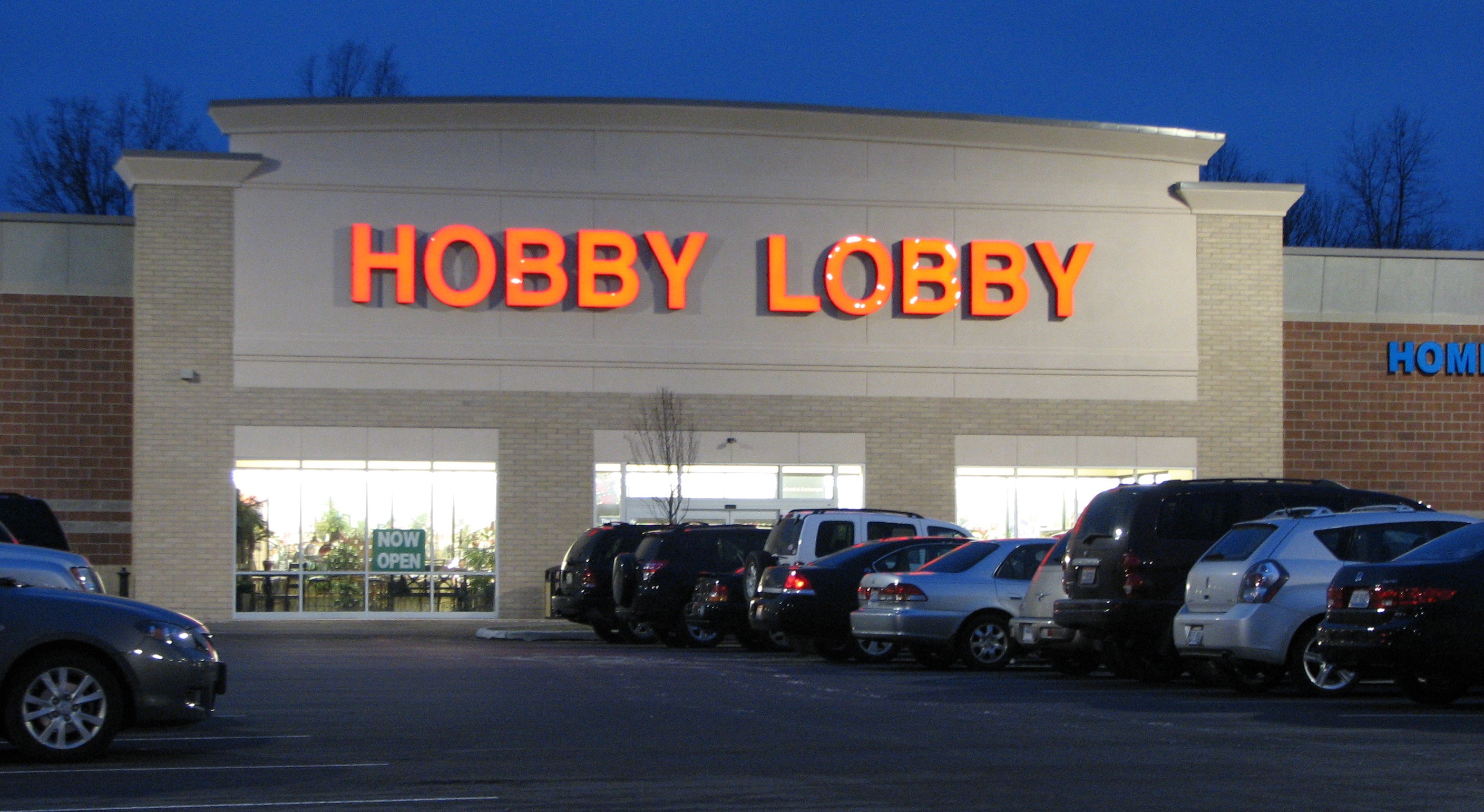
Hobby Lobby: Trying to get DemProgs to understand what it means

HobbyLobbyStowOhio

Support Hobby Lobby With Your Business… And Help Explain the Truth About Them and the Supreme Court Decision to the Low-Informed

Bookworm Room: Impressed by the ill-informed hysterical reaction that my “real me” Facebook friends had to the Hobby Lobby decision, I explained to them that the decision is very narrow and will not (a) ban contraceptives across America and (b) lead to anti-gay lynch mobs. Here’s a slightly revised version of my Facebook post, which still failed to satisfy their paranoia and inability to understand the law.  I’ve also added a little hypothetical that might open their minds.  (No, don’t say it.  It’s improbable, but not impossible, that a DemProg mind can open).

The Hobby Lobby decision addresses one thing only:  whether an administrative rule conflicts with a long-standing law.

In 1993, a Democrat Congress passed, and a Democrat president signed, the Religious Freedom and Restoration Act (“RFRA”). RFRA holds in relevant part that the federal government may act in a way that substantially burdens the exercise of religion only if it can establish that its action is the least restrictive means of advancing a compelling government interest. Nothing in the Act distinguishes between individuals and corporations.

The administrative rule at issue is the edict from Health and Human Services (“HHS”) mandating that all corporations affected by Obamacare must provide their female employees with unlimited access to all contraceptives available on the market.

Hobby Lobby is a closely-held, family-run corporation. The Green family, which owns Hobby Lobby, has a strong Christian faith, and is open about the fact that it runs its company in a way that is consistent with the family’s religious beliefs. These beliefs affect every aspect of the way in which Hobby Lobby is run, whether it’s the fact that even the least of Hobby Lobby’s employees gets paid an hourly amount that’s almost twice as much as minimum wage, or the fact that many of the store’s craft products come complete with little crosses attached to them.

Hobby Lobby has long provided comprehensive insurance for its employees. As part of this insurance, it makes available to its employees 16 different types of contraceptives. Moreover, Hobby Lobby has never said (a) that it would stop covering contraceptives entirely or (b) that contraceptives should be outlawed in America. Instead, it made a very narrow protest to the HHS mandate:  It objected to the fact that the mandate would force it to offer, not 16, but 20 contraceptives to its employees.  The additional 4 contraceptives are or can be used as abortion-causing agents.  The Green family’s religious faith means that it is adamantly opposed to abortion, which it considers murder.

The HHS mandate put Hobby Lobby in an impossible position: It could either use its own money to pay directly for abortifacient drugs or it could pay $475 million a year in penalties. It was this dilemma, it argued, that constituted a substantial burden on its exercise of religion under RFRA. Put another way, Hobby Lobby argued that it faced a Hobson’s choice:  directly fund something it opposes on core religious grounds or go bankrupt.  On these facts, the Supreme Court agreed that Hobby Lobby had satisfied the “substantial burden” requirement under RFRA.

There was something else that the Supreme Court accepted as given: For purposes of the ruling, the Supreme Court accepted as true HHS’s claim that forcing corporations to pay for their female employees’ contraceptives (simply because the Obama administration says it’s unfair not to) serves a compelling government interest.

(As an aside, I was thinking about this “unfair” point. According to my DemProg friends, the demand that corporations pay for contraceptives arises because it’s not fair that women have to shoulder these costs, while men don’t. Let’s put aside the fact that the DemProgs can’t explain why it’s fair that corporations must bear contraception costs.  The really important point is that, if the reason to force corporations to shoulder the burden is so that women don’t have to pay more in costs related to their unique biology just because they are women, corporations should also be required to pay for tampons, sanitary pads and, most importantly, chocolate, all of which are costly menstrual necessities that burden women, not men.  Additionally, corporations should be entitled to learn which employees have gone through menopause, so as to scale back on those uniquely feminine costs.  And now back to the Hobby Lobby case…)

With the Supreme Court having accepted that Hobby Lobby had proved that it was being significantly burdened and that HHS had proved a compelling government interest, the sole issue before the Court was whether HHS was using the least restrictive means to advance its compelling interest. Based on this single, limited issue, the Supreme Court concluded that HHS’s birth control mandate did not meet the RFRA test. The Court had a very simple metric for proving this conclusion: HHS itself handed the Court proof that there was a less restrictive way to serve this compelling interest.

HHS created this less restrictive contraception mandate when religious non-profit organizations objected to paying directly for contraceptives and abortifacients. HHS said that religious institutions could avoid the mandate by signing a document stating that their religious beliefs prevented them from complying with the contraception mandate. With this document, the onus shifts to the insurance company to apply the mandate.  (The Little Sisters of the Poor are challenging this workaround on the ground that it cannot apply to self-insured entities.  Likewise, even if the religious entity has a third party insurance company, the insurance company will simply increase its rates, with the result that the money for the contraceptives and abortifacients will still come from the corporation that has religious objections.  The Supreme Court’s eventual decision should be interesting.)

With HHS having already figured out a less intrusive method for getting “free” contraceptives to women, the Supreme Court held that the same workaround that applies to religious non-profits can apply equally well to closely held corporations if the owners have a sincere belief in a core religious issue. And that’s it. That’s the whole Hobby Lobby decision.

My Facebook explanation was clear enough that those who have been brainwashed into being terrified by the Hobby Lobby decision had only two defenses left. The first was that religious fanatics will use the decision to justify myriad things such as banning birth control nationwide, revoking the rule that corporations must pay for women’s contraceptives, and refusing to hire gays (a fear based upon this letter from a religious leader who clearly hadn’t read the Hobby Lobby decision himself).

The second defense, which I’ll address in the remainder of this post, was that the entire decision is wrong because, as a predicate matter, it treats a corporation as a person. “Corporations aren’t people” my DemProg friends cry, as they’ve been programmed to do since the Citizens United decision.  In other words, Hobby Lobby has no conscience and therefore cannot be treated as a conscientious objector.

I came up with a hypothetical scenario — a probable hypothetical scenario — that should have DemProgs insisting that, yes indeedy, corporations can and should be people — or, at least, Leftist corporations can and should be people.

The year is 2026. Since 2020, Republicans have majorities in Congress and a president in the White House. The wars in Syria and Iraq long ago merged, starting a conflagration that constantly threatens to spill over into every region of the world. The result is the Islamist caliphate equivalent of the Cold War, with the U.S. trying to put out small Islamic fires all over the world in order to de-fang the Sunni and Shia monsters without having to engage them directly on American soil.

The military is more central to American life and survival than ever. Defense costs have therefore skyrocketed, so Republicans went looking for new ways to equip the military. To this end, they noted that America’s business class was arguably benefiting most from the military’s efforts, because businesses were able to carry on and profit primarily because the military kept the Islamists far from American shores. It therefore would be logical for corporations to subsidize a significant part of the war effort.

Based upon this reasoning, in 2022, the Republicans successfully passed a new law, known as the Act for an Affordable Military (“AAM”). The Acts’ supporters affectionately call it “Adopt A Marine.” Its detractors refer to it disdainfully as “America’s A Monster.”

AAM goes far beyond traditional military funding, which relied upon tax revenues funneled to the Pentagon. Instead, AAM directly engages corporate America as an essential part of equipping the American military. Immediately upon the Act’s passage, the Pentagon was tasked with creating rules under AAM (a 3,200 portmanteau document written in vague and broad terms) that would shift onto corporations primary responsibility for equipping troops.

The Pentagon immediately issued a rule mandating that henceforth every corporation will be responsible for outfitting Marines with everything a Marine at war could need:  uniform, pack, weapons . . . the whole megillah.  Moreover, the number of Marine Gear Kits (or “MGKs”) that a corporation must assemble will be equal to the number of employees the corporation has. Thus, a corporation with ten employees must put together 10 MGKs, a corporation with 50 employees must put together 50 MGKs, and so on. Thanks to the Supreme Court’s 2012 Obamacare decision, this kind of . . . ahem . . . “tax” (i.e., forcing taxpayers to purchase a product, even if they don’t want it themselves) is perfectly legitimate.

Corporations that fail to comply with the MGK mandate will be assessed an annual tax equal to $10,000 per MGK, with no maximum cap. That means that, if a corporation with 50 employees refuses to put together its designated MGKs, it will pay an annual penalty of $500,000. A corporation with 30,000 employees could find itself on the hook for $300,000,000 annually.  Again, the Supreme Court’s 2012 Obamacare decision legitimized this “penalty” for failure to “pay” the “tax.”

Something else has changed now that the Cold War against the new Caliphate is being carried out by Republicans:  The DemProg peace movement is resurgent. Two of the most active peaceniks, Sol and Luna Giggleweed started out in their home office in 2020 (when Republicans finally re-took Congress and the White House following Elizabeth Warren’s ill-fated four-year presidency), designing, creating, and marketing bumper stickers, window signs, mugs, toilet paper . . . anything that could advance the pacifist cause.

With business booming, the Giggleweeds incorporated, calling their new business “Pacifists United Together Zone” or “PUTZ.” They now have 50 full-time employees working in their green-compliant factory in San Francisco’s SoMa district.

Thanks to the Giggleweed’s business acumen, you can now walk into any trendy store and buy one of PUTZ’s $25 king-size mugs emblazoned with “Live Peacefully or Die.”  If that’s too expensive, for $10 you can get a set of 10 bumper stickers reading “Peace : The New Caliphate Wants It Too.” PUTZ also manufactures the usual complement of sweatshirts with peace signs on them; posters urging people to “Visualize World Peace” or “Pray for Israel’s Destruction”; and the ever-popular Naughty Underwear set, in both multigender and cisgender versions, with “Make Love, Not War” glitter-stamped on the crotch.

For the Giggleweeds, peace isn’t just a gimmick to make a motive; it’s also their core ideology. Both Sol and Luna attended the Bush-era anti-war protests, and they oppose Republican-led wars with every fiber of their DemProg beings.

Significantly, even the Giggleweed’s faith is driven by their pacifism. They are ardent members of the Presbyterian Church (USA) (aka “PCUSA”).  In 2018, PCUSA’s governing board formally voted that “We, the PCUSA, oppose all wars, except for those wars dedicated to Israel’s destruction.”

Nobody quite knows how it did it, but PCUSA asserted that this vote reflected a core religious principle derived from the Books of Samuel, 1 Kings, and 1 Chronicles.  PCUSA’s revised doctrine is immune to challenge thanks to the tattered remnants of the First Amendment (which, in 2018, was amended to state that “Except as to matters of human sexuality and gender identity, Congress shall make no law respecting an establishment of religion, or prohibiting the free exercise thereof. . . .”).

PUTZ employees are as devout as the Giggleweeds. Indeed, many of them came to the Giggleweed’s attention during the Bush War protests.  Without exception, all of the employees belong to PCUSA or affiliated faiths. Their strong anti-war beliefs (unless, of course, the war is waged against Israel) infuse every aspect of their lives.  They are grateful to work at PUTZ, a corporation with a business model that puts pacifism on the front line, so to speak.

For these reasons, the Giggleweeds and their PUTZ employees were horrified when AAM became law and, even worse, when the Pentagon explicitly passed to corporations the responsibility for providing MGKs. PUTZ therefore joined with PCUSA and other like-minded churches and mosques, which are also on the hook for MGKs, to object to the mandate that they directly invest in MGKs or pay a substantial penalty to help fund the “Republican Anti-Caliphate War Machine.”

The Republican establishment was unmoved by anti-AAM protesters. Instead, it took great pleasure in reminding the protesters and litigants that, thanks to agitation from this same cadre of people in the wake of the Hobby Lobby decision, Congress in 2016 (Year One of Elizabeth Warren’s disastrous administration) amended RFRA to state explicitly that it does not apply to corporations, regardless of the corporation’s size or whether it’s publicly traded or closely held. There is no way out for the Giggleweeds and PUTZ: they either put together MGKs for the Marines, or they pay $500,000 so that someone else can put the MGKs together for them.

To the Giggleweeds and their ilk, the Republicans have only one thing to say:  It’s always nasty when your own chickens come home to roost.

Saturday, July 5, 2014

The Biggest Threat to Obamacare Yet is Right Around the Corner: Halbig vs Burwell

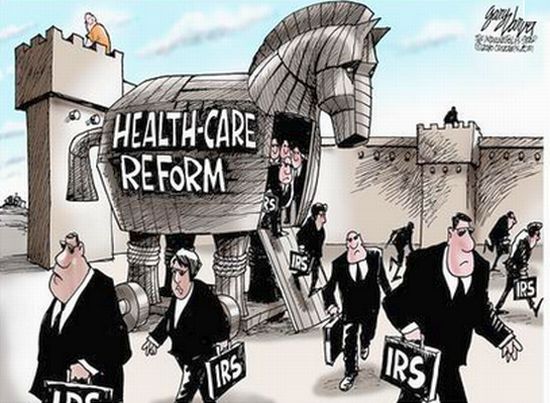
obamacare-irs-cartoon

Halbig v. Burwell is based on an illegal action taken by the Internal Revenue Service in 2012

By: C. Steven Tucker  -  Gulag Bound  -  TruthAboutObamacare.com  -  h/t to the NoisyRoom

A case about to be decided by the U.S. Court of Appeals for the D.C. Circuit could stop Obamacare dead in its tracks in 34 states. Halbig v. Burwell is based on an illegal action taken by the Internal Revenue Service in 2012. Below I will outline that illegal action and the two sections of the PPACA (Obamacare) that are relevant in this case.

State-based exchanges and federally facilitated exchanges

Section 1311 of the PPACA describes state-based health insurance exchanges. That section outlines the powers granted to the IRS to provide APTC – “Advance Premium Tax Credits” (a.k.a. ‘subsidies’) that will be used to artificially lower the high cost of health insurance offered in a state-based exchange. Tied to those APTC’s is also the power granted to the IRS to levy a $2,000 or $3,000 excise tax (non-tax deductible) on all employers with 50 or more full-time employees (first 30 employees waived) if they do not provide PPACA approved health insurance. This is a lot of new power granted to the IRS and this is the primary reason the IRS is hiring thousands of new agents.

Section 1321 of the PPACA describes federally-facilitated exchanges and state-federal partnership exchanges – like the exchange the state of Illinois has chosen to establish. In these types of exchanges, the IRS is granted no authority to provide APTC’s or to levy excise taxes on any employer in that state for not providing PPACA approved health insurance. Since the crafters of the PPACA assumed that every state would willingly establish a state-based exchange, there was no money appropriated for federally-facilitated exchanges.

Thus far 34 states have chosen not to open a state-based health insurance exchange. As such federally-facilitated exchanges have been implemented in those states regardless of the wishes of those state’s legislatures.

The illegal action taken by the IRS

Here’s the kicker, in order to ‘fix’ this legal ‘opt out’ that section 1321 provides to states that choose not to open a state-based exchange. The Internal Revenue Service finalized a proposed rule on the 2 year anniversary of the passage of the PPACA that offers APTC’s -Advance Premium Tax Credits – through exchanges “established under section 1311 OR 1321 of the PPACA. Those six characters—”or 1321?—constitute as Cato’s Michael Cannon correctly describes “an unconstitutional and as such illegal rewriting of the statute.” By issuing tax credits where Congress did not authorize them, this rule triggers billions of dollars in taxpayer provided “subsidies” and imposes excise taxes on employers with 50 or more full-time employees in all 50 states. Whether they have a state-based, state-federal partnership or federally facilitated exchange. Since the IRS is not a Legislative branch, this action was illegal. It was not authorized by Congress and as such it should not stand.

Worse yet, President Obama is following this new proposed rule as if it was codified law. This illegal action taken by the IRS and President Obama’s support of it is the crux of the Halbig v. Burwell case. If the U.S. Court of Appeals upholds the rule of law in this case it will mean the end of Obamacare in 34 states. In turn, it may be the final death blow to an unconstitutional and wildy unpopular law.

Thursday, July 3, 2014

Hobby Lobby Wins SCOTUS Decision as Obama Racks Up a String of Judicial Losses at Supreme Court

It has been a tough week for President Obama at the Supreme Court!  As the somewhat surprising ObamaCare loss to Hobby Lobby was added to the tally on Monday, the Obama administration lost 4 out of 5 big decisions and 2 were rare 9 to 0 decisions.

supreme.jpg

The Roberts Court

By Marion Algier – Ask Marion

Although not unanimous decisions, after months of judicial rulings reining in big government and police on issues like snooping on Americans without a warrant, restrictions on campaign finance and President Obama’s recess appointment powers, the administration’s losses on ObamaCare rules and compulsory union dues served as a final rebuke by the Supreme Court on their last day of this session.

In the five years that President Obama has been in office, the Supreme Court has rejected the government’s argument with a 9-0 decision 20 times.

During the eight years each in the administrations of Bill Clinton and George W. Bush, the government lost on unanimous votes 23 times and 15 times, respectively, putting the Obama administration on course to to be the biggest loser in recent history in terms of judicial losses.  Unfortunately for the American people, Obama won on the big one… the most damaging decision for America: ObamaCare, a decision many people are still baffled by and questioning.

President Obama appointed two of the sitting Supreme Court Judges Elena Kagan and Sonia Sotomayor, under an umbrella of considerable scrutiny and dissent by conservatives, the right. So the number of unanimous cases are important in that nobody can say, ‘Well, there are five Republican appointees on the court and only four Democrats.’

“These cases where they haven’t gotten the votes of either of the two Obama nominees means the arguments being presented by the Justice Department to the court are just out of left field,” said Ilya Shapiro, a senior fellow in constitutional studies at the libertarian Cato Institute.

Monday’s decisions were not unanimous, but congressional Republicans and other critics of President Obama saw the rulings as evidence that the Roberts court is finally acting as something of a final line of defense, a check and balance as they were meant to be, against a president who brags about his use of executive power to bypass Congress and impose his progressive agenda on the American people.

House Speaker John A. Boehner said of Monday’s decision, “It is a victory for religious freedom and another defeat for an administration that has repeatedly crossed constitutional lines in pursuit of its big government objectives.”  Boehner announced last week that he would be suing the president for abuse of executive authority.  And although it is unclear how that lawsuit will play out, the administration’s recent track record in high-profile cases has been poor.

Chief Justice John Roberts managed to corral unanimous votes on both privacy and recess appointments — cases that have dealt stinging defeats to the president, having himself been a lawyer and former lecturer on constitutional law.

US Supreme Court to police: To search a cell phone, 'get a warrant':

Christian Science Monitor: WASHINGTON — In a major affirmation of privacy in the digital age, the US Supreme Court on Wednesday ruled that police must obtain a warrant before searching digital information on a cell phone seized from an individual who has been arrested.

The 9-to-0 decision marks a Fourth Amendment landmark of profound importance given the ubiquity of cell phones, tablets, and portable computers in public places throughout society.

“Modern cell phones are not just another technological convenience,” Chief Justice John Roberts wrote for the court. “With all they contain and all they may reveal, they hold for many Americans the ‘privacies of life,’ " he said.

“The fact that technology now allows an individual to carry such information in his hand does not make the information any less worthy of the protection for which the Founders fought,” the chief justice said.

“Our answer to the question of what police must do before searching a cell phone seized incident to an arrest is accordingly simple – get a warrant.” Read More

0625-COURT-PHONE-sized.jpg_full_600

The Supreme Court delivered a solid blow Thursday to President Obama, ruling that he went too far in making recess appointments to the National Labor Relations Board.

SCOTUS Limits Recess Appointments Decision:

Fox News: In a unanimous decision, the high court sided with Senate Republicans and limited the president's power to fill high-level vacancies with temporary appointments. It was the first-ever Supreme Court test involving the long-standing practice of presidents naming appointees when the Senate is on break.

In this case, Obama had argued that the Senate was on an extended holiday break when he filled slots at the NLRB in 2012. He argued the brief sessions it held every three days were a sham that was intended to prevent him from filling the seats.

The justices rejected that argument, though, declaring the Senate was not actually in a formal recess when Obama acted during that three-day window.

Justice Stephen Breyer said in his majority opinion that a congressional break has to last at least 10 days to be considered a recess under the Constitution. Read  More

On recess appointments, justice was delayed but served…

Mandatory Union Fees Curbed by Court in Blow to Labor

BusinessWeek: A divided U.S. Supreme Court handed a setback to organized labor by placing new limits on the ability of unions to demand fees from some public-sector workers.

The high court, voting 5-4, invalidated Illinois rules requiring union payments from people who provide in-home care for disabled Medicaid recipients. The majority said those rules violated the workers’ constitutional right to freedom of speech and association because the home health-care workers weren’t true public employees.

“If we accepted Illinois’ argument,” Justice Samuel Alito wrote in today’s majority opinion, “we would approve an unprecedented violation of the bedrock principle that, except perhaps in the rarest of circumstances, no person in this country may be compelled to subsidize speech by a third party that he or she does not wish to support.”  Read More

Hobby Lobby Wins SCOTUS Decision

Ask Marion/THITW:  Monday’s decision was very narrow and some pro-life and religious groups question whether it was a win in the long run in their battles.  It certainly was in the short run!! You be the judge…

Attorneys Who Defended Hobby Lobby

Attorneys Who Defended Hobby Lobby Celebrating

American Thinker: Hobby Lobby 1, Obamacare 0

Hobby Lobby Stores Inc. co-founders David and Barbara Green who are asking a federal appeals court in Denver on Thursday, May 23, 2013,  for an exemption from part of the federal health care law that requires it to offer employees health coverage that includes access to the morning-after pill.  The Oklahoma City-based arts-and-crafts chain argues that businesses, and not just religious groups, should be allowed to seek exemptions from that part of the health law if it violates their religious beliefs.  PHOTO ILLUSTRATION/ AP PhotosThe Supreme Court upheld the religious freedom rights of Hobby Lobby, the closely-held corporation owned by believing Christians who objected to being required to supply the abortion pill to their employees.

Steve Ertelt of Life News reports:

…the U.S. Supreme Court today issued a favorable ruling in Sebelius v. Hobby Lobby Stores, Inc., a landmark case addressing the Constitutionally guaranteed rights of business owners to operate their family companies without violating their deeply held religious convictions.

Writing for the 5-4 majority, Justice Samuel Alito handed down the decision for the high court, saying, “The Supreme Court holds government can’t require closely held corporations with religious owners to provide contraception coverage.”

“HHS’s contraception mandate substantially burdens the exercise of religion,” the decision reads, adding that the “decision concerns only the contraceptive mandate and should not be understood to mean that all insurance mandates.”

Justice Anthony Kennedy wrote a concurring opinion saying that government itself could provide the coverage for contraception and the abortion-causing drugs if a company declines to do so.

The Hobby Lobby decision only applies to companies. Non-profit groups like Priests for Life and Little Sisters are still waiting for a ruling about their right to opt out of the mandate.

Note that this ruling only applies to closely-held corporations, but does not rule out applying the same religious freedom reasoning to publicly-held firms and nonprofits.

Ed Lasky points out:

The fact that both these decisions [Hobby Lobby and the forced union dues case] were 5-4 points out the danger of Obama picking the next SC Justice with Reid in control of the Senate. If the opportunity present itself, he will abolish the filibuster for SC nominees, too.

Memo.com: The Supreme Court Gets It Right

Finally, the U.S. Supreme Court has stepped up to defend Americans’ most basic freedoms from the full-frontal assault by the rampaging band of leftists running America. In a 5-4 decision, the Court ruled in favor of Hobby Lobby, a Christian business that objected on religious ground to Obamacare’s mandate that they must cover certain contraceptives.

Hobby Lobby is among about 50 businesses that have sued over covering contraceptives. Some, like Hobby Lobby, are willing to cover most methods of contraception, as long as they can exclude abortifacients.

Justice Samuel Alito said the decision is limited to contraceptives. “Our decision should not be understood to hold that an insurance-coverage mandate must necessarily fall if it conflicts with an employer’s religious beliefs,” he said. He suggested two ways the administration could deal with the birth control issue. The government could simply pay for pregnancy prevention, he said. Or it could provide the same kind of accommodation it has made available to religious-oriented, not-for-profit corporations.

Justice Anthony Kennedy, who was part of the majority, also wrote separately to say the administration can solve its problem easily. “The accommodation works by requiring insurance companies to cover, without cost sharing, contraception coverage for female employees who wish it,” Kennedy said. He said that arrangement “does not impinge on the plaintiffs’ religious beliefs.” Everyone’s rights respected and problem solved. Easy peasy.

Of course, Obamacare was never about health care or health insurance. It was only and always about government power and control. Over you. That’s what the contraceptive mandate was all about: social engineering, abortion made even easier to get, and with the government holding the strings of control over all of it.

Thank goodness the Supremes ruled on the side of religious liberty. It’s about time. But that 5-4 split is too close for comfort. As we head into 2016, don’t forget that the Supreme Court—like all of our courts—hangs by a thread, and with it, our most basic freedoms.

Huffington Post:  If Hobby Lobby Wins, Pro-life Christians Lose

We now know with certainty that the Supreme Court will announce its Hobby Lobby decision on Monday. This weekend, the craft and home décor store, along with numerous evangelical institutions that have filed briefs in its support -including my former employer the National Association of Evangelicals–are hoping and praying God will favor them with a whole new expansion of religious freedom and the protection of human life. I’m praying for the opposite.

Along with nearly 50 other for-profit corporations, Hobby Lobby is demanding the same religious freedoms and protections that each of us has. Hobby Lobby was not endowed by its Creator with certain unalienable rights. It does not have a soul. It cannot have faith. Yet its owners (and their lawyers) insist that it should not have to comply with the contraceptive coverage requirement in the Affordable Care Act on religious grounds. The Obama Administration reasonably granted an opt-out to houses of worship and other religious nonprofits. Hobby Lobby wants similar treatment.

Evangelical intervention on behalf of the multi-billion dollar corporation, which donates generously to their causes, is wrong for many reasons but here are two major ones: If you are pro-religious liberty and pro-life and family, you can’t support allowing a for-profit corporation to use religion to deny contraceptive coverage.

First, supporters of Hobby Lobby think they are helping the Christian faith but are actually harming it. In fact, a ruling in favor of Hobby Lobby weakens religious freedom.

When anyone can use religion to claim an exemption on anything, religion loses meaning. Rather than a personal belief embedded in our souls, faith would become a set of arbitrary rules any corporation could choose from to skirt the law.

Is this what evangelicalism needs? I spent nearly three decades in governmental relations at the National Association of Evangelicals defending the free-exercise of religion and the right to life, among many other traditional values. Coming to the aid of for-profit corporations who want to ride on the backs of religion is not one of these honored principles.

Indeed, it is a kind of corporatism invading the body of Christ — concern not for the “least of these” but the richest of those among us. Is this what Christ would do?

When corporations are allowed the same exemptions that have always been reserved just for churches–whether on health benefits, hiring, or land use–those special protections become less clear and more open for interpretation.

If a for-profit corporation is eligible for legal exemptions on grounds of religious freedom, it puts government in charge of deciding what is or isn’t religion. You can just imagine the lawyers who will find work forever litigating these claims. I know, from experience, that their concern for what should be “legal” is not the same as what is “spiritual” or truly serves the interests of the Church.

What if a corporation owned by Jehovah Witnesses refuses to cover blood transfusions? If Christian corporations are allowed to use faith to refuse contraception coverage to women who work for them, what’s to stop a Christian Scientist business from refusing to cover any health benefits?

Second, the supporters of Hobby Lobby think they are being “pro-life.” They are wrong. A massive study conducted in 2012 showed that contraception coverage without a co-pay could dramatically reduce the abortion rate.

That study, conducted by the Washington University School of Medicine, of 10,000 women at-risk for unintended pregnancy found that when given their choice of birth control methods, counseled about their effectiveness, risks, and benefits, with all methods provided at no cost, about 75 percent of women in the study chose the most effective methods: IUDs or implants. Most importantly, as a result, annual abortion rates among study participants dropped up to 80 percent below the national abortion rate.

Well, you might ask, based upon some of the charges being made, aren’t the contraceptive methods being funded through the Affordable Care Act, abortifacients? Not if you believe medical science.

In the words of Jeffrey F. Peipert, M.D., Ph.D., the Robert J. Terry Professor of Obstetrics & Gynecology at Washington University School of Medicine, “these contraceptive methods work by preventing pregnancy (fertilization) from occurring in the first place. For instance, the intrauterine device works primarily by preventing fertilization. Plan B (or the progestin-containing, morning-after pill), along with Ella (ulipristal acetate), delay the release of a woman’s egg from her ovary. The egg does not get fertilized, which means the woman does not become pregnant.”

In sum, Evangelicals supporting Hobby Lobby at the Supreme Court are not actually being pro-religious freedom or pro-life. If they win at the Supreme Court, these causes will be damaged in the long run.

Although this decision in favor of Hobby Lobby is generally seen as a victory by most on the right, and a win for freedom in general, it has opened the door for a lot of whining by the left, who will certainly take their misinformation and use it as a weapon in the upcoming 2014 Elections.  Therefore, it could not be a better time for Carly Fiorina’s new Pac… the UP Project, to educate women.

A big Supreme Court win on ‘greenhouse gas’ regulations for the EPA

The only win for the White House and the EPA this Supreme Court Session was on greenhouse gas:

A big Supreme Court win on 'greenhouse gas' regulations for the EPA

Human Events:

The outcome is likely to be welcomed by environmentalists because it confirms the Environmental Protection Agency’s authority to restrict greenhouse gases.

The justices handed down two separate rulings in a dispute over permits for new or modified power plants and factories.

In a 7-2 vote, the justices agreed the Environmental Protection Agency could force major polluters to use new and better technology to limit their emissions of carbon dioxide.

“These are major polluting facilities, such as factories and coal-fired power plants,” said Justice Antonin Scalia, and they are already subject to EPA restrictions. Now, those restrictions can include limits on greenhouse gases, he said.

The only disappointment faced by the regulatory State was that a separate 5-4 decision kept it from extending this authority to “millions of other facilities,” as the L.A. Times puts it, although I think that could be more properly rendered as “virtually all other facilities.”  The greenhouse-gas fantasy retains its grip on power plants, but at least they can’t make nearly every construction project pull “greenhouse gas permits,” which is where all of this was headed.  Today’s ruling also won’t do anything to stop the broader War on Energy carried out by the Obama Administration.  Considering what they won at the Supreme Court, their losses are trivial. Read More

Jonathan Turly Weighs In On Supreme Court Ruling & Executive Orders Special Report:

REP. BOB GOODLATTE (R-VA): Professor Turley, the constitution, the system of separated powers is not simply about stopping one branch of government from usurping another. It's about protecting the liberty of Americans from the dangers of concentrated government power. How does the president's unilateral modification of act of Congress affect both the balance of power between the political branches and the liberty interests of the American people?

JONATHAN TURLEY: Thank you, Mr. Chairman. The danger is quite severe. The problem with what the president is doing is that he's not simply posing a danger to the constitutional system. He's becoming the very danger the Constitution was designed to avoid. That is the concentration of power in every single branch.

This Newtonian orbit that the three branches exist in is a delicate one but it is designed to prevent this type of concentration. There is two trends going on which should be of equal concern to all members of Congress. One is that we have had the radical expansion of presidential powers under both President Bush and President Obama. We have what many once called an imperial presidency model of largely unchecked authority. And with that trend we also have the continued rise of this fourth branch. We have agencies that are quite large that issue regulations. The Supreme Court said recently that agencies could actually define their own or interpret their own jurisdiction. (House hearing, December 3, 2013).

Video:  Jonathan Turly Weighs In On Supreme Court Ruling & Executive Orders Special Report

UPDATE: The Kelly File, 2/12/2014: Turley on Expansion of Presidential Powers: "We Have Become a Nation of Enablers"

As for me… All in all, I’d say it was a great week!!  It is just too bad we can’t get decisions on the Constitutionality of important matters a little bit quicker!  It would save us a whole of hurt… money and time!!

Related:

Hobby Lobby Wins SCOTUS Decision

Supreme Court Delivers Unanimous Decisions in Two Important Patent Cases: What Do This Week’s Limelight and Nautilus Decisions Mean for You?

Two Unanimous Supreme Court Decisions Grant Immunity to Police, Secret Service

Supreme Court ruling dents public sector labor unions

Justices turn away 'conversion' therapy ban cases

Scalia Dissent: Judicial Gay Marriage Decision Is Jaw-Dropping

Supreme Court: Prayer at council meetings Constitutional

Did NSA Blackmail Roberts to OK ObamaCare?

U.S. Supreme Court dumps AZ voter law

Supreme Court Upholds Obamacare…

Scalia vs. Thomas Jefferson on secession

Democrats eye Hobby Lobby defeat as a weapon on the campaign trail

HUMPHRIES: The liberal bully of the week is … Supreme Court Justice Ruth Bader Ginsburg

Critics Question Constitutionality of President’s Executive Actions – Andrew Napolitano – The Kelly File

Monday, June 30, 2014

Hobby Lobby Wins SCOTUS Decision

It has been a tough week for President Obama at the Supreme Court!  The Obama administration lost 4 out of 5 decisions and 2 were rare 9 to 0 decisions, and today ObamaCare’s loss to Hobby Lobby was added to tally.  However, today’s decision was very narrow and some pro-life and religious groups question whether it was a win in the long run in their battles. You be the judge…

By Marion Algier – Ask Marion

Attorneys Who Defended Hobby Lobby

Attorneys Who Defended Hobby Lobby Celebrating

American Thinker: Hobby Lobby 1, Obamacare 0

The Supreme Court upheld the religious freedom rights of Hobby Lobby, the closely-held corporation owned by believing Christians who objected to being required to supply the abortion pill to their employees.
Steve Ertelt of Life News reports:

…the U.S. Supreme Court today issued a favorable ruling in Sebelius v. Hobby Lobby Stores, Inc., a landmark case addressing the Constitutionally guaranteed rights of business owners to operate their family companies without violating their deeply held religious convictions.

Writing for the 5-4 majority, Justice Samuel Alito handed down the decision for the high court, saying, “The Supreme Court holds government can’t require closely held corporations with religious owners to provide contraception coverage.”

“HHS’s contraception mandate substantially burdens the exercise of religion,” the decision reads, adding that the “decision concerns only the contraceptive mandate and should not be understood to mean that all insurance mandates.”

Justice Anthony Kennedy wrote a concurring opinion saying that government itself could provide the coverage for contraception and the abortion-causing drugs if a company declines to do so.

The Hobby Lobby decision only applies to companies. Non-profit groups like Priests for Life and Little Sisters are still waiting for a ruling about their right to opt out of the mandate.

Note that this ruling only applies to closely-held corporations, but does not rule out applying the same religious freedom reasoning to publicly-held firms and nonprofits.

Ed Lasky points out:

The fact that both these decisions [Hobby Lobby and the forced union dues case] were 5-4 points out the danger of Obama picking the next SC Justice with Reid in control of the Senate. If the opportunity present itself, he will abolish the filibuster for SC nominees, too.

Memo.com: The Supreme Court Gets It Right

Finally, the U.S. Supreme Court has stepped up to defend Americans' most basic freedoms from the full-frontal assault by the rampaging band of leftists running America. In a 5-4 decision, the Court ruled in favor of Hobby Lobby, a Christian business that objected on religious ground to Obamacare's mandate that they must cover certain contraceptives.

Hobby Lobby is among about 50 businesses that have sued over covering contraceptives. Some, like Hobby Lobby, are willing to cover most methods of contraception, as long as they can exclude abortifacients.

Justice Samuel Alito said the decision is limited to contraceptives. "Our decision should not be understood to hold that an insurance-coverage mandate must necessarily fall if it conflicts with an employer's religious beliefs," he said. He suggested two ways the administration could deal with the birth control issue. The government could simply pay for pregnancy prevention, he said. Or it could provide the same kind of accommodation it has made available to religious-oriented, not-for-profit corporations.

Justice Anthony Kennedy, who was part of the majority, also wrote separately to say the administration can solve its problem easily. "The accommodation works by requiring insurance companies to cover, without cost sharing, contraception coverage for female employees who wish it," Kennedy said. He said that arrangement "does not impinge on the plaintiffs' religious beliefs." Everyone's rights respected and problem solved. Easy peasy.

Of course, Obamacare was never about health care or health insurance. It was only and always about government power and control. Over you. That's what the contraceptive mandate was all about: social engineering, abortion made even easier to get, and with the government holding the strings of control over all of it.

Thank goodness the Supremes ruled on the side of religious liberty. It's about time. But that 5-4 split is too close for comfort. As we head into 2016, don't forget that the Supreme Court---like all of our courts---hangs by a thread, and with it, our most basic freedoms.

Huffington Post:  If Hobby Lobby Wins, Pro-life Christians Lose

We now know with certainty that the Supreme Court will announce its Hobby Lobby decision on Monday. This weekend, the craft and home décor store, along with numerous evangelical institutions that have filed briefs in its support -including my former employer the National Association of Evangelicals--are hoping and praying God will favor them with a whole new expansion of religious freedom and the protection of human life. I'm praying for the opposite.

Along with nearly 50 other for-profit corporations, Hobby Lobby is demanding the same religious freedoms and protections that each of us has. Hobby Lobby was not endowed by its Creator with certain unalienable rights. It does not have a soul. It cannot have faith. Yet its owners (and their lawyers) insist that it should not have to comply with the contraceptive coverage requirement in the Affordable Care Act on religious grounds. The Obama Administration reasonably granted an opt-out to houses of worship and other religious nonprofits. Hobby Lobby wants similar treatment.

Evangelical intervention on behalf of the multi-billion dollar corporation, which donates generously to their causes, is wrong for many reasons but here are two major ones: If you are pro-religious liberty and pro-life and family, you can't support allowing a for-profit corporation to use religion to deny contraceptive coverage.

First, supporters of Hobby Lobby think they are helping the Christian faith but are actually harming it. In fact, a ruling in favor of Hobby Lobby weakens religious freedom.

When anyone can use religion to claim an exemption on anything, religion loses meaning. Rather than a personal belief embedded in our souls, faith would become a set of arbitrary rules any corporation could choose from to skirt the law.

Is this what evangelicalism needs? I spent nearly three decades in governmental relations at the National Association of Evangelicals defending the free-exercise of religion and the right to life, among many other traditional values. Coming to the aid of for-profit corporations who want to ride on the backs of religion is not one of these honored principles.

Indeed, it is a kind of corporatism invading the body of Christ -- concern not for the "least of these" but the richest of those among us. Is this what Christ would do?

When corporations are allowed the same exemptions that have always been reserved just for churches--whether on health benefits, hiring, or land use--those special protections become less clear and more open for interpretation.

If a for-profit corporation is eligible for legal exemptions on grounds of religious freedom, it puts government in charge of deciding what is or isn't religion. You can just imagine the lawyers who will find work forever litigating these claims. I know, from experience, that their concern for what should be "legal" is not the same as what is "spiritual" or truly serves the interests of the Church.

What if a corporation owned by Jehovah Witnesses refuses to cover blood transfusions? If Christian corporations are allowed to use faith to refuse contraception coverage to women who work for them, what's to stop a Christian Scientist business from refusing to cover any health benefits?

Second, the supporters of Hobby Lobby think they are being "pro-life." They are wrong. A massive study conducted in 2012 showed that contraception coverage without a co-pay could dramatically reduce the abortion rate.

That study, conducted by the Washington University School of Medicine, of 10,000 women at-risk for unintended pregnancy found that when given their choice of birth control methods, counseled about their effectiveness, risks, and benefits, with all methods provided at no cost, about 75 percent of women in the study chose the most effective methods: IUDs or implants. Most importantly, as a result, annual abortion rates among study participants dropped up to 80 percent below the national abortion rate.

Well, you might ask, based upon some of the charges being made, aren't the contraceptive methods being funded through the Affordable Care Act, abortifacients? Not if you believe medical science.

In the words of Jeffrey F. Peipert, M.D., Ph.D., the Robert J. Terry Professor of Obstetrics & Gynecology at Washington University School of Medicine, "these contraceptive methods work by preventing pregnancy (fertilization) from occurring in the first place. For instance, the intrauterine device works primarily by preventing fertilization. Plan B (or the progestin-containing, morning-after pill), along with Ella (ulipristal acetate), delay the release of a woman's egg from her ovary. The egg does not get fertilized, which means the woman does not become pregnant."

In sum, Evangelicals supporting Hobby Lobby at the Supreme Court are not actually being pro-religious freedom or pro-life. If they win at the Supreme Court, these causes will be damaged in the long run

Thursday, March 27, 2014

Obamacare’s Tough Day in Court

Divided Supreme Court Hears Hobby Lobby’s Challenge to the Contraceptive Mandate

By: Roger Aronoff  -  Accuracy in Media  -  Cross-Posted at the NoisyRoom

Since its passage, a number of lawsuits have attempted to undermine Obamacare as a law, with varying degrees of success. The individual mandate challenge failed before the Supreme Court in 2012, despite what seemed like positive reception to the challenge during oral argument. Hobby Lobby went before the Supreme Court on March 25 to challenge the religious liberty implications of the contraception mandate portion of the law.

While the media have largely focused on the Hobby Lobby challenge, a few blocks away, the D.C. Court of Appeals was hearing another argument about Obamacare—one that, if passed, could well have the effect of ending this law as we know it. And it has liberals running scared.

In the piece “Forget Hobby Lobby. The Bigger Legal Threat to Obamacare Still Has Life,” Alec Macgillis writes for the New Republic, “If the contraception challenge succeeds, it just means that that one sliver of Obamacare is struck down. If this other challenge succeeds, both sides agree that it would blow up the entire law.”

The argument for the plaintiffs is as follows: In order to provide the 60th vote, which was necessary to get the bill through the Senate, Ben Nelson, the then-Democratic senator from Nebraska, insisted on a clause that said that federal subsidies could only go to people who signed up on exchanges set up by the states. The purpose was to incentivize states to actually set up exchanges.

Then, the plaintiffs argue, the IRS wrote a rule in 2012 which reinterpreted the law to say that federal exchanges could give out subsidies as well. “The alternative policy under the IRS’ rewriting of the rule creates a bizarre circumstance where it’s almost impossible to fulfill the Act’s purpose of having state-run exchanges, because it eliminates any tangible incentive for these people to go ahead and adopt the exchanges,” argued Michael A. Carvin, the plaintiffs’ attorney, before the Court of Appeals on March 25. “So they’ve created a situation which has predictably resulted in only 14 states doing what Congress clearly wanted 50 states to do, which is to set up their exchanges.”

Arguably, however, the mostly Republican governors who have refused to set up exchanges also did so for political reasons.

Carter-appointed Judge Harry Edwards had a Hillary Clinton moment during the oral arguments. He demanded that Carvin “forget the subsidies” argument and explain why it was important whether the federal government or states control the exchanges. He demanded loudly, twice, “What difference does it make who does it? Forget the subsidy.”

But we can’t forget the subsidies. They are at the heart of the law, and its practice. The Washington Post has reported that “About 85 percent of those signing up for insurance in federal-run exchanges have qualified for financial assistance to purchase coverage.” In other words, this amounts to a massive federal redistribution of wealth for millions—85% of enrollees. (Let’s ignore for a moment that we have no idea how many enrollees actually purchase their insurance after “selecting” it. If they know, the federal government isn’t telling us.) “Without those subsidies, the insurance would be less affordable, leaving those with the greatest health needs with more motivation to purchase coverage,” writes the Post. “That makes for a worse risk mix, driving up the cost of insurance to cover the sicker pool of people, creating what’s known as an insurance ‘death spiral.’” The federal exchange is already at risk of a death spiral if it cannot entice enough of the young and healthy to sign up.

The case could also undo the individual mandate. “Were the case to succeed, it would mean that dozens of state governments opposed to Obamacare could significantly narrow its scope by refusing [to] set up exchanges, thus preventing residents from claiming subsidies,” explains the Washington Examiner. “In those states, employers wouldn’t be penalized for failing to offer qualifying insurance (which is triggered by workers seeking federal subsidies), meaning that anti-Obamacare states could become more attractive to businesses trying to get around the employer mandate.”

“It would also increase pressure on Congress to undo the individual mandate.”

Judge Edwards said that this was a transparent attempt by Carvin and his plaintiffs to “gut” the law. Indeed, those opposed to the lawsuit seem more concerned with saving the law than looking at the Act’s original language. MacGillis cites Clinton-appointed Judge Paul Friedman in his earlier ruling that “Plaintiffs’ proposed construction in this case—that tax credits are available only for those purchasing insurance from state-run Exchanges—runs counter to this central purpose of the ACA: to provide affordable health care to virtually all Americans…Such an interpretation would violate the basic rule of statutory construction that a court must interpret a statute in light of its history and purpose.” “Under the challengers’ logic, Judge Friedman added, the exchanges administered by the federal government ‘would have no customers, and no purpose,’” writes Macgillis. Is it really the Courts’ purview to decide whether a government program should survive, as opposed to whether the law is being executed constitutionally and legally?

Indeed, according to The Wire, without federal subsidies, “Many of those people would fall in to the hardship gap and not have to buy insurance or pay the individual mandate.” There are two other cases besides this one “challenging the authority of the IRS to rewrite the statute and allow subsidies to flow through the federal exchanges,” according to Forbes.

Never afraid of punditry, MSNBC abandoned all pretense of journalism and called this discussion of the Senate’s original intent a “drafting error.” Adam Serwer writes that “The Affordable Care Act managed to have two bad days in court on the same day,” adding that the argument means that “Congress was handing Republicans an Obamacare self-destruct button.”

But, he offers hope to his liberal readers: “If the government loses before the panel, it can ask for the D.C. Circuit to hear the case ‘en banc,’ before the judges on the D.C. Circuit.” Then it could go to the Supreme Court.

Why is the ‘en banc’ ability important? Because President Obama has stacked the court, of course. “After the Democrats nuked the filibuster, Obama was able to make four appointments to the court,” writes Serwer. “Though judges’ opinions don’t always track with those of the party that appointed them, thanks to the changes to the filibuster, more Democratic appointees than Republican appointees would rule on the matter.” In other words, partisan politics would play out if the entire bench were to hear the case.

A decision is supposed to come in late June, and looks like it will be in favor of the plaintiffs. But, the Washington Examiner warns, oral arguments can be misleading. “As always, it’s hard to predict judicial outcomes based on oral arguments, a lesson that was made abundantly clear when many observers predicted that the Supreme Court would strike down the individual mandate only to see it upheld,” Philip Klein writes.

Roger Aronoff is the Editor of Accuracy in Media, and can be contacted at roger.aronoff@aim.org. View the complete archives from Roger Aronoff.

Hobby Lobby vs Sebelius Goes Before the Supreme Court

INFOGRAPHIC: What Exactly This Hobby Lobby Case Is About

If the contraception mandate passes, it will ruin a core U.S. ideology


Tuesday, June 18, 2013

Was Justice Roberts Intimidated Into Voting for ‘ObamaCare’? Senator Mike Lee Presents the Evidence

TheBlaze/AP photo: After Chief Supreme Court Justice John Roberts voted to uphold the Affordable Care Act, more commonly known as “ObamaCare,” many wondered if there could be a yet-unknown reason why the Republican-nominated justice made the unexpected decision.

On the Glenn Beck radio program Tuesday, Senator Mike Lee (R-UT) explained why he believes Roberts was intimidated into changing his vote late in the process, as laid out in his new book: Why John Roberts Was Wrong About Healthcare: A Conservative Critique of The Supreme Court's Obamacare Ruling.

Senator Mike Lee on Why Justice John Roberts Voted to Uphold ObamaCare | Glenn Beck Radio Program

Lee’s argument is not based on the NSA or its monitoring of the nation’s communication.  Rather, Lee said, there are indications that Roberts originally intended to vote against the act, but that a public “campaign of intimidation” made him change his mind.

First, the senator claimed “the opinion was written in a way to suggest he switched his vote,” and that the dissenting opinion reads like it was originally written as the majority.  He added that several news outlets reported that Roberts did change his vote, based on insider information.

Not only that, he said, but the court performed an unusual feat of “legal gymnastics” in upholding the legislation, particularly with regard to whether the fines incurred are or are not taxes.  They had to re-write sections of the the bill not once, but twice.

Lee continued to say that he has “no evidence” that Roberts was being blackmailed, but said that doesn’t mean Roberts wasn’t under any kind of “direct pressure.”

But even if he wasn’t, Lee reminded the Obama administration and Democratic lawmakers were open in their warnings to the court, “denigrating the authority of the house,” and saying the Supreme Court would become irrelevant if it failed to uphold ObamaCare.

The argument that Roberts changed his vote has been made in the past, but is certainly lent additional credibility when a U.S. senator writes a book making the case.

Watch Lee’s complete interview, below:

Video: Sen. Mike Lee has a theory on why John Roberts decided to uphold Obamacare in the Supreme Court

Wednesday, November 28, 2012

Liberty Counsel Victory: High Court Breathes New Life Into ObamaCare Lawsuit

This ruling breathes new life into the challenge to ObamaCare

Liberty Counsel: At issue is the constitutionality of the employer mandate and also whether ObamaCare's forced funding of abortion is unconstitutional under the First Amendment Free Exercise of Religion Clause and the federal Religious Freedom Restoration Act (RFRA).

US Supreme Court

US Supreme Court

Washington, DC (Liberty Counsel) On Monday, November 26, 2012, the U.S. Supreme Court granted Liberty Counsel's Petition for Rehearing in the ObamaCare case of Liberty University v. Geithner. Liberty Counsel filed the petition for rehearing on behalf of Liberty University and two private individuals.

The ruling breathes new life into the challenge to ObamaCare. The Court directed that the case be reheard at the federal court of appeals in Richmond. This may pave the way for the case to return to the High Court in 2013.

At issue is the constitutionality of the employer mandate and also whether ObamaCare's forced funding of abortion is unconstitutional under the First Amendment Free Exercise of Religion Clause and the federal Religious Freedom Restoration Act (RFRA).

In 2010, Liberty Counsel filed the first private lawsuit against ObamaCare on the day it was signed by President Obama. In 2011, an appeals court in Richmond, VA, ruled that the Anti-Injunction Act (AIA) barred the court from addressing the merits in the Liberty University case, which challenged the individual mandate (Section 1501) and the employer insurance mandate (Section 1513) of ObamaCare.

In addition to the constitutional arguments that Congress lacked authority to pass the law, the suit also raised the Free Exercise of Religion and the RFRA claims because of the forced abortion funding.
The first day of oral argument was dedicated to the AIA, the issue that Liberty University's case placed before the High Court.

In June, the Supreme Court ruled that the AIA does not apply to ObamaCare. Therefore, Liberty Counsel asked the Court to grant its petition (because Liberty University prevailed on the AIA claim), vacate the ruling of the court of appeals, and remand (send back) the case to the court of appeals to consider the Free Exercise claim and the employer mandate, neither of which were decided by the High Court.

"I am very pleased with the High Court's ruling. This ruling breathes new life into our challenge to ObamaCare. Our fight against ObamaCare is far from over," said Mat Staver, Founder and Chairman of Liberty Counsel and Dean of Liberty University School of Law.

"Congress exceeded its power by forcing every employer to provide federally mandated insurance. But even more shocking is the abortion mandate, which collides with religious freedom and the rights of conscience," Staver said.

Liberty Counsel is an international nonprofit, litigation, education, and policy organization dedicated to advancing religious freedom, the sanctity of life, and the family since 1989, by providing pro bono assistance and representation on these and related topics.

- - -
Liberty Counsel is a nonprofit litigation, education and policy organization dedicated to advancing religious freedom, the sanctity of human life and the traditional family. Established in 1989, Liberty Counsel is a nationwide organization with offices in Florida, Virginia, and Washington, D.C., and hundreds of affiliate attorneys across the Nation.