Showing posts with label Changing-Winds. Show all posts

Wednesday, March 18, 2015

Nevada Law Would Make 'Pot for Pets' Legal

Medical marijuana is dispensed at the Takoma Wellness Center, Oct. 10, 2014, in Takoma Park, DC.
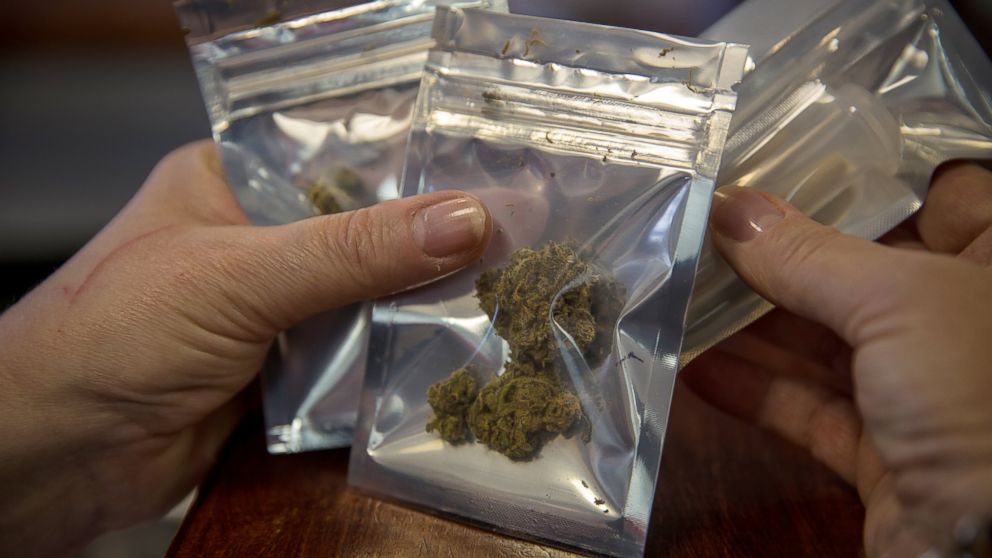
 PHOTO: Medical marijuana is dispensed at the Takoma Wellness Center, Oct. 10, 2014, in Takoma Park, DC.

Evelyn Hockstein/The Washington Post/Getty Images

ABC Health News  - Mar 18, 2015, 1:54 PM ET  -  By LIZ NEPORENT – Cross-Posted at Just One More Pet (JOMP)  and True Health Is True Wealth (THITW)

A new bill introduced in the Nevada state legislature earlier this week would allow owners to give their ailing pets medical marijuana. Many owners across the country said it’s about time, and that “pot for pets” should be legal everywhere.

Becky Flowers, a California ranch owner, said she gave her mare Phoenix regular doses of medical marijuana for several years to help ease the pain of a degenerative joint condition. The horse could barely walk due to extreme swelling in her front legs that traditional and herbal medications didn’t seem to help, Flowers said.

“She would lay there for days and she wouldn’t eat or drink,” Flowers told ABC News.

Flowers said she considered having the animal euthanized but decided as a last ditch effort to give her some of marijuana legally prescribed to her husband who is a paraplegic. In less than an hour, the horse was up and moving, Flowers said.  

PHOTO: Becky Flowers gave her horse Phoenix, right, medical marijuana to help ease the pain of a chronic joint condition.

PHOTO: Becky Flowers gave her horse Phoenix, right, medical marijuana to help ease the pain of a chronic joint condition.

Flowers began giving Phoenix about a tablespoon of medical marijuana in oil every day, she said, noting that the horse lived largely pain-free for two more years before dying in her late twenties. Since then, Flowers has given marijuana to some of her other horses and has recommended it to other horse owners as well.

Medical marijuana does show some promise for easing the pain and suffering in animals, but veterinarians and owners should proceed with caution, said Dr. Robert Silver, president of the veterinary botanical medical association.

“There needs to be a lot more research and education taking place before we introduce this to pets,” Silver said, who is a veterinarian in Colorado, a state where both medical and recreational marijuana are legal for people.

medical marijuana dogStudies show that dogs in particular react differently than humans to THC, one of marijuana’s active ingredients, Silver said. Because they have a high concentration of THC receptors in the back of their brains, they are susceptible to severe neurologic effects and toxic reactions, he added. States where medical or recreational use is legal have seen an increase in canine emergency room admissions associated with the drug, Silver said.

The American Veterinary Medical Association does not have an official stance on the use of medical marijuana with pets but suggests that vets make treatment decisions based on sound clinical judgment that stay in compliance with the law. They note that even in states where medical marijuana is legal, it is still a Class I narcotic under federal law which means vets are not legally allowed to prescribe it to their patients.

If passed, the Nevada law would allow animal owners to get marijuana for their pet if a veterinarian certifies the animal has an illness that might be helped by the drug. The proposal is in its earliest stages and faces numerous legislative hurdles before it could become law. It’s part of a larger bill that would refine the state’s existing medical marijuana law by clarifying penalties for drivers under the influence and allowing the resale of marijuana dispensaries.

**My question is how about Hemp CBD Oil, verses THC oils or marijuana. CBD Hemp Oil (HCHO) is obtained from select strains of CBD rich hemp grown legally worldwide. But always consult your veterinarian. 

Interestingly, cannabis smoking is associated with a 45% reduced risk of bladder cancer in humans and a 47-62% reduced rate of head and neck cancer, regardless of whether or not they had been infected with HPV.  And using hemp oils increases the survival success rate of treatments like chemotherapy and radiation by 25%. JOMP~

Veterinarian Administers Medical Marijuana To Dogs, Says It Works Wonders

More Dogs (and Cats) Getting High, Sick and Fat In States Where Marijuana Is Legal

Canada marijuana growers use wild bears to guard pot

Medical marijuana and the positive effects of hemp oil are a great breakthrough, help and blessing for many… humans and animals with a large variety of illnesses, including Cancer.  But widespread legal recreational marijuana use, perhaps not so much…

George Soros’ Latest Crusade: Legalizing Marijuana in the U.S.

THE HARMFUL EFFECTS OF MARIJUANA

Friday, April 11, 2014

So, the person who wrote Obama’s budgets (which failed to win even Dem support) will replace Sebelius. What can even possibly go wrong?

Yep you heard that correctly, the person who wrote Obama’s budgets (which failed to win even Dem support) will replace Sebelius. What can even possibly go wrong?

Kathleen Sebelius resigns: Health and Human Services Secretary Kathleen Sebelius attends a Senate committee hearing, April 10, 2014.: Health and Human Services Secretary Kathleen Sebelius listens on Capitol Hill in Washington, Thursday, April 10, 2014, during the Senate Finance Committee hearing on the HHS Department's fiscal Year 2015 budget.

AP Photo Susan Walsh

Health and Human Services Secretary Kathleen Sebelius will resign from her post following a rocky rollout for the president's healthcare program.

By Juliet Eilperin and Amy Goldstein, Updated: Thursday, April 10, 7:59 PM - E-mail the writersWaPo – Cross-Posted at AskMarion

Video: Health and Human Services Secretary Kathleen Sebelius is resigning, ending a tumultuous tenure as the public face of the Affordable Care Act. President Obama will nominate his budget director on Friday as her successor, according to White House officials.

Sebelius entered the Cabinet in 2009, three months into Obama’s presidency, as a well-regarded former governor of conservative Kansas. She is leaving after months of intense criticism over the botched rollout in the fall of the insurance marketplace.

During the firestorm, Obama made clear to his aides that he would not seek the resignation of his health secretary, and her departure is timed to brighter news for the White House as enrollment soared late last month.

Still, some White House allies said Thursday night that the troubled launch of HealthCare.gov had heightened tensions between Sebelius and the president’s staff members, who had become increasingly mistrustful of the department she led. Some Democrats, meanwhile, had argued privately that someone should be held accountable for the problems with the federal insurance exchange.

According to federal health officials, Sebelius approached Obama in early March and told him that, with the insurance enrollment period ending that month, the time had come for new leadership at HHS, the government’s largest domestic agency. A White House official, who spoke on the condition of anonymity to discuss internal deliberations, said Sebelius told the president that “she felt confident in the trajectory for enrollment and implementation of the Affordable Care Act.”

According to White House officials, Obama will nominate Office of Management and Budget Director Sylvia Mathews Burwell to take Sebelius’s place. Although Burwell does not have an extensive background in health-care policy, she is known for her strong management skills and has experience in issues of poverty and global health issues from her time at the Bill and Melinda Gates Foundation. Moreover, she is popular on Capitol Hill. The Senate confirmed her as OMB director 96 to 0 almost exactly a year ago. Her nomination to lead HHS will require Senate confirmation as well.

Sebelius and Replacent

Sebelius and Burwell

The news of Sebelius’s resignation, first reported Thursday night by Bloomberg News and the New York Times, caught Washington and health-care policy circles by surprise. Even the administration’s closest allies on health-care issues said they had no clue that her departure was imminent.

Senior Democrats on Capitol Hill also appeared to be caught off guard by the announcement. But they rushed out praise for Sebelius. House Minority Leader Nancy Pelosi (Calif.) said in a statement: “From day one, Secretary Kathleen Sebelius has remained laser-focused on a single purpose: to make health care a right, not a privilege, for all Americans. Her leadership has been forceful, effective, and essential.”

One former administration official, speaking, like others, on the condition of anonymity about behind-the-scenes working relationships, said Thursday night that Sebelius maintained a warm relationship with the president.

A health policy specialist close to the White House said that Obama’s staff had long preferred to be “running the show” on the health-care law but that Sebelius and her aides were increasingly “cut out of the process” after the launch of HealthCare.gov escalated into a political disaster for the president.

Other senior administration officials played central roles in helping repair the Web site and steer the law’s implementation after the rollout. Jeffrey D. Zients, a former OMB official who directs the National Economic Council, rejoined the administration to spearhead a team of federal employees and contractors who worked to repair HealthCare.gov. Meanwhile, Phil Schiliro, who served as Obama’s chief legislative liaison during his first term, returned in December to oversee the policy side of the law.

Sebelius was not part of the group of White House aides who recently told Obama in the Oval Office that health-care enrollment had surpassed 7 million. While she sat in the front row as the president told the nation on April 1 about the law’s success, he did not mention her in his speech.

Yet Sebelius remained a tireless promoter of the health-care law over the past six months, urging uninsured Americans to sign up on state and federal exchanges. Traveling to major cities such as Miami, Phoenix and Houston to reach residents whose Republican governors opposed the law, she held 43 local events and more than 100 local interviews over the past several months.

Sebelius was confirmed on April 28, 2009. Her tenure — 1,808 days as of Thursday — is about 500 days longer than the average for HHS secretaries, dating to the Carter administration. Federal health officials said Thursday night that she has not set a departure date but that her plan generally is to remain until her successor is confirmed. As for her next professional role, she “is considering other options,” the officials said.

Although Sebelius is best known as the public face of the Affordable Care Act, her work spanned issues from the H1N1 virus to childhood obesity to parity for mental health treatment.

With the equivalent of 77,000 full-time employees, she has had a sprawling domain at HHS. The department oversees Medicare and Medicaid as well as the National Institutes of Health, the Food and Drug Administration, the Centers for Disease Control and Prevention, and many smaller agencies. For that reason, the department’s work touches the lives of more Americans than most other parts of the government.

Congressional Republicans seized on Sebelius’s resignation to criticize the Affordable Care Act as unworkable.

“Secretary Sebelius was asked to promote something unready, poorly structured, and unpopular,” Sen. Charles E. Grassley (Iowa) said in a statement. “She was given a law that was just about written in pencil the way the deadlines changed all the time. That put her in a position of having a strained relationship with Congress. It’s disingenuous for the White House to distance itself from the problems and attribute them to partisan sniping at one member of the Administration. The next secretary might have a fresh start with the public and Congress but the flawed law is still the law.”

Despite the troubled launch of HealthCare.gov, which left many consumers unable to access the federal exchange for nearly two months, the administration managed to meet its goal of enrolling 7 million Americans during its initial sign-up period. On Thursday, Sebelius said that about 7.5 million consumers had enrolled, although those who don’t pay their premiums will not be insured.

In the fall, Sebelius proved steely under harsh congressional questioning, telling her Republican critics that they could blame her for the Web site’s problems.

“Access to HealthCare.gov has been a miserably frustrating experience for way too many Americans,” she said in her opening statement before the House Energy and Commerce Committee in late October. “So let me say directly to these Americans: You deserve better. I apologize. I’m accountable to you for fixing these problems. And I’m committed to earning your confidence back by fixing the site.”

Thursday, January 23, 2014

Fantastic Video: Heritage Foundation On The Ground At March For Life 2014 – New Poll: 62% of Americans Now Believe Abortion is Morally Wrong

Marchers braved the cold and snow in Washington, DC today for the annual March for Life. The Heritage Foundation was on the ground to capture the event and grabbed some amazing footage and interviews.

Video: Fantastic Video: Heritage Foundation On The Ground At March For Life 2014

New Poll: 62% of Americans Now Believe Abortion is Morally Wrong

Examiner: A new Knights of Columbus/Marist poll released Wednesday shows that more than six in 10 Americans believe that abortion is morally wrong.

Sixty-two percent of those polled believed that abortion is morally wrong, and only 36 percent found it morally acceptable. Two percent of Americans indicated that it was not a moral issue.

Fifty-three percent of respondents said they believe life begins at conception.

The poll shows that most Americans choose a more moderate position on abortion, but believe it should be restricted.

Support for restrictions on abortion includes 79 percent supporting a 24-hour waiting period, 58 percent supporting a woman receiving an ultrasound before her abortion and 80 percent supporting parental notification for underage patients.

Even respondents who identify themselves as strongly pro-choice indicated that they do not believe in unrestricted access to abortions.

Sixty-four percent of strongly pro-choice Americans agreed that a patient should wait 24 hours before an abortion and consult with professionals, 62 percent support parental notification and 68 percent believe doctors who perform abortions should be required to have hospital admitting privileges.

The release of the poll coincides with the National March for Life in Washington.

Saturday, December 28, 2013

Are Young Americans Signing Up For Obamacare?

Video: Are Young Americans Signing Up For Obamacare?

Scottie Nell Hughes (News Director of Tea Party News Network) joins FBN's Charles Payne and Josh Nass (Voices of Conservative Youth Chairman) to discuss the reasons behind lack of enthusiasm by young Americans to sign up for Obamacare.

Wednesday, December 4, 2013

Millennials Abandon Obama and Obamacare

A majority of America's youngest adults would vote to recall the president.

(JIM WATSON/AFP/Getty Images)

National Journal: Young Americans are turning against Barack Obama and Obamacare, according to a new survey of millennials, people between the ages of 18 and 29 who are vital to the fortunes of the president and his signature health care law.

The most startling finding of Harvard University's Institute of Politics: A majority of Americans under age 25 -- the youngest millennials -- would favor throwing Obama out of office.

The survey, part of a unique 13-year study of the attitudes of young adults, finds that America's rising generation is worried about its future, disillusioned with the U.S. political system, strongly opposed to the government's domestic surveillance apparatus, and drifting away from both major parties. "Young Americans hold the president, Congress and the federal government in less esteem almost by the day, and the level of engagement they are having in politics are also on the decline," reads the IOP's analysis of its poll. "Millennials are losing touch with government and its programs because they believe government is losing touch with them."

The results blow a gaping hole in the belief among many Democrats that Obama's two elections signaled a durable grip on the youth vote.

Indeed, millennials are not so hot on their president.

Obama's approval rating among young Americans is just 41 percent, down 11 points from a year ago, and now tracking with all adults. While 55 percent said they voted for Obama in 2012, only 46 percent said they would do so again.

When asked if they would want to recall various elected officials, 45 percent of millennials said they would oust their member of Congress; 52 percent replied "all members of Congress" should go; and 47 percent said they would recall Obama. The recall-Obama figure was even higher among the youngest millennials, ages 18 to 24, at 52 percent.

While there is no provision for a public recall of U.S. presidents, the poll question revealed just how far Obama has fallen in the eyes of young Americans.

IOP director Trey Grayson called the results a "sea change" attributable to the generation's outsized and unmet expectations for Obama, as well as their concerns about the economy, Obamacare and government surveillance.

The survey of 2,089 young adults, conducted Oct. 30 through Nov. 11, spells trouble for the Affordable Care Act. The fragile economics underpinning the law hinge on the willingness of healthy, young Americans to forgo penalties and buy health insurance.

According to the poll, 57 percent of millennials disapprove of Obamacare, with 40 percent saying it will worsen their quality of care and a majority believing it will drive up costs. Only 18 percent say Obamacare will improve their care. Among 18-to-29-year-olds currently without health insurance, less than one-third say they're likely to enroll in the Obamacare exchanges. 

More than two-thirds of millennials said they heard about the ACA through the media. That's a bad omen for Obamacare, given the intensive coverage of the law's botched rollout. Just one of every four young Americans said they discussed the law with a friend or through social media. Harvard's John Della Volpe, who conducted the poll, said the president has done a poor job explaining the ACA to young Americans.

Infographic

Republican and Democratic leaders should find little solace in the results. The survey said that 33 percent of young Americans consider themselves Democrats and 24 percent identify with the GOP. The largest and growing segment is among independents, 41 percent of the total.

Democrats' advantage among young voters is fading. Among the oldest millennials (ages 25 to 29), Democrats hold a 16-point lead over the GOP: 38 percent say they're Democrats, and 22 percent call themselves Republicans. Among the youngest of this rising generation (ages 18 to 24), the gap is just 6 points, 31 percent for Democrats and 25 percent for Republicans.

Approval ratings of Congress have declined steeply in the past few years, with congressional Democrats now at 35 percent and congressional Republicans at just 19 percent.

Young blacks say they are much less likely to vote in the 2014 midterm election than they were in November 2009, signaling a worrisome level of engagement among a key Democratic constituency.

In addition to health care, domestic spying is an issue that puts Obama on the wrong side of the rising generation. While split on whether Edward Snowden is a "patriot" or a "traitor" for revealing Obama's surveillance programs, strong majorities of 18-to-29-year-olds oppose the government collecting information from social networks, Web-browsing histories, email, GPS locations, telephone calls, and text messages.  

College loans are a big issue with young Americans, too. Nearly six of 10 called student debt a major problem, and another 22 percent called it a minor one. Seventy percent said their financial situation played into their decision whether to attend college.

Respondents were given a list of options for shrinking the nation's debt. Majorities favored suggestions to tax the rich, cut foreign economic aid in half, slash the nuclear-warhead arsenal, and reduce food stamps.

The results conform with a story I did this summer with the help of the IOP ("The Outsiders: How Can Millennials Change Washington If They Hate It?"), arguing that while Millennials are deeply committed to public service they don't see government as an efficient way to improve their lives or their communities.

The IOP report issued today said: "This is not to say that young Americans are rejecting politics, the role of government and the promise of America more generally. They are sending a message to those in power that for them to re-engage in government and politics, the political process must be open, collaborative and have the opportunity for impact -- and not one that simply perpetuates well-worn single issue agendas."

The survey was conducted online. The National Journal generally refrains from covering online-only polls but has made past exceptions. In this case, Harvard's IOP survey uniquely focuses on millennials with accumulated data set and a credible polling operation.

(Find full poll results here: http://www.iop.harvard.edu/)