Wednesday, November 10, 2010

Monsanto Battle Continues After Suing Midwest Farmers for Saving Seeds


soybeans 300x276 Monsanto Battle Continues After Suing Midwest Farmers for Saving Seeds

Image by Wellness Uncovered

Over a decade ago, Monsanto sued two brothers who farm in Arkansas, John and Paul Mayfield, for saving and replanting 800 bushels of Roundup Ready soybeans. Monsanto filed a number of lawsuits, but unlike John and Paul Mayfield, most farmers settled out of court to avoid a protractive and expensive legal battle. At the time, Monsanto was investigating some 365 farmers for saving seed.

Although saving seed is a common practice for farmers, Monsanto prohibited the practice, and required farmers to buy new seed from the company every year. When buying seed from Monsanto, farmers are required to sign a contract stating they are not allowed to save any of the seed from their crop to plant the next season.

Because Monsanto Roundup Ready soybeans are creations of the company, Monsanto patented their genetically engineered beans which are immune to Monsanto’s Roundup pesticide; the genetic trait has been available in soybeans since 1996.

In their defense, John and Paul Mayfield argued that Monsanto had no right to patent plants in the first place. “Patent law is basically set up for machines and things of that sort, but not things that self-replicate,” said their attorney, who claimed patent law forbids people from recreating a machine or process someone else invented, but it doesn’t pertain to something like a soybean plant that naturally recreates itself. The legal system didn’t agree.

Monsanto set up a toll-free line for encouraging people to turn in farmers suspected for violating the company’s rules, and when Monsanto received a tip, they sent detectives out search farmers’ fields and go through their documents to find out how much seed farmers bought, and how much grain they sold to discover which farmers were saving seeds.

Monsanto’s attempts to monopolize the seed industry prompted soybean and other farmers to form the National Family Farm Coalition to combat the spread of genetically engineered crops. The coalition helped file a class action lawsuit against Monsanto and other seed companies that accuses the firms of trying to monopolize the seed trade with patented crops. The suit charged that Monsanto and other companies work together to fix prices and dominate the market.

SOY Monsanto Battle Continues After Suing Midwest Farmers for Saving Seeds

Seed Wars a Decade Later

Since then, as a result of Monsanto’s Roundup Ready technology — gene-modified seeds that inoculate plants against Roundup herbicide — hundreds of seed companies have failed in the last 20 years. Chris Holman, a patent lawyer who teaches at the University of Missouri, Kansas City, likens Roundup Ready technology to Microsoft and its dominant Windows operating system.

This seed monopoly results, of course, in price control. Farmers experience significant increases every year; and seed costs shot up almost 50 percent last year. But to a degree, farmers willingly fell into this trap themselves. “There’s nothing like Roundup. A monkey could farm with it,” says a Kansas corn and soybean farmer.

And as Jim Tobin, a vice president of Monsanto says, “Farmers get to vote every year before they plant, and it’s that vote each year that determines who has the largest market share or volume.”

Roundup Ready 1 Patent Expires 2014

Now 9 out of 10 soybean seeds carry the Roundup Ready trait. Monsanto has unprecedented control of the corn and soybean market. Their Roundup Ready corn is now planted on nearly 80 percent of the farmland acreage in the U.S., and Monsanto’s soybeans, with their Roundup Ready gene, is in 93 percent of U.S. soybean seeds.

monsanto roundup ready soy bean seeds1 300x200 Monsanto Battle Continues After Suing Midwest Farmers for Saving Seeds

But Monsanto’s patent on Roundup Ready 1expires in 2014, and unless Monsanto can switch farmers over to their new Roundup Ready 2, they will lose a revenue stream of half a billion dollars a year in royalties.

Paul Schickler, president of Pioneer, a competing seed company owned by DuPont, says Monsanto is forcing its licensees to do the same. He charges that Monsanto is trying to make Roundup Ready 1 disappear. “That’s our concern: bridging or switching from one patented product, Roundup Ready 1, to the next-generation Roundup Ready 2 Yield, doesn’t allow competition for the original technology,” Schickler says. DuPont suggests Monsanto is using incentives and penalties to switch the industry to the new product to extend their Roundup Ready monopoly.

Pioneer licenses the Roundup Ready trait from Monsanto, as do about 150 other seed companies. Last year, Monsanto sued to stop Pioneer from “stacking” Roundup Ready with another trait. Pioneer complained to the Justice Department, who launched a formal antitrust investigation of Monsanto’s genetically modified soybeans.

At least seven states are investigating many of the same claims made by Dupont/Pioneer, as well as whether Monsanto illegally offered rebates to distributors who limit sales of competing seed. Farmers would like to buy cheaper generic soybean seed, but won’t be able to if Monsanto doesn’t make the gene traits in its Roundup Ready 1 soybean seed available to other companies. Farmers also worry about how Monsanto will handle continued registration of those gene traits in foreign countries.

West Virginia sues Monsanto over access to soybean data

West Virginia’s attorney general is suing Monsanto Co. for refusing to turn over information to support claims that the company’s biotech soybeans are as good as promised. Jeffrey Tomich with Checkbiotech.org reports that West Virginia began investigating claims surrounding Monsanto’s Roundup Ready 2 Yield soybeans after studies in 2009 by two universities and a pair of independent research firms questioned whether the new seeds delivered advertised yield gains.

Farmers “need to know if it is worth the extra money to buy new products that may not live up to the hype,” said Darrell McGraw, West Virginia’s attorney general, in a statement.

The subpoena seeks the names of the 20 largest seed companies that bought or license soybeans and the amount of annual payments received from each; copies of complaints about Roundup Ready 2 Yield soybeans; and documents related to efforts to switch farmers or seed companies to the new seeds.

Tomich notes that the investigation being conducted in West Virginia is similar to one in Arkansas. Last month, the Arkansas attorney general opened an investigation of Monsanto’s soybean marketing practices. Monsanto claims that 16,000 head-to-head comparisons in nine key soybean-growing states indicate Roundup Ready 2 Yield soybeans are yielding more than 3 bushels per acre more than first-generation Roundup Ready varieties.

Soybean11 300x226 Monsanto Battle Continues After Suing Midwest Farmers for Saving Seeds

Superweeds – Birth Defects

Mike Ludwig with t r u t h o u t, reports that a leading embryologist at the University of Buenos Aires Medical School first released a study in 2009, published in the United States this past summer, that shows glyphosate-based herbicides like Monsanto’s popular Roundup formula caused deformations in chicken embryos that resembled the kind of birth defects being reported in areas like La Leonesa, a small farm town in Argentina, where big agribusinesses depend on glyphosate to treat genetically engineered crops.

The deformations resulted from much lower doses of herbicide than those commonly found on crops, according to the study. Monsanto patented glyphosate under the trade name Roundup in the 1970′s. We strongly recommend reading the entire t r u t h o u t article.

Additionally, Monsanto’s herbicide use has caused the rise of new glyphosate resistant weeds called “superweeds.” Like the GM corn and soy, these weeds have bred themselves to tolerate Roundup and are invading farms across the country.

In October, Monsanto announced a new program that offers millions of dollars in rebates to farmers who combine Roundup with more herbicides manufactured by the company’s competitors to combat the glyphosate-resistant weeds threatening GM crops across the country.

“The mere presence of superweeds and the fact that Monsanto is now paying farmers to spray additional chemicals that are more toxic than Roundup, is evidence of a complete regulatory breakdown, according to watchdog group Center for Food Safety (CFS)”.

William Freese, a CFS senior policy analyst who testified to Congress in September, said that the USDA regulates GM crops and the Environmental Protection Agency (EPA) regulates herbicides, but there is no regulation of the combined system.

“And it is the system – the invariable use of glyphosate made possible and fostered by glyphosate-resistant seeds, for instance – that is responsible for the growing epidemic of glyphosate-resistant (GR) weeds,” Freese said in his testimony. “This is clearly demonstrated by the near complete absence of GR weeds for the first 20 plus years of glyphosate’s use and the explosion of weed resistance in the decade since the widespread adoption of Roundup Ready crop systems.”

by Spence Cooper on 11/10/10 at 11:36 am – Friends Eat


Video:  Monsanto Will Own All Seed

Monday, November 8, 2010

The Chicken Which Should be Banned

girl eating fried chicken

Do you put dimethylpolysiloxane, an anti-foaming agent made of silicone, in your chicken dishes?

How about tertiary butylhydroquinone (TBHQ), a chemical preservative so deadly that just five grams can kill you?

These are just two of the ingredients in a McDonalds Chicken McNugget. Only 50 percent of a McNugget is actually chicken. The other 50 percent includes corn derivatives, sugars, leavening agents and completely synthetic ingredients.

Organic Authority helpfully transcribed the full ingredients list provided by McDonalds:

"White boneless chicken, water, food starch-modified, salt, seasoning (autolyzed yeast extract, salt, wheat starch, natural flavoring (botanical source), safflower oil, dextrose, citric acid, rosemary), sodium phosphates, seasoning (canola oil, mono- and diglycerides, extractives of rosemary).

Battered and breaded with: water, enriched flour (bleached wheat flour, niacin, reduced iron, thiamin mononitrate, riboflavin, folic acid), yellow corn flour, food starch-modified, salt, leavening (baking soda, sodium acid pyrophosphate, sodium aluminum phosphate, monocalcium phosphate, calcium lactate), spices, wheat starch, whey, corn starch.

Prepared in vegetable oil (Canola oil, corn oil, soybean oil, hydrogenated soybean oil with TBHQ and citric acid added to preserve freshness). Dimethylpolysiloxane added as an antifoaming agent."

Sources:

Organic Authority

Wednesday, November 3, 2010

Vibration May Keep Aging Bones Healthy

 "Shake, rattle, and roll" was the theme of many seniors in their youth, and shaking their aging bones may help reduce the bone-thinning that usually occurs with age.

An animal study at the Medical College of Georgia found that daily vibrations improved bone density around the hip joint. Hip fractures are a major cause of death among the elderly.

Dr. Karl H. Wenger, biomedical engineer in the MCG Schools of Graduate Studies and Medicine, subjected 18-month-old mice (the human equivalent of 55- to 65-year-old humans) to daily 30-minute vibrating sessions for 12 weeks.

Wenger and his colleagues found that vibration improved density around the hip joint as well as improvement in the femur, the long bone of the leg. They also found a reduction in a biomarker that indicates the breakdown of bone.

The researchers theorize that the vibration produces a sensation similar to that of a vibrating cell phone but on a larger scale, exercises cells so they work better, and spurs the production of osteoblasts, the cells that create bone.

Vibration, Wenger said, also helps those with bone injuries, and is a low-risk option for injured patients with limited mobility. “We think that in fracture healing, you get a more dramatic response," he said in a statement. "We don’t know exactly why it affects the biology differently, but it’s likely because of the extent to which stem cells invade the injured area,” Wenger said. They have found that vibration slows stem cell proliferation, which may sound counterintuitive, but likely means more stem cells differentiate into bone cells rather than continuing to just make more generic stem cells. With age, stem cells have difficulty differentiating.

The researchers are evaluating human patients' tolerance to pain in patients with lower-limb fractures, and have found that as early as two weeks after the injury, the vibration is soothing instead of painful.

In a related study at the State University of New York at Stony Brook, postmenopausal women, who were at the peak of age-related bone loss, had results similar to the mice.

Although vibration doesn't provide the same cardiovascular benefit of exercise, both human and animal study show it can improve weight loss and muscle strength.

Wednesday, November 3, 2010 7:54 AM

By Sylvia Booth Hubbard

Source: NewMaxHealth 

© 2010 Newsmax. All rights reserved

Tuesday, November 2, 2010

Traditional Medicines to Become Illegal in Europe

Traditional Medicines to Become Illegal in Europe

November 2, 2010

Gavel

It sounds like a bad April Fool’s joke, but it’s not. On the first of April next year, thousands of products associated with traditional medicine will become illegal throughout the European Union.

April 1, 2011, is the date the Traditional Herbal Medicinal Products Directive (THMPD) comes into force throughout Europe. Many herbal products—including those already sold safely as food supplements—will need to be registered under THMPD if they are to be made available. But registration involves a series of eligibility and technical challenges as well as prohibitive costs, so a large number of traditional medicines will be prevented from being registered. This is especially true if the medicines are made by smaller companies with low annual sales volumes—a fairly common occurrence with traditional medicines.

A related concern is that laws and regulations that are enacted in Europe often influence US policy—and a negative outcome over there is a dangerous precedent that could be adopted here at home. So preserving access in the EU is absolutely critical to our own health freedoms.

Our colleagues at the Alliance for Natural Health International (ANH-Intl), together with the European Benefyt Foundation (EBF), have established a joint working group to coordinate their response to this issue. They plan a three-pronged attack:

  1. Force a judicial review of THMPD as being an unsuitable vehicle for assessing traditional medicines. Not a single Ayurvedic or traditional Chinese medicine product has been registered under it. This will be expensive—please see below about how you can help with a gift.
  2. Change the EU food supplement regulations. The current regulations say that herbal products previously sold as food supplements are to be reclassified as medicines; a food or herb preparation is considered “novel” (and thus banned from sale) if it cannot be proved that one or more of its ingredients had been used significantly in the EU before May 1997; and health claims made by many herbal products are banned, limiting consumer choice.
  3. Facilitate a new regulatory framework for traditional medicinal products to replace THMPD and expand its scope. This would regulate not only over-the-counter herbal medicines, but practitioner-prescribed and pharmacy-dispensed supplements as well. The European Benefyt Foundation has been working to develop such a framework for over a year.

In order for this work to proceed, they desperately need additional funding. We invite you to read their Call to Action, but even more importantly, we ask you to send a donation in support of ANH-Intl’s efforts. Just go to this page to make your donation, and we will forward to them every penny you give.

Remember—your financial support of our European colleagues not only benefits the millions of Europeans who use natural supplements and medicines, but could make a huge difference in the way US supplement policy is shaped in the future. Please give today.

Saturday, October 30, 2010

Obamacare Endgame: Doctors Will be Fined or Jailed if they Put Patients First

If Obamacare is completely implemented, doctors will no longer be practicing medicine. They will instead become the drones tasked with deciding who gets the meager healthcare crumbs doled out by the bureaucrats who have the ultimate power over patient life and death. Those who are deemed to have illnesses that require treatments which are not cost effective can expect a one way ticket to a hospice.

ObamaCare.PNG

Like so many bills passed by Congress, there was a hidden provision in the Stimulus bill passed in 2009. It spends 1.1 billion dollars to create an important piece of the framework for the healthcare bill called the Coordinating Council on Comparative Effectiveness Research. It is based on the false premise that doctors in consultation with their patients don’t have the ability to make the right healthcare choices (see executive summary). The council consists of 15 people appointed by the President.

They all have one thing in common–they are all isolated from day to day patient care; and therefore, are insulated from the real practice of the art of medicine. It makes it easy to see patients as a cost center to be controlled. With views of members like Dr Emanuel, who champions the complete-lives system, it is hard to ignore the probability that senior citizens, those with chronic illness, and the very young will be on the outside looking in. This council is another example of the people of this country being told by the government that it knows what is best for us.

The framework set up by the stimulus bill merely set the stage for the implementation found in the healthcare reform bill. How can the government get doctors to participate in Obamacare thereby a) willingly destroying the doctor patient relationship, and  b) betraying their Hippocratic Oath to provide treatments that they deem to be effective? Simple – fear and intimidation.

A second board created by the stimulus bill called The National Coordinator for Health Information Technology “will determine treatment at the time and place of care”. They are charged with deciding the course of treatment for the diagnosis given by the doctor. Now it becomes obvious why there has been a big push towards the implementation of universal electronic medical record use. It becomes a tool to completely control the physician and the patient. Those physicians and hospitals that choose to practice individualized patient care in consultation with their patients will be punished because they are not “meaningful users of the system over time.” Beginning January 1, 2013 penalties for doing the right thing for a patient will cost the doctor $100,000 for the first offense and jail for the second offense. This will have a chilling effect and may be the straw that completely breaks the foundation of good medicine – the doctor patient relationship.

46% of physicians in a survey by The New England Journal of Medicine stated that they would leave the practice of medicine if Obamacare was implemented. This will only further decrease the quality of healthcare when the 30 million more people enter the system. Maybe that’s why there is a big push in the healthcare bill to increase the number of other providers such as physician assistants and nurse practitioners. There is no question that rationing will become our future. If you add 30 million more people into a system with fewer resources how could you possibly avoid rationing? Perhaps those members of Congress who passed this nightmare don’t care since they made sure that it wouldn’t apply to them.

And how about the realization of who is exempt and why.

Americans need to remember who voted for ObamaCare and realize what they sold us.  Remember Nancy Pelosi telling us we have to pass the bill to find out what is in it… Well we are finding out more every day and are realizing that those who voted for this bill sold out the American people. 

Dr. Elaina   Georgeby Dr. Elaina George

Source:  BigGovernment

IF YOU NEVER WATCH ANOTHER 6 MINUTE VIDEO - WATCH THIS ONE!  DR. DAVID JANDA FROM ANN ARBOR AND A NATIONALLY KNOWN HEALTH CARE EXPERT SPOKE TO US ON SUNDAY, OCT. 10TH IN SALINE, MI..  THIS IS WHAT IS 'GOING' TO HAPPEN IF OBAMACARE IS NOT REPEALED.  DR. JANDA, AS HE STATES IN THE VIDEO, TESTIFIED BEFORE CONGRESS AND THIS IS WHAT HE WAS TOLD.  THIS WILL SEND CHILLS DOWN YOUR SPINE - GUARANTEED. 

Video: Dr. David Janda explains rationing in Health Care Bill – ...

Why Doesn’t Everyone Know Jan Schakowky’s Husband Wrote ObamaCare in Jail?

Please remember who voted for ObamaCare and vote them out of office on Tuesday, November 2nd.

Is Bottled Water Making us Stupid?

Originally Posted on Tuesday, October 12, 2010
By Rhondalynn Korolak

Bottled water is one of the most profitable drink products in the world, selling for 3000 to 9000 times what most of us pay for the perfectly safe, inexpensive liquid that comes out of our tap at home.

To put this in context, paying $2.40-3.90 for a 750ml bottle of water is equivalent to:

  • $10,000 for a tuna sandwich at your local cafe or
  • A bill from your water company this month for $3000/tonne of water (as opposed to the going rate of $1.2/tonne)

According to the Australasian Bottled Water Institute, Australians consume over 250 million litres a year at a price of $385 million.  We have been systematically brainwashed by the beverage industry to believe that our tap water is somehow unsafe or insufficient – look around and you will see that there are now hundreds of brands competing for your attention with clever marketing campaigns designed to scare, seduce and mislead us to part with our hard earned money.

Despite its association with prestige, purity and pristine conditions, bottled water is often no better than tap water (in terms of taste and cleanliness) and the production process it is extremely harmful to our environment.

Did you know that:

  • For every 250 million litres of bottled water, it takes 125million litres of oil to produce the plastic bottles, refrigerate and ship them from one part of the world to another
  • For every litre of bottled water sold, another 2 litres are used up in the production process
  • More than ½ of the brands on the market are derived from municipal water supplies, despite the fact that the packaging would lead us to believe they come from unspoiled mountain streams or underground springs
  • Over 80% of the bottles end up in landfills and are never recycled

It is estimated that bottled water has become a more than $45 billion dollar industry worldwide. Surprisingly, 97% of it is consumed in countries which have plentiful sources of clean, safe drinking water. We can afford to turn our noses up, avoid the tap and fork out millions for bottled water: our choice however is purely a lifestyle one.  A lifestyle choice for us with life and death consequences for others and the planet.

For 2.6 billion people in the developing world, lack of clean water and basic sanitation is a life or death situation.  It is estimated that half of the people in the developing world are suffering from diseases associated with inadequate water or sanitation and that 5 million people die each year. According to the International Water Management Institute, clean water and improved sanitation could be provided to everyone on earth for an outlay of $11 billion a year (less than a quarter of our global $45 million spending on bottled water), yet to date, there has been no impetus to re-channel the money and change our thinking on this important issue.

So you may be sitting there and thinking, what does this mean for YOU and your business?

Well, nothing… and yet perhaps everything.

How often have you (or someone else in your team) said:

  • “if we had more money, we could invest in X and improve our business?”
  • “if we put our prices up by 10%, we will lose customers.” or
  • “we can’t afford to buy X because it’s too expensive.”

We already have enough money to do and buy all of the things that we need – it’s simply a matter of common sense and priorities.  We are all affluent in this country: It is our mindset and our language which is lacking, not our bank accounts.  

In fact, each and every day we waste money by overpaying for bottled water and other convenience/impulse items – both personally and professionally.  We rarely stop to think about the true value of what we got vs. what we paid. Bottled water is just one obvious example and it is not difficult to see how this might be playing out in other areas of our lives.

We have all happily overpaid for products.  Yet we struggle to charge what we are worth or put our prices up because we fear that no one will buy.  Isn’t that interesting?

Perhaps we all need to take a lesson from the bottled beverage industry and focus on how we are marketing and selling our products/services?  Is fear more powerful than selling benefits?  Is perception more influential than reality?  Are you seducing your customers with sizzle or merely putting them to sleep with your low prices?

Think about it.  Beverage companies have managed to package and sell to us something that is practically free and plentifully abundant, for thousands of times what it is worth.  And up until now, we have all paid willingly.  Bottled water has in fact made us all look a bit foolish.

Maybe it’s not the price you are charging that is the problem?  It’s the way you are choosing to promote your product/service.  The best time to change your mindset and your approach is now. Anything is possible.

Take for example the beverage industry, you can bet they are already looking for other free commodities (like mud and air) that can be packaged, promoted and flogged to us at a huge profit.

Rhondalynn Korolak is the author of ‘Financial Foreplay — Whip Your Business Into Shape & Take Home More Cash’ and ‘On The Shoulders of Giants -– 33 New Ways to Guide Yourself to Greatness’. Grab your copies today by visiting  www.imagineeringunlimited.com  Both books are also available on Amazon, Kindle and iTunes.

Source:  http://www.fastthinking.com.au/bloggers/rhondalynn-korolak/is-bottled-water-making-us-stupid.aspx

Thursday, October 28, 2010

The End of Cheap Food… The Food Shock of 2011

Food is the ultimate regressive tax, which is why it might offer some of the most compelling investment opportunities of the next ten years.

The prince dispenses the same number of tuppence for his crumpet as the pauper. But as a percentage of their respective incomes, the crumpet is much more costly for the pauper. This contrast is obvious, but the implications of this contrast for global food prices may be less obvious.

The poor spend as much as they possibly can to nourish themselves. The wealthy spend as much as they wish. In fact, because the cost of food does not rise commensurately with incomes, the cost of food becomes so trivial to the wealthy that they end up tossing the stuff into trashcans.

For perspective, consider the econo-caloric history of the United States, as it progressed from "Emerging Market" to Superpower. According to the Federal Reserve Bank of Dallas, the average American in 1919 had to work two hours and 38 minutes to buy a 3-pound chicken. Nowadays, it takes just 15 minutes.

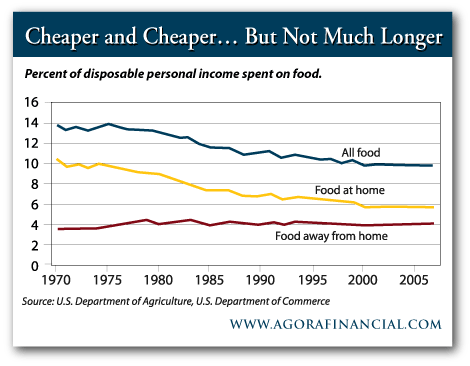
In statistical terms, Addison Wiggin observes in the latest edition of Apogee Advisory, "Americans spent 23.4% of their disposable income on food in 1929. By 1950 this number had dropped to 20.6%. By 1975, 13.8%. The number finally cracked single digits in 2000. And that figure includes meals eaten both at home and away from home.

Disposable Income Spent on Food

Compare that to Germans," Addison continues. "They spend 11.4% of disposable income just on meals eaten at home. The French, Japanese and South Koreans spend about 14-15%. Brazilians? 24.6%. And the Chinese spend 39.4% of their disposable income on meals eaten at home.

"Even Canadians, with a much smaller population and their vast productive prairies, aren't as lucky as we are. They spend 9.2% of their disposable income on meals at home. That's nearly as much as Americans spend both home and away."

Therefore, imagine a world in which the global population is rapidly increasing, and in which a growing percentage of that growing population is progressing from mere sustenance levels of existence to conditions of relatively greater prosperity.
You don't need to imagine such a world; it has arrived.
As the major Emerging Markets of the world like Brazil, India and China continue their progression from chronic underachievers to periodic overachievers, their national wealth will increase. And as this wealth increases, the recipients of it will certainly increase the quantity and/or quality of their diets.

Even if the quantity does not increase much, improving the quality of diet would be sufficient to drive food prices much higher. Replacing one meal of beans and rice, for example, with a meal of chicken and rice may not seem very significant. But it requires 6 pounds of grain to produce one pound of chicken meat, according to the USDA. Therefore, if hundreds of millions of individuals begin opting for chicken over beans, the global grain markets would certainly feel the effects...and these effects would not be limited to the grain markets.

As the organic food website, www.opes.biz points out, "It requires 700 gallons of water to produce one pound of chicken. Instead, farmers could produce 16 pounds of broccoli, or up to 20 pounds of other grains and vegetables... Also, it takes 8 times the amount of gasoline/fossil fuel for production of one pound of chicken as compared to one pound of protein from tofu."

Therefore, forward-looking investors cannot afford to avert their gaze from global dietary trends. As the Emerging Markets continue to emerge, demand for the world's finite supplies of grain, water and energy will increased commensurately...and that means much higher prices.

"Americans have become accustomed to cheap and abundant food," Addison winds up. "Probe the psyche of the average American and he'd probably tell you it's a birthright. Amber waves of grain and all that. They're about to get a rude surprise. After a century in which Americans have spent less and less of their incomes on food, the trend is about to reverse."

In the column below, Addison probes deeper into the global dynamics of food production and consumption. And he also suggests ways that investors might benefit from the trends he anticipates…

By Eric Fry

The Food Shock of 2011

By Addison Wiggin

leadimage

10/26/10 Baltimore, Maryland – Every month, JP Morgan Chase dispatches a researcher to several supermarkets in Virginia. The task – to comparison shop for 31 items.

In July, the firm’s personal shopper came back with a stunning report: Wal-Mart had raised its prices 5.8% during the previous month. More significantly, its prices were approaching the levels of competing stores run by Kroger and Safeway. The “low-price leader” still holds its title, but by a noticeably slimmer margin.

Within this tale lie several lessons you can put to work to make money. And it’s best to get started soon…because if you think your grocery bill is already high, you ain’t seen nothing yet. In fact, we could be just one supply shock away from a full-blown food crisis that would make the price spikes of 2008 look like a happy memory.

Fact is; the food crisis of 2008 never really went away.

True, food riots didn’t break out in poor countries during 2009 and warehouse stores like Costco didn’t ration 20-pound bags of rice…but supply remained tight.

Prices for basic foodstuffs like corn and wheat remain below their 2008 highs. But they’re a lot higher than they were before “the food crisis of 2008” took hold. Here’s what’s happened to some key farm commodities so far in 2010…

  • Corn: Up 63%
  • Wheat: Up 84%
  • Soybeans: Up 24%
  • Sugar: Up 55%

What was a slow and steady increase much of the year has gone into overdrive since late summer. Blame it on two factors…

  • Aug. 5: A failed wheat harvest prompted Russia to ban grain exports through the end of the year. Later in August, the ban was extended through the end of 2011. Drought has wrecked the harvest in Russia, Ukraine and Kazakhstan – home to a quarter of world production
  • Oct. 8: For a second month running, the Agriculture Department cut its forecast for US corn production. The USDA predicts a 3.4% decline from last year. Damage done by Midwestern floods in June was made worse by hot, dry weather in August.

America’s been blessed with year after year of “record harvests,” depending on how you measure it. So when crisis hits elsewhere in the world, the burden of keeping the world fed falls on America’s shoulders.

According to Soren Schroder, CEO of the food conglomerate Bunge North America, US grain production has filled critical gaps in world supply three times in the last five years, including this summer…

  • In 2010, when drought hit Russian wheat
  • In 2009, when drought hit Argentine soybeans
  • In 2007–08, when drought hit Australian wheat

So what happens when those “record harvests” no longer materialize?

In September, the US Department of Agriculture estimated that global grain “carryover stocks” – the amount in the world’s silos and stockpiles when the next harvest begins – totaled 432 million tons.

That translates to 70 days of consumption. A month earlier, it was 71 days. The month before that, 72. At this rate, come next spring, we’ll be down to just 64 days – the figure reached in 2007 that touched off the food crisis of 2008.

But what happens if the US scenario is worse than a “nonrecord” harvest? What if there’s a Russia-scale crop failure here at home?

World Grain Carryover Stocks

“When we have the first serious crop failure, which will happen,” says farm commodity expert Don Coxe, “we will then have a full-blown food crisis” – one far worse than 2008.

Coxe has studied the sector for more than 35 years as a strategist for BMO Financial Group. He says it didn’t have to come to this. “We’ve got a situation where there has been no incentive to allocate significant new capital to agriculture or to develop new technologies to dramatically expand crop output.”

“We’ve got complacency,” he sums up. “So for those reasons, I believe the next food crisis – when it comes – will be a bigger shock than $150 oil.”

A recent report from HSBC isn’t quite so alarming…unless you read between the lines. “World agricultural markets,” it says, “have become so finely balanced between supply and demand that local disruptions can have a major impact on the global prices of the affected commodities and then reverberate throughout the entire food chain.”

That was the story in 2008. It’s becoming the story again now. It may go away in a few weeks or a few months. But it won’t go away for good. It’ll keep coming back…for decades.

There’s nothing you or I can do to change it. So we might as well “hedge” our rising food costs by investing in the very commodities whose prices are rising now…and will keep rising for years to come.

“While investor eyes are focused on the gold price as it touches new highs,” reads a report from Japan’s Nomura Securities, “the acceleration in global food price is unrestrained. We continue to believe that soft commodities will outperform base and precious metals in the future.”

So how do you do it? As recently as 2006, the only way Main Street investors could play the trend was to buy commodity futures. It was complicated. It involved swimming in the same pool with the trading desks of the big commercial banks. And it usually involved buying on margin – that is, borrowing money from the brokerage. If the market went against you, you’d lose even more than your initial investment.

Nowadays, an exchange-traded fund can do the heavy lifting for you, no margin required. The name of the fund is the PowerShares DB Agriculture ETF (DBA).

There are at least a half-dozen ETFs that aim to profit when grain prices rise. We like DBA the best because it’s easy to understand. It’s based on the performance of the Deutsche Bank Agriculture Index, which is composed of the following:

  • Corn        12.5%
  • Soybeans    12.5%
  • Wheat        12.5%
  • Cocoa        11.1%
  • Coffee        11.1%
  • Cotton         2.8%
  • Live Cattle    12.5%
  • Feeder Cattle     4.2%
  • Lean Hogs    8.3%

So you have a mix here of 50% America’s staple crops of corn, beans, wheat and sugar…25% beef and pork…and 25% cocoa, coffee and cotton. It might not be a balanced diet (especially the cotton), but it makes for a good balance of assets within your first foray into “ag” investing.

The meat weighting in here looks especially attractive compared to some of DBA’s competitors, which are more geared to the grains. It takes about six months for higher grain prices to translate to higher cattle and hog prices.

You can capture that potential upside right now…and you’ll be glad you did when you sit down to a good steak dinner a few months down the line. After all, it’s going to cost you more.

Regards,  Addison Wiggin

The 40-Year Food Outlook

leadimage

10/27/10 Baltimore, Maryland – The short-term (1-3 year) outlook for agricultural commodities is bullish enough. When you start looking out decades, the picture becomes one of an epic bull market.

Feast on the following highlights from an August report by the United Nations Food and Agriculture Organization, working with the Organization for Economic Cooperation and Development…

  • World population will grow 2.3 billion by 2050, to over 9 billion
  • Nearly all this growth will come in developing countries
  • This population growth will require a 70% increase in global food production
  • In developing countries, production will need to nearly double
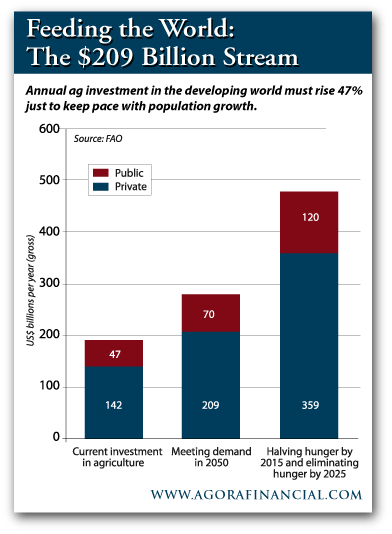
  • Making this happen will require annual investment averaging $209 billion.

And if you break out the details, that $209 billion figure is just the private investment required if the percentage of the world that goes hungry stays static.

Global Ag Investing

If hunger is to be eliminated in the next 15 years, that investment figure jumps to $359 billion.

Is it any wonder the FAO expects grain prices over the next 10 years to remain 15-40% above their levels of 1997-2006? Oh, and that’s before you adjust for inflation over the next ten years.

So who stands to profit from that annual investment of $209 billion to boost crop production? Hint: It won’t be food manufacturers. They’re going to be hit hard. Instead, you’ll want to be investing in the suppliers of fertilizer and/or farm equipment.

Every month, the Institute for Supply Management releases its…Read more…

By Addison Wiggin  -  The Daily Digest

Cross-Posted at True Health Is True Wealth

Tuesday, October 26, 2010

Feds Deciding When Healthcare Science Costs Too Much To Save Lives

If anyone wants a current example of what is looming ahead for medical science at the hands of Obamacare, the Avastin controversy is a perfect one. The Food and Drug Administration (FDA) wants to de-list the cancer drug Avastin one reason being that it is a drug too expensive for government to fund. It is scary to think that the federal government can summarily dismiss cancer drugs merely because of expense, but that is what happens when government starts counting the beans. It becomes an issue of cost instead of effectiveness.

There were other reasons that the FDA wants to dump Avastin, but cost was one of them. One of those that sat in judgment of Avastin admitted that cost was a factor in the decision to delegitimize the treatment. Natalie Compagni Portis, a member of one of the panels that the FDA convened to investigate the drug, said, “We aren’t supposed to talk about cost, but that’s another issue.”

In some cases it costs as much as $88,000 annually for an Avastin breast cancer regimen, certainly not a cheap deal. But who is the government to decide that a lifesaving (or life extending or life changing) drug is too expensive for us to be allowed to use?

Imagine what this might mean for future experimental drug treatments? How many drug companies will continue pursuing new treatments when they begin to see the expense involved? How many promising drugs will be abandoned as companies become fearful that the costs of development will never be returned in sales because of government proscriptions?

Let’s put it in different terms. Remember when flat screen TVs first came out? They often cost over $20,000 a set. Certainly only the very rich could afford such a ridiculously extravagant price for a mere television, right? But as more people clamored for them companies began to experiment on production techniques and the technology began to come down in price. More people bought flat screens when prices fell to $10,000, then $5,000, then $2,000 per set. Thanks to the profit motive more and more customers could finally afford flat screen TVs until today that is practically all you can buy, often they are under $1,000.

Now, imagine where our TV technology would be if the federal government stepped in and summarily decided that $20,000 was too much for a TV and prevented companies from selling products that were initially so highly priced? TV manufacturers would have instantly ceased experimenting and manufacturing the over priced products, prices would never have come down through competition and innovation, and today few people would have the benefit of a flat screen TV.

This example may seem trivial, but the drug manufacturing industry is not that much different than the example above. The fact is drug companies are companies first and foremost. They manufacture products for sale. They aren’t charities. And if these companies see no profit at all in the effort they will not bother pursuing it. That is simply a fact of life.

That fact of life, that quashing of the entrepreneurial spirit, the destruction of the profit motive, all at the hands of government, will also quash new drugs that might bring lifesaving cures in the future. Avastin is one example of the heavy hand of government putting us all at risk.

Source:  Emerging Corruption - October 22, 2010 By Warner Todd Huston

Monday, October 25, 2010

HEAL: The pink-ribbon campaign's dirty little secret - Dr. Wm Campbell Douglass, II, M.D.

Interesting and by my research (I am not an expert) seems to be true. Cancer is something we all worry about, with reasons, and this should be taken into consideration.

Stop helping the pharmacological business at your own expense. As is being proved,  the majority only care about their money making.

I have posted a great many emails on this one topic -  Perhaps reading it as written by someone with *credentials* will reach thru to some folks.

Once again - I include the link to how one woman cured her body of third stage breast cancer by her DIET -  not a bunch of PINK T-SHIRTS AND RIBBONS.

2007 was a big year for Kim Tinkham - in February she was diagnosed with stage three breast cancer, in March she appeared on Oprah to discuss her decision to treat cancer by alternative means and in November she found out the cancer was gone...
Read more...

For Kim’s story in her own words, a list of books, movies and resources she used during her journey, as well as an excerpt from her book, “Cancer Angel,” visit www.cancerangel.com

Hat tip to Deb for this item:

Daily Dose with William Campbell Douglass II, M.D.

WC Douglass, M.D. [ mailto:realhealth@healthiernews.com]
Monday, October 25, 2010 7:16 AM
Daily Dose - The pink-ribbon campaign's dirty little secret

The pink-ribbon campaign's dirty little secret

Here's what October smells like: burning leaves, pumpkin pie and BS.
That's because it's Breast Cancer Awareness Month, which is practically a national holiday at this point -- and if you don't join the "in" crowd and slap a pink ribbon on whatever you're wearing, you're treated like some kind of cold-blooded breast-hating monster.
But those pink ribbons don't exist to cure disease or save lives -- they represent a Big Pharma-funded effort to drive millions of women through a funnel of screenings for a disease many don't even have, and treatments that most of them don't even need.

In fact, the supposed benefits of all those screenings and treatments are about as real as the Great Pumpkin -- and the numbers prove it every time.

Breast Cancer Awareness Month is now 26 years old. In the 26 years since it was launched by AstraZeneca to help sell the company's cancer drugs, it's been a wild success -- for AstraZeneca and anyone else who makes money off cancer screenings and treatments.
But when it comes to saving lives and curing disease, it's been a miserable failure. Up to 15 lives are ruined with unnecessary and deforming breast-chopping surgeries and poisonous radiation treatments for every life "saved."

And even then, there's no guarantee that the one life "saved" was actually the result of early detection and brutal mainstream treatments -- because plenty of them were actually CAUSED by the radioactive and tumor-bursting screenings in the first place.

There's something you won't hear anywhere else this month!
The LA Times -- and kudos to them for this -- recently asked AstraZeneca if maybe Breast Cancer Awareness Month wasn't all it cracked up to be.

"If it's not broken, I don't think we should try and fix it," was all a spokesman could say.

Why mess with success, right?

But the Times didn't stray too far from the mainstream message -- because the very same day, the paper ran a massive 1,400-word article urging women with no sign of the disease to take AstraZeneca's cancer meds strictly as a preventive measure.
I'm taking those kudos back.

Another alternative is: Sanoviv Medical Center, a holistic treatment center


Mainstream pushes radiation tests

Whatever you do, don't get your health advice from the Los Angeles Times.

Hot on the heels of a report urging healthy women to take breast cancer meds even if they have no signs of the disease, the newspaper issued another stunner -- urging people to go out and get their X-rays.

The logic? Nearly everything has a radiation level anyway... so what's a little more?

The first example in the article is a banana -- which, because of its potassium content is slightly radioactive.

Not mentioned: You'd have to eat 600 bananas in one sitting to get a blast of radiation equal to a single chest X-ray... and 240,000 bananas to match an abdominal CT scan.

King Kong doesn't eat that many bananas!

What's more, the article tries to cloud the issue by mentioning everything from gamma rays to Hiroshima while making the ludicrous claim that, "it's impossible to know the real toll from CT scans and X-rays."

But it's not impossible.

In fact, there's some pretty clear research on this -- just don't expect to read about it in the Los Angeles Times. Where you can expect to read it is in The Douglass Report. I wrote an in-depth article on the dangers of CT scans earlier this year.

Studies have found that one percent of all new cancers are caused by CT scans alone. In fact, mainstream researchers have estimated that CT scans performed just in 2007 -- just that one single year -- will eventually lead to 29,000 cancers.

What does the Times have to say about this? Only that CT scans can cause cancer "in rare cases."

Does 29,000 in one year sound rare to you?

No matter how you look at it, radiation-based tests come with major risks -- and studies have found that half of them are completely unnecessary, and many more are wildly redundant.

I won't say never, ever get an X-ray or CT scan -- but before you put yourself into a lead-lined tube, make sure it's really necessary first.
You might be surprised at how often it's not.

Using my X-ray vision,
William Campbell Douglass II, M.D.

P.S. If you want to save your life, skip the test. It's as simple as that. To learn more about the dangers of CT scans, read the February 2010 issue of The Douglass Report. Not a subscriber? Click here to get instant access to this life-saving information.


To start receiving your own copy of the Daily Dose, visit:
http://clicks.douglassreport.com//t/AQ/AALsQw/AAL1vQ/C+U/AQ/AaJ5Qw/5KmN Or forward this e-mail to a friend so they can sign-up to receive their own copy of the Daily Dose.


Copyright (c) 2010 by Healthier News, LLC. The Daily Dose may not be posted on commercial sites without written permission.

If you haven’t read it, get a copy of Knockout  - based Suzanne Somers personal experience of beating cancer holistically

Monday, October 18, 2010

Experts Admit Swine Flu Jab ‘May Cause’ Deadly Nerve Disease

Daily Mail
By Jo Macfarlane

clip_image001

Experts Admit Swine Flu Jab ‘May Cause’ Deadly Nerve Disease

United Kingdom – Health chiefs have for the first time acknowledged that the swine flu jab may be linked to an increased risk of developing a deadly nerve condition.

Experts are examining a pos­sible association between the controversial jab and Guillain-Barre Syndrome, according to a report from official watchdog the Medicines and Healthcare products Regulatory Agency (MHRA).

Previously, the Government has always stressed there is no evidence to link the paralysing condition to the H1N1 vaccine.

After The Mail on Sunday revealed in August 2009 that doctors were being asked to monitor cases of GBS during the swine flu pandemic, a letter from the Health Protection Agency’s chief executive Justin McCracken stated: ‘There is no evidence to suggest an increased risk of GBS from the vaccines being developed to fight the current pandemic.’

Now the MHRA’s newly published report suggests the Government’s position has changed.

It says: ‘Given the uncer tainties in the available information and as with seasonal flu vaccines, a slightly elevated risk of GBS following H1N1 vaccines cannot be ruled out. Epidemiological studies are ongoing to further assess this possible association.’

It is not known precisely what causes GBS but the condition attacks the lining of the nerves, leaving them unable to transmit signals to muscles effectively.

It can cause partial paralysis and mostly affects the hands and feet – but it can be fatal.

clip_image002

The MoS report last year

Mother-of-two Hilary Wilkinson, 58, from Maryport, Cumbria, developed GBS following a chest infection and spent three months in hospital learning to walk and talk again.

She said: ‘It’s a frightening illness and I think more research needs to be done on the effect of the swine flu vaccine.’

A vaccine used to combat a different form of swine flu in the US in 1976 led to 25 deaths from the condition, compared with just one death from swine flu itself.

Amid fears there could be a repeat, neurologists were asked to record cases of GBS in the UK swine flu outbreak. Millions of people this year will be exposed to the swine flu vaccine as it has been included within the seasonal flu jab.

Government experts say there is no evidence of an increase in risk similar to 1976, but the MHRA report reveals they are calculating if there might be a smaller raised risk.

The MHRA had 15 suspected GBS cases after vaccination – and six million doses of the swine flu jab Pandemrix were given. It is not known if swine flu or the vaccine could have caused the suspected cases.

A spokeswoman for the MHRA said the risk with the vaccine had not changed and that the report ‘simply expands’ on ongoing GBS analysis.

Source - http://www.dailymail.co.uk/health/article-1321203/Experts-admit-swine-flu-jab-cause-deadly-nerve-disease.html#ixzz12kxMBiYg

Related:

Alternatives to Flu Shots

Anyone Recall Jane Bergermeister and the Lethal Vaccines???

ANYONE, RECALL JANE BERGERMEISTER AND THE LETHAL VACCINATIONS??? IT'S BACK..!

Beware… H1N1 combined with regular flu shot this time…

· Posted by maureeen worhach  -  on October 12, 2010 at 3:55pm

·DAMAGE..OR..DAMAGE CONTROL???

If a serious vaccine adverse reaction occurs and you decide to sue the drug company, their lawyers will tell you in court that you were adequately warned in the package insert of adverse reactions.

Historically when the jurors saw a child with vaccine damage, they always sided with the victim. The vaccine makers were losing every time. The vaccine manufacturers found the burden of liability so great that they sought and obtained relief from the U.S. government. In 1986 our government stepped in and decided to disallow direct lawsuits to the pharmaceutical company and created VAERS: Vaccine Adverse Event Reporting System and the Vaccine Injury Compensation Program. They in effect, assume the liability of the drug manufacturers.

When parents elect to vaccinate their children, a portion of the money spent on the vaccination goes into a congressional fund to compensate them if their child is hurt or killed by the shot. If your child becomes sick and visits a doctor or hospital during the four weeks after immunization, this is to be reported to the doctor, where the vaccine was given. Doctors are then required to report vaccine damage to VAERS. It is estimated that less than ten percent do. Remember, “It’s not vaccine damage,” it’s something else. Even so, with only ten percent reporting, 12,000 to 14,000 reports of adverse events are made annually. By August 31, 1997, more than 802 million dollars had already been paid. Awards for death cases are capped at $250,000 plus attorneys’ fees or costs. This does not include private settlements. With VAERS, the manufactures and doctors have virtually no liability for adverse events that may occur. Examples of lawsuits. I checked my son's vaccines lots to see if any other kids had had reactions and this is what I found. Vaccine record
The Soldiers Dr. Dean Black, author of Immunizations: Compulsion or Choice, points out that government discussions of vaccine risks are recorded in the Congressional Record, in a text concerning compensation to families of children who have been harmed by the procedure. Black tells us that Congressman Henry Waxman, who chaired the hearing, is quoted as saying, “A properly manufactured vaccine that has been properly administered can cause a terrible adverse reaction, an admitted scientific fact. The children who will be victims rather than beneficiaries cannot be predicted.” The Congressional Record goes on to justify mass immunization practices by comparing children to soldiers at war who must at times sacrifice themselves for their country: As a nation we require that all children be immunized so that most children will be healthy. Today, the subcommittee will begin to consider what society owes to those who are hurt, to children injured in the line of public health.
The International Association of Biological Standards is the association which sets the expected risk vs. benefit ratio that should allow vaccines to be used. What is this standard? How beneficial must it be, relative to a risk, to be able to be used?


Journalist Fired Over Flu Pandemic Lawsuit

Kurt Nimmo
Infowars
July 7, 2009

Jane Bürgermeister Indicts flu Vaccine Mfgs 2  & Project Camelot Interviews Jane Bürgermeister (below)


Video: Austrian journalist Jane Bürgermeister, who recently filed criminal charges with the FBI against the World Health Organization (WHO), the United Nations (UN), and several high ranking government and corporate officials concerning bioterrorism, has been fired from her job.

“On Monday, I was unexpectedly fired from my job as European Correspondent of the Renewable Energy World website,” Bürgermeister writes on her blog.


Jane Bürgermeister contends offshore banksters have cooked up an engineered flu virus in order to realize their eugenics plan for mass extermination.

“Because there is reason to believe this decision was related to my filing charges alleging bioterrorism against the people of the USA and the rest of the world, and because I am entitled as a citizen to report a crime if there is credible evidence, I intend to file a lawsuit against Pennwell, a magazine,” she explains. “I have heard of other journalists fired or harassed for covering this subject.”
In a document entitled Bioterrorism Evidence, Bürgermeister points to an international corporate criminal syndicate and extensively details its plan to carry out mass genocide against the American people by unleashing a deadly flu virus and instituting a forced vaccination program.

“There is proof many organizations — World Health Organization, UN as well as vaccine companies such as Baxter and Novartis — are part of a single system under the control of a core criminal group, who give the strategic leadership, and who have also funded the development, manufacturing and release of artificial viruses in order to justify mass vaccinations with a bioweapon substance in order to eliminate the people of the USA, and so gain control of the assets, resources etc of North America.”

Bürgermeister says the core group sets its strategic goals in secret using the Trilateral Commission and Bilderberg meetings. “It can be identified as the ‘Illuminati,’ a mafia-like group with family dynasties at its center.” It is the “world’s first truly global crime syndicate” based in “off shore banking centers” and employs international organizations such as the UN and WHO.

In her lawsuit, Bürgermeister alleges that a manufactured flu pandemic “is part of a long term plan by the syndicate, who have built large numbers of FEMA concentration camps with incinerators and prepared mass graves in state such as Indiana and in New York to quarantine people and dispose of the bodies of the people who are killed by the bioweapons attack.

Infowars and Prison Planet have posted reports on the construction of mass graves. In February, D. H. Williams, writing for the Daily Newscaster, published a report on FEMA and DHS vaccination and mass grave plans in the vicinity of Chicago and northern Indiana. In March of this year, Infowars posted extensive coverage of mass grave sites in Arizona and Texas.

Bürgermeister names Barack Obama, the UN’s Influenza coordinator David Nabarro, WHO director Margaret Chan, HHS secretary Kathleen Sibelius, DHS secretary Janet Napolitano, bankster kingpins David de Rothschild and David Rockefeller, international criminal financier George Soros, and others as defendants. The WHO, European Union, the CDC and other research labs, FEMA, vaccine companies, and the DHS have interacted with each other to develop and distribute biological weapons, the journalist contends, and have leveraged funding through the banking system and its global drug trade mechanism.

The Rockefeller Foundation has funded the eugenics movement for over a century. “The Rockefeller Foundation is the prime sponsor of public relations for the United Nations’ drastic depopulation program. Evidence in the possession of a growing number of researchers in America, England, and Germany demonstrates that the Foundation and its corporate, medical, and political associates organized the racial mass murder program of Nazi Germany,” writes Anton Chaitkin. “In the 1950s, the Rockefellers reorganized the U.S. eugenics movement in their own family offices, with spinoff population-control and abortion groups.”

Billionaires Ted Turner and Warren Buffett have funded the eugenics movement. “Other billionaires have begun funding parts of the eugenics movement. Bill Gates, the richest man in the country, and George Soros, the financier, have started putting their money into population control projects,” writes John Cavanaugh-O’Keefe in The Roots of Racism and Abortion: An Exploration of Eugenics.

Bürgermeister’s charges include evidence that Baxter AG, Austrian subsidiary of Baxter International, deliberately sent out 72 kilos of live bird flu virus, supplied by the WHO in the winter of 2009 to 16 laboratories in four counties. Bürgermeister “noted that Baxter’s lab in Austria, one of the supposedly most secure biosecurity labs in the world, did not adhere to the most basic and essential steps to keep 72 kilos of a pathogen classified as a bioweapon secure and separate from all other substances under stringent biosecurity level regulations, but it allowed it to be mixed with the ordinary human flu virus and sent from its facilities in Orth in the Donau,” writes Barbara Minton for Health News.

On June 29, Bürgermeister sent an email to the Fourwinds 10 website indicating she plans to take legal action against Sorcha Faal, a mysterious writer often accused of penning sensationalistic disinformation. “I can confirm I am the Jane Burgermeister who sent the email to Fourwinds10 setting the record straight about Sorcha Faal’s false report linking my charges against Baxter for their role in contaminating vaccine material with 72 kgs of live bird flu virus and the sudden death of Michael Jackson,” she wrote. “I am now looking at legal action against whoever writes under the name of Sorcha Faal. I believe this is a deliberate and cynical attempt by the people behind Baxter etc to manipulate public opinion by trivializing Baxter investigation.”

Faal’s disinfo worked so well that even medical doctors emailed Bürgermeister asking her to confirm the link to “I have had to spend a lot of time explaining that the Sorcha Faal report is a tissue of lies,” Bürgermeister complained.

See Flu Case:  http://www.theflucase.com/

Related:

Journalist Files Charges Against WHO and UN for Bioterrorism and Intent to Commit Mass Murder

Wednesday, October 6, 2010

New Program to Highlight Health Benefits of Pet Ownership

Mars Petcare has teamed up with the YMCA to launch a new community-focused initiative that highlights how owning a pet can make pet owners more active and healthy.

New Program to Highlight Health Benefits of Pet Ownership

Research suggests that owning a pet helps increase levels of physical activity. A recent survey of 1,000 U.S. pet owners conducted by Mars Petcare revealed that more than half of pet owners would prefer to exercise with their pet instead of alone. The survey also revealed that 39% of pet owners feel that making sure their pet is more active has made them more active as well. During the pilot year, Mars Petcare's new Power of Pets™ program will be rolled out at YMCA locations in Washington, D.C., New York City, Nashville, Chicago and Portland, at which Mars Petcare will sponsor family-focused healthy living fairs for pets and people in the coming months. Additional on-going activities, such as community dog-walking programs, will debut in specific markets in the coming months.

"At the YMCA, we believe healthy lifestyles are about nurturing the spirit, mind and body - and pets certainly play a role in that. We encourage families to play together every day, and incorporating the family pet is a great way to make everyone more active," said Ted Cornelius, a spokesman for the YMCA.

For decades, Mars Petcare has invested in research into Human-Animal Interaction (HAI) through it's world-renowned WALTHAM® Centre for Pet Nutrition. WALTHAM® scientists have formed a partnership with the Eunice Kennedy Shriver National Institutes of Child Health and Human Development to fund over $9 million in studies that seek to establish a scientific link between pet ownership and better physical and mental health.

"WALTHAM® has established an incredible body of evidence on the health benefits of pet ownership and The Power of Pets™ program will help us translate that research to people and communities. With obesity levels rising and health levels falling, we want to contribute our knowledge and expertise to help address those very serious issues, and at the same time, call attention to what we can do as humans to ensure the pets in our lives are also healthy and happy," said Dr. Karyl Hurley, global director of scientific affairs, The WALTHAM® Centre for Pet Nutrition.

This news story is independently sourced and PetPeoplesPlace.com does not specifically endorse products or services offered by any company referenced in this article, or benefit from any association with any companies referenced. 

P1010029

Winter

Let's Go Dad - June 2010

Spring

image

Summer

Popular Stop - Thanksgiving 2009

Fall

I know our gang gets us out no matter the season!

Related:

Busy Pets are Happy Pets

The Dog Whisperer  -  What Your Pets Can Teach You

Posted:  Just One More Pet   -  Cross-Posted:  True Health Is True Wealth

ObamaCare… Hits, Misses and a Perhaps a Look into the Future

Most folks were unaware of the hidden perils within the recently passed Health Care Reform bill that many now call “Obamacare.” Remember, “We have to pass it before we know what’s in it.” One item of interest turned out to be the federal government taking over all student loans; private lending institutions will no longer be making them.  Go Here to Read Full Article. 

And this is only the tip of the Iceberg!

Obamacare Misses Major Deadlines (CRS: Commiecare™ a bloated, bureaucratic failure)

Tuesday, October 05, 2010 8:06:31 PM · by Connie Hair

Human Events ^

The largest, most sweeping government takeover of health care in modern history is a bloated, bureaucratic failure according to the latest Congressional Research Service (CRS) report. At the six month mark, the Department of Health and Human Services (HHS) has already missed one-third of the new law’s mandated deadlines. And they want to run the nation's healthcare system? The new report was requested of the non-partisan CRS by Sen. Tom Coburn (R-Okla.), one of two physicians currently serving in the U.S. Senate, along with Sens. Orrin Hatch (R-Utah) and John Cornyn (R-Texas). From... Continue reading at:  Human Events ^

 The Doctor Deficit

Tuesday, October 05, 2010 8:38:00 PM · by Nachum

Investor's Business Daily ^

ObamaCare: One of the marks of national health care is the waiting-list problem that plagues Britain and Canada. Delays in treatment have caused suffering and, in some cases, death. Soon, we'll be waiting for doctors too. Last week, the Association of American Medical Colleges reported that the looming doctor shortage will be worse than previous reports claim because of ObamaCare. Rather than "a baseline shortage of 39,600 doctors in 2015, current estimates bring that number closer to 63,000, with a worsening of shortages through 2025," says the medical college group's Center for Workforce Studies.  Continue reading at: Investor's Business Daily ^

BBC:  Abortion is a Kindness… Is This Where We Are Headed?

Remember when ObamaCare was being promoted?  How we were told about all the positives of socialized medicine in Canada and the UK?  Really??  The Canadian system is bankrupt.  Patients in English hospitals are often ignored and there have been many reports of them not being able to even get water.

Could we possibly be going in this direction?  Yes this is extreme… but perhaps not as extreme as you think… and it is not just in the UK.  These thoughts are already being promoted here in the United States.

Who is this woman…? a Fabian Socialist, like George Bernard Shaw.  The Fabian Society is the English version of our Progressive Party.  They promote Eugenics, like Margaret Sanger, Founder of Planned Parenthood did.

UK PUNDIT TO SHOCKED TV HOST: SUFFERING CHILDREN SHOULD BE SMOTHERED

Advice columnists in Britain are known as “agony aunts” (or uncles).  Virginia Ironside is one.  Her latest bit of advice has drawn outraged reaction from television viewers who caught her comments on the BBC yesterday.  She appeared during a segment called, “Can abortion be a kindness?” Here’s the Daily Mail account of her comments:

Miss Ironside said: ‘If a baby’s going to be born severely disabled or totally unwanted, surely an abortion is the act of a loving mother.’
She added: ‘If I were the mother of a suffering child – I mean a deeply suffering child – I would be the first to want to put a pillow over its face… If it was a child I really loved, who was in agony, I think any good mother would.’

Video:  Suffering Children Should be Smothered

Disability rights advocates called her pro-eugenics approach “despicable.”  Even the host seemed stunned:

Programme host Susanna Reid appeared visibly shocked by her comments during the live debate, gasping: ‘That’s a pretty horrifying thing to say, that you would put a pillow over a suffering child.’

In the past, Ironside has said she believes doctors should not try to save the lives of “very premature babies.”

Can abortion be a kindness?
A commentary that has to be heard to be believed, Glenn has the audio from the BBC in which smothering babies with pillows can actually be the kind thing to do. It's the complete lives, national health insurance type of thinking - they are a burden to others, so their time is up. Listen to Glenn play the disturbing audio and react. ( Transcript, Insider Audio)

The following 1 min 30 sec. video is not Fox News, it is CNN. It is about all the campaign promises in 2008 for the most honest and transparent congress in history....and the passage of Obamacare.

Video:  Secret Health Care Negotiations - Obama Lies - Transparency In Government a Joke

Please Share…

Watch or Record Glenn Beck to today  (10.06.10) for more on the Fabian Socialist, the people like Miss Ironside above, who believe in and promote smothering (or invoking death panels for) handicapped children and the elderly, eugenics and commercials like 10:10 EcoFasism Campaign Group Mini-Movie – No Pressure  Let us also remember that Fabian Socialists are a sister organization to American Progressives who wrote the ObamaCare Bill.

Sunday, October 3, 2010

Alternatives to Flu Shots

Fall is here, along with the yearly advice from health professionals to get a flu shot. But should you? Will a flu shot really protect you from a nasty virus, or could it even raise your risk of developing a deadly disease such as Alzheimer’s or Parkinson’s?

I believe the vaccine itself is dangerous. Many people suffer complications from it, and some are left permanently paralyzed and neurologically damaged. (Find more details on how you can protect your brain by reading my report "Vaccination: The Hidden Dangers.")

One recent study found that people over the age of 55 who receive the flu vaccine every year for five years in a row increase their risk of developing Alzheimer’s disease 10-fold, in part due to two powerful brain toxins — mercury and aluminum — in the vaccine.

I believe a new mechanism, which involves mercury and aluminum as well the over-activation of the brain’s immune system caused by the vaccines, is to blame. There is compelling evidence that this mechanism can trigger Alzheimer’s dementia, Parkinson’s disease, Lou Gehrig’s disease, and autism spectrum disorders, as well as Gulf War Syndrome.

The greatest risk of vaccinations triggering brain disorders is among those with impaired immunity. We know that as we age, the immune system becomes compromised, primarily because of poor nutrition.

I believe the idea of having yearly mercury injections is insane, to say the least, but millions still willingly line up for their annual flu shot. My report "Vaccines and Brain Injuries — Are You At Risk?" will give you more information on the dangers of vaccines.

Can you avoid taking the vaccine and still protect yourself from flu? Absolutely. We know that there is a solid connection between a strong immune system and nutrition. Several studies have shown that age-related immune problems can be corrected with nutrients such as selenium, vitamins E and C, zinc, and the carotenoids. Vitamin D-3 is also an important immune-booster and helps prevent over-reaction of the immune system. My special report "Key Vitamins that Save Your Heart, Prevent Cancer and Keep You Living Long" will give you more details.

Viruses are commonly spread by touching contaminated objects — like doorknobs, phones, and shared computer keyboards — as well as from shaking hands. Simple precautions, such as avoiding crowds and washing your hands, also help protect you and your family.

For more of Dr. Blaylock’s weekly tips, go here to view the archive.  © 2010 Newsmax. All rights reserved. Thursday, September 30, 2010 2:52 PM

Related:

Research Firm Blows Hole in Big Pharma Vaccination Lie

Monday, September 27, 2010

Something Fishy


But What About Gulf Seafood???

Exclusive: Gulf seafood poses long-term health risks, experts say

blue%20crabs%20gulf Exclusive: Gulf seafood poses long term health risks, experts say

Wednesday, September 22nd, 2010 -- 7:49 am

Despite repeated assurances from federal officials and President Obama, independent scientists and public health experts have serious concerns about the long-term safety of Gulf seafood consumption.

In particular, experts tell Raw Story, contaminants from the massive oil spill and unprecedented use of the dispersants employed to dissolve the spill have the potential to cause cancer and neurological disorders.

In interviews with Raw Story last week, scientists and public health experts expressed concerns over possible long-term risks from eating contaminated Gulf seafood.

Polycyclic aromatic hydrocarbons (PAHs) are cancer-causing chemicals found in crude oil that can accumulate in the food chain, absorbed by fish and shellfish. During the ongoing testing of seafood in the Gulf of Mexico by federal and state authorities, PAHs are of primary concern.

But crude oil also contains heavy metals such as lead, mercury and cadmium that can accumulate in the food chain as well, though at a slower pace than PAHs, and are toxic to the brain and nervous system.

Another potential long-term health concern left in the wake of BP’s catastrophic oil spill is the nearly two million gallons of dispersant unleashed into the Gulf, much of it subsurface, which made both the amount used and its use unprecedented.

In interviews with Raw Story last week, FDA and National Oceanic and Atmospheric Administration officials said that all fish and shellfish in reopened federal and state waters have tested well beneath the level of concern for PAHs.

But what worries some scientists and public health experts is what these tests don’t -- and can’t -- reveal. They feel it’s “premature” for government officials to claim Gulf seafood poses no future health risks.

“Those are the short-term effects,” said Edward Trapido, the Wendell Gauthier Chair of Cancer Epidemiology at the Louisiana State University School of Public Health.

“We don’t know the long-term effects,” he explained. “And we don’t know, particularly related to cancer and particularly related to age and exposure, what the long-term effects will be.”

Trapido testified in June at a House Subcommittee on Energy and Environment hearing on the spill and is heading a research group at LSU that will look at a range of health effects, including psychiatric and behavioral effects, chronic diseases and cancers.

The issue we don’t know at this point, he said, is the extent to which these compounds may bioacccumulate in shellfish or fish and what the half-lives are.

“So you could imagine if a large fish feasted on several hundred small fish and each of those small fish have eaten a certain number of microorganisms which had a little of contaminant, there’s a possibility, certainly, that you could go over the current measurements.”

In interviews with Raw Story last week, NOAA and FDA officials, in general, tended to downplay bioaccumulation of PAHs in Gulf seafood. But in some cases they denied it’s occurring at all, or even that it could occur.

“We have not found it,” FDA spokeswoman Meghan Scott claimed. “Every sample that we have tested for PAHs has come back clean. It has the potential to [bioaccumulate]. But we have not found it, even from samples taken from inside of closure areas.”

Christine Patrick, NOAA spokeswoman for seafood safety, went so far as to tell Raw Story, “The concept that the oil bioaccumulates [in seafood] – that’s not correct. It’s metabolized and excreted.”

Raw Story confirmed, in consultation with independent scientists, that these two statements were, respectively, impossible and inaccurate.

Miriam Rotkin-Ellman, a staff scientist at the Natural Resources Defense Council (NRDC), a leading national environmental group, underscored two things that NOAA, FDA and Gulf state officials have been playing down.

“The monitoring that’s currently being conducted by both NOAA and various different state agencies, and compiled by FDA, show that there is PAH contamination of fish in the Gulf,” she said. “They are detecting various different levels of the various different PAH constituents.”

Ellman, who contributed to last month’s peer-reviewed Journal of the American Medical Association (JAMA) study, which identified a number of issues about the health of Gulf seafood, also noted, “There is a good body of literature showing that seafood can be impacted by these contaminants.”

The JAMA report cites a 2002 study in the peer-reviewed journal Marine Environmental Research on the lasting effects of the Exxon Valdez oil spill, which concluded: "Our data show that 10 years after the spill, nearshore fishes within the original spill zone were still exposed to residual hydrocarbons. All biomarkers [for contaminants] were elevated in fish collected from sites originally oiled, in comparison to fish from unoiled sites.''

Ellman added, “We understand that the different types of seafood – fish vs. crustaceans and bivalves – all have different capacities to retain the contaminants, and that’s important to note. But it’s not the basis on which to make a blanket statement that there’s no risk.”

“So it’s premature,” Trapido cautioned, “to say that it’s safe in the long-term.”

“We can say that it’s safe at this point based on what we know,” he continued. “But as a cancer epidemiologist, which is what I am, I have to maintain an air of skepticism and say, well, we don’t have any data to make a judgment on the long-term cases.”

The startling lack of data on the future health effects from oil spills on humans was a common lament among experts who spoke with Raw Story.

Trapido confirmed that the longest follow-up study that’s ever been done on people exposed to oil spills was just four years, and that was to track mental health only.

Two new areas of scientific research not being accounted for in the current risk assessments could also adversely impact future health, Ellman noted.

She said that studies have shown that early life exposure to the chemical benzo(a)pyrene, one of the most carcinogenic PAHs, increases the risk of cancer later in life. It wouldn’t have the same effect, she clarified, if the exposure came later in life.

“So because children’s bodies are different and they’re developing, exposures that happen early in life can have a more detrimental effect than if they were exposed later on,” said Ellman.

In addition to the cancer risks, Ellman told Raw Story that there’s also a new body of literature that has shown adverse developmental impacts from in utero exposure to PAHs, such as delayed growth, low birth weight and other indicators of impact during fetal development.

NOAA toxicologist John Stein said that he and other scientists within the agency have proposed to continue monitoring the Gulf waters to ensure seafood safety for the next three to five years. But Patrick confirmed that the agency has not made an official commitment to this.

Independent scientists and public health officials who spoke with Raw Story agreed that even if federal and state officials committed to such a time frame, it would still fall short of what's necessary.

They pointed out that due to bioaccumulation in the food chain, it's quite possible contamination levels in Gulf fish and shellfish may actually be higher in three to five years.

"If they were to completely suspend any monitoring prematurely," Ellman warned, "we wouldn't necessarily know whether levels of contaminants in seafood that we're most worried about have gone back down or remain elevated."

Brad Jacobson is a contributing investigative reporter for Raw Story.


Related: